Showing posts with label Jenna Jackson's posts. Show all posts

Friday, March 13, 2009

Table Talk

by Jenna Jackson

I look better on paper.

I just do. I figured that out when a good friend of mine asked me to speak at a recent Table Talk evening for the University of Houston. This was a huge event–about 500 people, mostly women–and she wanted me to be a part of it. I was honored.

But, I told her then, I look better on paper. It sounds really cool to work for 48 Hours, but most of the time, when I show up somewhere, people ask me for ID because I don’t exactly look the part.

She laughed and ignored me, so I said sure I’d do it. All it consisted of was talking to the ten people at my particular table. It was very informal and easy.

I was completely relaxed. Until she told me, a week or so before the event, that I had been assigned the table who bid the highest donation in the entire event. They picked me, she said. I reminded her AGAIN, and this time vehemently, I’m much better on paper!

She again ignored me, and today I went to speak to this table. Once I arrived and saw how many people surrounded us–and how incredible and intelligent my tablemates were–I repeated to them my mantra: "I’m much better on paper. Hope I’m not a disappointment!"

Turns out I was the one with the lesson to learn. I should have known it from the incredible ratings CSI–and even 48 Hours these days–have garnered on a regular basis. People love what I do for a living. They love what we, as a blog, do for a living. People are riveted to crime stories, especially true ones.

These women at my table were smart, lively, charismatic. And curious. They were completely curious about what I do every day–how I get people to talk to me, whether I’m ever scared, whether I believe them. I told them stories about people who I'd met over the years that I didn't even remember.

It was refreshing to me. And having to explain to them why I do what I do on a daily basis made me believe in it all over again. As depressing as it can sometimes be to speak to people who are going through their toughest times, it is also inspiring. These people are courageous. They choose to keep moving and pushing forward, despite the fact that they lost a loved one–or that their loved one is accused of something unthinkable.

In each crime we cover at 48 Hours, each family is a victim. The actual murder victim’s family, clearly, has lost someone beloved to them. I do not know how people survive this and have the strength to move forward. This can never be replaced or understood. And the killer’s family–almost without fail–is shocked, saddened and (many times) in disbelief about the act/s their loved one is accused of committing.

The thing that I learn day after day is that nothing is black and white; almost no one is good or evil. Everything is gray.

And, today, at this luncheon for a very good cause–the University of Houston’s Friends of Women’s Studies–I was reminded of how important it is to know and understand and appreciate human nature and all that goes along with it.


Friday, February 6, 2009

Vanished

by Jenna Jackson

A 37-year-old woman was kidnapped at gunpoint Monday night as she was leaving a well-traveled shopping center in Pearland. Texas EquuSearch is leading the search for her right now.

Even the search leaders say they aren’t optimistic about finding Susana De Jesus (pictured above) alive at this point, considering how she was taken. I know this kind of thing happens all the time–but this one stuck with me because of how brazen it was. And because of what this woman and her family have already gone through in the past year.

De Jesus was snatched as she was walking to her car in the parking lot outside of Catherine’s Plus Sizes, a boutique in a shopping center on Smith Ranch Road, where she has been assistant manager since November 2007.

She wasn’t alone–she was walking with a co-worker. The co-worker described a masked man who grabbed De Jesus at gunpoint and forced her into her own Cadillac. Then he drove the Cadillac out of the shopping center parking lot with another vehicle following.

The brazenness of abducting someone who is not alone–in a visible spot, even though it was late evening, is terrifying. To add to that, this poor woman lost her husband in a freak accident in May. His Corvette crashed into a concrete bridge support and burst into flames on the Gulf Freeway.

I feel very sad for De Jesus’ family–and am hoping the searchers have luck finding her today. The odds aren’t great that she’s still alive, considering the motive in this abduction was likely money. But I hope for the family’s sake that she is the exception–they’ve certainly had enough tragedy in the last year already.

A security camera snapped a photo later the night of her abduction of a masked man in the driver's seat of her black 2008 Cadillac at an automated teller machine outside a bank at 3636 Old Spanish Trail in Houston. He used De Jesus' card to withdraw cash.

It was not clear whether De Jesus was still in the car when the photo was taken, according to a story in the Houston Chronicle. Houston police found the Cadillac early Tuesday at an apartment complex in the 6000 block of West Airport.

Tim Miller, the director of EquuSearch, has organized volunteers to search for the missing woman today.

"We have one fairly small girl and really and truly, a big area," said Miller to the Houston Chronicle. "Where do you start with something like that?"

Based on phone calls he has received, Miller said he expects a huge turnout of volunteers today as a widespread search for Susana De Jesus begins.

The ATM where the man was photographed is about 11 miles from the store and another 11 miles from where the car was found.

Miller, who founded Texas EquuSearch after the 1984 abduction and murder of his daughter, Laura, said he and others in the group were trying to decide which of those three locations should be the focus of today's search.

Police said they don’t know why De Jesus was targeted.

Brazoria County sheriff’s Capt. Chris Kincheloe told the Chronicle investigators are not sure whether the abduction has any connection to a recent series of home-invasion robberies in Pearland and other communities in the area. Each of the crimes has been different, he said.
Miller said single women driving impressive new cars—such as De Jesus’ Cadillac—sometimes become targets.

“I don’t believe this was just random,” he said of the kidnapping. “I would anticipate he’d seen her over a few days or few weeks.”

Anyone with information about the incident is asked to call the Brazoria County Sheriff’s Office at 281-756-2392, or investigator Wade Nichols at 281-756-2220. Brazoria County Crime Stoppers also is taking anonymous tips at 800-460-2222.

I’m hoping this will give just a little more publicity to the search for this woman. Maybe she is still alive–and maybe a random sighting will help discover her location.


Thursday, January 15, 2009

A Scary Possibility

By Jenna Jackson

A man who has been on Death Row here in Texas for nearly 30 years could be getting out.

Jonathan Bruce Reed (pictured left) was convicted and condemned for the November 1978 rape-slaying, of Wanda Jean Wadle at her Dallas apartment. But, the 5th U.S. Circuit Court of Appeals has ruled Dallas County prosecutors improperly excluded black prospective jurors from Reed’s trial and ordered him released unless prosecutors choose to retry him quickly.Prosecutors haven’t yet decided if they will re-try him. They say they need time to “dissect” the opinion, according to a story by Mike Gracyk of the Associated Press. The real question will be, CAN they re-try him? After 30 years, it’s hard to imagine what, if any, evidence remains preserved. Witnesses are probably dead or gone, and who knows if the victim’s family is even still around.

If they are—this is a terrible day for them. They probably thought this case was closed, even though the man a jury said was responsible hasn’t yet been executed.It seems it was pretty much the policy of the Dallas County District Attorney’s Office, at the time, to exclude black people from a jury in the belief that blacks empathize with defendants. Reed is white – but the Constitutional efforts remain the same.“Although we do not relish adding a new chapter to this unfortunate story more than 30 years after the crime took place, we conclude that the Constitution affords Reed a right to relief,” a three-member panel of the New Orleans-based court wrote in the ruling posted late Monday.

Reed has been on death row since September, 1979 making him among the longest-serving prisoners awaiting execution in Texas.
The 5th Circuit said Reed’s case mirrored the capital murder case of Thomas Miller-El, on Texas death row for nearly 20 years until the Supreme Court overturned his verdict, citing racial discrimination during jury selection. Miller-El last year took a life prison sentence as part of a plea deal.

In that case, the Supreme Court cited a manual—written by a prosecutor in 1969 and used for years later, that advised Dallas prosecutors to exclude minorities from juries. Documents in Miller-El’s case described how the memo advised prosecutors to avoid selecting minorities because “they almost always empathize with the accused.”

“Reed presents this same historical evidence of racial bias in the Dallas County District Attorney’s Office,” the 5th Circuit panel said.It is a sad statement on our culture at the time that racial bias would be all but policy in one of the state’s largest district attorney’s offices. And I’m certain it wasn’t the only office in the state that followed such ridiculous notions. Thankfully, at least in most sectors, that sort of racial bias and ignorance is no longer tolerated.It does seem clear that—based solely on the racial bias issue, the Court had no choice but to overturn this case. The scary part is that it doesn’t seem like there was much doubt that Reed was the guilty party.

Reed, now 57, was identified as the man who attacked Wadle and her roommate, Kimberly Pursley, on November 1, 1978. He’d apparently entered their apartment by posing as a maintenance man. Pursley survived an attempted strangulation by feigning unconsciousness. Two other residents identified Reed as the man they saw in the apartment complex just before the time of the attack.

I’m sure nearly everyone in Texas knows the story of when serial killer Kenneth McDuff (pictured left) was released. McDuff was first convicted of three rapes and murders that took place in 1966. He was given the death penalty, but his sentence was commuted in 1972 when the U.S. Supreme Court abolished capital punishment. He was released on parole in 1989 due to prison overcrowding.That release had disastrous consequences.

He began killing again a year after his release. He was arrested for the murder of 22-year-old Melissa Ann Northrup , and was suspected in at least three other murders. McDuff was eventually sent back to death row and executed November 17, 1998.

It seems to me that the only good solution in this case will be if prosecutors have enough evidence left to convince Reed to take a plea deal, similar to Miller-El’s, that will keep him locked up.I don’t know much of anything about Jonathan Reed, but anyone who has spent nearly three decades on death row has had to learn to adapt in order to survive. And those same adaptation skills don’t transfer into too many careers on the outside.

It’s a scary possibility that he could be released into the free world and left to his own devices.


Friday, December 5, 2008

A Look Behind the Camera

by Jenna Jackson

In January, it will have been 10 years since someone took the life of Belinda Temple (pictured left) and her unborn little girl, Erin, by putting a shotgun to the back of her head and firing. For nearly all of that time, it has been a tale with twists, turns and surprises – and, some feel, still a lot of questions.

I started working on the Belinda Temple murder case for
48 Hours in 2004, just after her husband, David, was arrested. Our show will finally air tomorrow night at 10 p.m. EST on CBS.

The case (and our show, by default) took years to unravel. And this is one of those cases where questions may always linger for some. Many think they know exactly who killed Belinda Temple and why. Her husband, David, was having an affair with another woman, a fellow teacher, at the time of Belinda’s death.
Kelly Siegler, also a WCI blogger, prosecuted the case. She is certain of David Temple’s guilt, as are the police, who investigated the case tirelessly for six years before the arrest.

But others – including his family and his defense attorney
Dick DeGuerin – are equally and vehemently as sure that Temple is an innocent man. And they point to another man who they say is the real killer.

Our show and the
web site give far more details on the case and how it unfolded. But what you won’t see on either of those is how the story process took place. At 48 Hours, we try to follow a story from as close to the beginning as we can get … until it has at least some sort of an ending. (Some stories continue to re-invent themselves. For example, I’m working on a brand new show about a case we followed five years ago – the case of Susan Wright, who was convicted and sentenced to 25 years for stabbing her husband 193 times. Kelly prosecuted that one, too.)

For the Temple story, I did the usual work at the beginning – I called the lawyers on both sides and met with them. We discussed whether they would be able to work with us – and I assured them that nothing would air until after his murder trial was complete. I don’t think anyone at that point knew how long it would take to get to that point. Because of a myriad of unforeseen delays, it ended up taking three years from the time of the arrest until Temple was tried.

Once the trial started, I sat through every day of it. I listened to testimony, took notes, talked to the lawyers on each side about how it was going – and occasionally filmed short interviews so that we could later keep our viewers posted on how this high profile murder trial was unfolding.

The trial was interesting, dramatic and tense. I literally had no idea what the verdict would be when the jury filed out to deliberate – and, generally, you have a pretty good idea of what the likely outcome is. In this case, it was a hard-fought case on both sides. The lawyers – who have a history of butting heads in the courtroom – were both especially devoted to this case.

The jury came back with a guilty verdict – our show will give you a better idea of how it happened. But once that verdict was announced, my real work began. We had filmed, along with every local news station in Houston, the closing arguments and verdict in the case. But we didn’t yet have a story, much less a full hour of television. My job was to get the main characters – notably David Temple – on camera to tell this story.

It is rarely easy to convince a defendant in a murder trial to sit down for a full interview. It becomes even more difficult when that person is convicted and about to head off to prison. The rules in Texas prisons regarding on-camera interviews make it nearly impossible to get a real, in-depth, nice looking interview.

So I had a very short window of opportunity to try to convince David Temple to speak to us before he was transferred to the prison system. He had been taken to the
Harris County Jail as soon as he was convicted – and that’s where he would stay until the prison system came to get him. The problem is no one (not even the jail) has much warning as to when this transfer will happen.

On the day of Temple’s motion for a new trial (which was denied by the trial judge, which is pretty standard), his attorney finally told me he would allow Temple to interview with us. I was elated. This would allow us to tell this story – it’s difficult to tell a person’s story if that person chooses not to participate.

My elation quickly turned to a sort of panic. The word was that Temple was likely to be transferred to prison within a day or two now that the motion for new trial had been heard and turned down. So I had to hustle. I immediately called our senior producer – and the correspondent on the case, Richard Schlesinger, and told them the plan. Richard hopped on a plane and headed to Houston – in the hopes that we would make this happen.

I started calling the jail – and booking two crews to come to Houston to be ready to film. After several phone calls and faxes (many of them pleading), the jail said yes. They would allow us inside to interview David Temple.

Our next goal was to make the jail look like anything but a jail. And to make Temple look like anything but an inmate. If the viewers saw him right off the top in a jail uniform, they would assume he’d been convicted – and there would be much less mystery in the show. The typical colors of inmate uniforms are bright orange (not flattering on anyone) and black and white stripes.

I breathed a slight sigh of relief when Temple walked into the room (set with three cameras and at least a dozen lights) in a yellow jumpsuit. We shot the interview as tightly as possible – so you see primarily his face – and hoped everything would come off without a hitch.

David Temple tells a compelling tale of how his life has unfolded. The attorneys on both sides are the best at what they each do. You’ve gotten a glimpse of the behind-the-scenes workings that make a show like this come together. Now I hope you’ll turn to CBS at 10 p.m. EST tomorrow (Saturday) night to see how the actual case takes incredible turns throughout the hour. And I have a feeling this one may not be completely over.


Saturday, November 1, 2008

Blood and Money on Horseshoe Bay

by Jenna Jackson

Horseshoe Bay is about 45 miles outside of Austin–
a slice of paradise in the Texas Hill Country. People with a lot of money move there when they are ready to relax in a private, gorgeous setting. Several celebrities, politicians, judges, NFL players live there. The police force generally deals with issues like speeding or boating after having too many drinks. Until November 2005, there hadn’t been a murder in this tiny community in 17 years.

That all chan
ged when police received a call on Monday, November 14, 2005. Charles Clinton White, a 73-year-old millionaire, was missing. Charlie (pictured above) hadn’t shown up for his regular golf game–and he hadn’t shown up to meet his jet for a planned trip to Dallas. When police arrived at his waterfront house, they discovered several of his friends gathered outside, all worrying. When investigators went inside, they found Charlie White–beaten to death and strangled.

Initially, there was a large pool of possible suspects for the police. Because of White’s reputation as a ladies’ man, there could be any number of women angry with him. But he was also in great shape for a man in his 70s, and this didn’t seem like a crime committed by a woman. But maybe it was a business deal gone bad, the police speculated–his briefcase had been dumped on top of his body. That was a tantalizing clue.

When they started digging into White’s life, the police found several extremely loyal friends–but they also did find many potential enemies. It turned out that some of the people angriest at Charlie White were (at least at one point) members of his family.

Through their intense investigation, the police discovered White’s killer within a matter of days–they arrested his youngest son, a good-looking 38-year-old ski instructor, Darin White. In one of the four angles of his mug shot, Darin is grinning like a little kid.

This may seem like a clear-cut case. But the arrest of Darin White was only the beginning of this case. Darin’s story began the real investigation into his life–and his father’s.

In my job as a producer for CBS News /48 Hours, I have covered this story for three years. I’ve gotten to know every person involved in this case: Darin, the police, the attorneys, the victim’s friends. I never would have guessed all the twists and turns this case would take. Through two trials, the little town of Horseshoe Bay (and especially all of the people involved in this case) have endured more than their share of exhaustion and drama. Definitely enough to last them another 17 years.

The case–and our show–finally has an ending. If you happen to be at home Saturday night at 10 p.m. ET, turn your television to CBS to watch a tale that involves very real people who have been through a very real drama . . . but one that is truly stranger than fiction. (And if you aren't home, DVR it for later!) Don't miss "Blood and Money on Horseshoe Bay." You won’t be disappointed. (And check out our
Web site for the inside scoop from correspondent Peter Van Sant.)


Wednesday, October 8, 2008

An American Girl on Trial for Murder Trial in Italy - The Amanda Knox Case

by Jenna Jackson

Last spring, we brought you the story (or at least the beginning) of the Amanda Knox case. She’s in Italy–accused of killing her roommate.

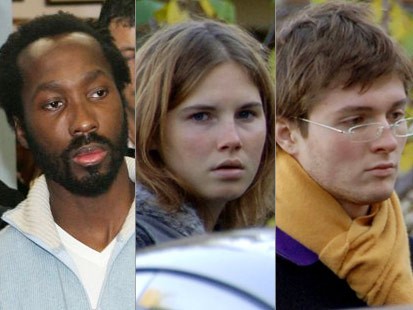
On November 1, 2007, Meredith Kercher, 21, was found semi-naked with her throat cut in her bedroom of the student house she shared with Knox (pictured center) in the Italian hilltop town of Perugia.

Her Italian ex-boyfriend,
Raffaele Sollecito (above, to Amanda's right), and another man, Rudy Guede (left), are accused of sexually assaulting, brutally murdering and stealing money from Kercher, Knox's British roommate in Perugia, the ancient learning hub near Rome where Knox was spending a year abroad from the University of Washington.

Pre-trial hearings are ongoing in this case–and a murder trial is finally on the horizon.

Peter Van Sant is a correspondent with me at 48 Hours–he has been working on this case for months. For those who missed the Mystery Man column he wrote for us in April, here it is. For our regular readers, here's a primer on an upcoming trial worth following.


by Peter Van Sant

This is a murder case that, from the beginning, just didn't seem to add up. The background here is very important to gain perspective on this investigation.

Amanda Knox is the classic all-American girl. She was a straight-A student at Seattle Prep, one of the top Jesuit high schools in the country. She plays guitar and has a wonderful singing voice, starring in a production of "Annie."

A tall brunette, Amanda's beauty turns heads wherever she goes. Her smile radiates. The twenty-one-year-old's biological parents divorced when Amanda (pictured right) was very young, but the family remained close. Mom is a math teacher. Dad is in management at a major department store. Her step father is in finance. All are good people.

Amanda went on to attend the University of Washington in Seattle, where she discovered her true passion in life, languages. She speaks fluent German (her grandparents on her mother's side are from Germany), Italian and some Japanese and Russian. Her friends describe her as friendly, helpful, someone who is concerned about others.

Doesn't sound like the profile of a killer, does it? I admit I'm teasing you here, but please read on.

While studying in Seattle, Amanda learned about a school in Perugia, Italy, called the University for Foreigners. Perugia is a beautiful medieval town about a two-hour drive north of Rome. The university offers students from around the world an opportunity to study in Italy. For Amanda, who was always interested in learning about different languages and cultures, it seemed the perfect place to go.

So while attending the University of Washington, Amanda worked three part-time jobs on the side. Eventually, she saved up more than $7,000. She was accepted into the University for Foreigners, and late last summer, she arrived in Perugia to begin a year of study abroad.

Six weeks later, Amanda was in prison—a suspect in the murder of her roommate, Meredith Kercher of greater London, England. Meredith (pictured left) was a lot like Amanda. She attended Leeds University in the U.K. and dreamed of studying abroad.

She got her chance last year and moved to Italy, where she attended a different school from Amanda's, the University of Perugia. Meredith needed a place to stay, and she eventually found a house she could rent with two Italian students and a young woman from Seattle, Amanda Knox.

On the night of November 1, 2007, Meredith was last seen walking home after having dinner with friends. Amanda wasn't home. She was spending the night at her boyfriend's house.The next morning, Amanda claims she went home to shower and change her clothes. She was upset that someone had left the front door open. After her shower, when she came out of the bathroom, Amanda says she noticed some blood on the floor. She tried calling her roommates, but no one answered their cell phones. Meredith's bedroom door was locked.

Amanda called her Italian boyfriend, Raffaele Sollecito, who walked over to the house. Just then, police arrived. Meredith's two cell phones had been found in someone's yard. Police had come over to the house to return them.Amanda told the police of her concerns. They broke open Meredith's door and discovered her body lying on the floor, covered with her bedspread. There was blood everywhere, including bloody finger stains on a wall.

Meredith's throat had been slashed. Authorities believe she may have taken nearly two hours to die. In the room were some tantalizing clues, a bloody fingerprint and a shoe imprint left in Meredith's blood on the floor.

Amanda Knox was questioned by police. She was later taken back to the crime scene with her boyfriend. Police wanted to see how they would react. They held each other and kissed several times, quick pecking-style kisses. Since Amanda's house was now a crime scene, she didn't have access to her clothes. Later, the two went to buy underwear for Amanda. The clerk claimed they were talking about having steamy sex that night. Authorities thought the behavior was cold and insensitive.

Four days after the murder, Amanda and her boyfriend were brought back to the police station for questioning.

After an all-night, 14-hour session in which Amanda was denied sleep, food, or an attorney, she agreed to sign a statement saying she HAD been at the house that night and that she thought she remembered her boss, Patrick Lumumba, killing Meredith Kercher. You should read her statement. It's written in bizarre English, clearly not dictated by Amanda.Amanda, Patrick Lumumba, and Raffaele Sollecito were all arrested.

Police developed a theory of the crime. They claimed that Amanda, Patrick, and Raffaele wanted Meredith to participate in kinky four-way sex. When Meredith refused, she was assaulted and murdered. The theory was fed to the news media in Italy and Great Britain. For weeks, tabloid newspapers gave the case sensational front-page coverage. Italian television also did extensive coverage. Much of the country saw Amanda as "The Dark Angel of Seattle." That coverage made its way to the U.S. as well.

Through her parents, Amanda has proclaimed her innocence. 48 Hours Mystery hired a renowned private detective, Paul Ciolino of Chicago. The investigator went to Italy to examine the case against Amanda. Ciolino has spoken with witnesses, key investigators, and people who knew all the suspects involved. He has come up with a startling conclusion.

This is a railroad job from hell," says Ciolino, a cigar chomping, pug-faced detective, who specializes in wrongful arrest cases. "There's not a shred of evidence putting this girl at that murder scene. But they've gotta convict her now, or they look like fools."

48 Hours Mystery has learned disturbing new details of what happened during Amanda's 14-hour interrogation that led to her "confession," which was not recorded or witnessed by a third party.

Paul Ciolino also questioned one of the most important witnesses in the case, a woman whose story helped form the police theory. What the woman tells Ciolino, while a 48 Hours Mystery camera is rolling, turns the case upside down.

In Italy, a person can be held without charges for up to one year. Amanda has still not been charged with any crime. She sits today in a maximum-security prison, allowed to see her parents twice a week for a brief time. Her parents say she is frightened. This is as disturbing a case as I've ever covered. (Click here for the full story.)


Tuesday, September 9, 2008

Notorious Murders Finally Go to Trial

by Jenna Jackson


One of the most notorious, brutal mass murders in East Texas history happened when I was eight years old. I clearly don’t remember anything about it at the time. But sadly for those involved, it has taken nearly my entire life for arrests to be made.

Twenty-five years ago, in the small East Texas town of Kilgore (better known as the home of the Kilgore Rangerettes), in September 1983, five people were abducted from a Kentucky Fried Chicken.

They were all discovered dead the next day, along an oil field road about fifteen miles from the KFC where they had been abducted the night before. Investigators have been working for two-and-a-half decades to find the killers. A good attorney friend of my parents’ has been working with the victims’ families for years and years.
This case has consumed lives and, unfortunately, made history.

And this week, Darnell Hartsfield, 47,
goes on trial for his part in the infamous murders. The trial was moved to Bryan, about 150 miles southwest of Kilgore, because of the publicity.

If the investigators are now correct about who they say did these horrible killings, one of the men has been sitting in prison for the bulk of the investigation. Darnell Hartsfield was arrested three days after the murders on an unrelated aggravated robbery charge. That charge earned him 25 years in prison, where he has been languishing while the investigation turned cold in the KFC murders.

I moved to Jacksonville, a tiny East Texas town very near Kilgore, two years after the murders—I was ten. I don’t remember the moment I heard about these killings—but I do recall knowing about them for as long as I can remember.

For most everyone who lived in East Texas, those killings represented this sad, pointless mystery that would likely never be solved. Routinely at breakfasts at the local cafes—or high school football games—the subject would come up. And everyone would describe their six degrees of separation from the people involved in the case—and their theories regarding who might have done such an unspeakable crime.

But in this new day and age of DNA testing, investigators finally announced a break in one of the state’s oldest unsolved murder cases. They arrested and charged two men—and recently said that DNA confirmed a third man was involved, although they refused to release any further details.

The second man arrested and charged in the murders was Romeo Pinkerton, Hartsfield’s cousin. In a secretly recorded conversation with a fellow prisoner, Pinkerton reportedly hinted he knew of that third person, but the identity of the man remains unknown.

Pinkerton took a plea deal midway through his capital murder trial, avoiding a possible death sentence by accepting five life prison terms. Pinkerton's deal did not compel him to testify against Hartsfield.

I hope, for the sake of the five victims’ families—and for the investigators who never let this one go—that the right men are in custody and that they identify and track down the third man involved. After 25 years, these people deserve to have the door closed on at least this portion of this murder case that has haunted East Texas for so long.

This is not a case I’m following as part of my job as a producer at CBS News/48 Hours—but as a small-town girl who grew up in East Texas, within miles of where these lives were taken 25 years ago, I can assure you I’ll be following it closely.


Friday, August 15, 2008

When Cheating Becomes A Crime

by Jenna Jackson

Everyone is talking about Sen. John Edwards this week—but not because he got the VP nomination. He admitted (after several months of denying it) that he had an affair with a woman who did some video work for his campaign, Reille Hunter. He admitted it to his wife a couple of years ago, but had hoped to keep it a private matter. That, of course, is impossible if you’re running for public office. And the newest question is whether Hunter’s child was fathered by Edwards. He is denying—but, of course, his denials don’t carry much weight since he denied the affair for months and then admitted it in installments.

Our blog is about crime, and I know this isn’t a crime—except against his wife and children. Unfortunately, it’s not even that surprising in this day and age. We have come to expect people to cheat—especially men in high-profile positions, it seems. Edwards said he just got to the point of being very narcissistic, so I guess he thought the rules didn’t apply to him.

In a Texas case near the Plano area, a man’s narcissism and tendency to cheat DID rise to the level of a crime—at least according to Collin County prosecutors. Last July, Philippe Padieu, 51, (left) was arrested at an Addison nightclub and charged with four counts of aggravated assault.

His crimes? He was dating several women at the same time—each of the women thinking they were in exclusive relationships. Some of these “relationships” had been going on for years. But as much as most of us women would consider that a crime, legally, it isn’t.

His crime, which his girlfriends/victims discovered over time, was knowingly spreading the HIV virus to each and every one of them, according to his charges.

Padieu tested positive for the human immunodeficiency virus, which causes AIDS, in fall 2005, a police sergeant told the local paper. Police said they believe he "intentionally, knowingly or recklessly caused serious bodily injury by creating a substantial risk of death by the exchange of bodily fluids."

He not only betrayed these women’s confidence and trust—he gave them what amounts to a death sentence. As a 48 Hours producer, I often speak to family members of victims who have been killed. But I’ve never spoken to the victim of a murder (even though it’s not called that legally) before he or she died.

When I first heard about this story, I was very sad for these women—all beautiful, independent professional women. They truly thought they were dating a nice man . . . and were shocked to find out he was cheating. Then imagine when they, one by one, discovered that they each had HIV.

This man has not yet been tried. And he, like everyone else in the country, deserves a fair trial. But I would not want to be him when each of those women likely takes to stand. She’ll describe their relationship, their discovery—and their sentence.

He is facing five to 99 years in prison for each count. My guess is the jury will lean toward the high side of those sentences.


Thursday, July 10, 2008

Career Choice—A Life of Crime?

by Jenna Jackson

I have a new intern for the summer. He’s a college student, working on his degree in journalism, and is trying to decide what he wants to do for a living once he graduates. It’s been a loooooong time, but I remember the pressure of that time. You’re about to end one major phase of your life and begin another—and you feel like you have to make a decision that will shape your future.

I kind of finked into my decision. I wanted to be a dance teacher—and had been working toward that most of my life. I injured my knees my senior year in high school, though, and that put an end to that. So I took the other scholarship I’d been offered at
Sam Houston State Universitya journalism scholarship. I needed the money, and that was the only other offer, now that my dance scholarship was gone.

That decision started me on a career that has taken me places I never imagined. For me, it has been a good career so far—and a good fit. But there are days when working almost exclusively on murder stories takes a toll. I almost forget how strange this world can be until someone new and unaccustomed to it comes along.


My intern, Matthew, is a blank canvas. He is smart, motivated, talented in many areas – and just trying to figure out what will fit him best. (He already runs a small but successful photo business, Matthew Crawford Photography.) And he is young—it has been an experience to me just to watch him take in this weird world I call a career. Many days, we’re sitting in my home office, making calls and sending e-mails. Exchanges and conversations that are completely normal to me cause him to look a little shocked at times. It has made me stop and listen to what I’m actually saying to people.

Nearly every conversation I have consists of details of a murder. I spend my days meeting with or talking to victims, suspects, lawyers—someone, who in some way, has been affected by a brutal crime. I always feel for the people to whom I’m talking—but it is also a job to me, and one I’ve been doing for more than a decade now. So sometimes I forget what an impact it has on people who aren’t used to this world.

Right now, I’m working on a couple of different cases, getting them ready (with a team of other people) to air on
48 Hours in the fall. In one, a man with no violent history is accused of executing his pregnant wife with a shotgun (Belinda and David Temple at left). My fellow blogger, Kathryn Casey, is writing a book on this bizarre case. In another, a 38-year-old man is accused of beating and strangling his own father, who he said had it coming because of years of abuse.

I had Matthew read the files so that he would be familiar with these cases—he has now listened to me talk to many of the people involved—and has sat through some on-camera interviews. During one interview session, one of our correspondents asked him (only half jokingly) why in the world he’d want to get into this dark business.

I am happy with the decisions I’ve made—I have a career that is never boring. And I get to meet incredible people fighting the odds every day. But I also am probably more cynical (and paranoid, especially when it comes to being a new mother) than the average person because of the tragedy I see every day.

I hope Matthew gets a good look at this business, so he can decide which direction he wants to go in his career. And I’m glad he’s seeing the full scope of it—because even though it’s a very rewarding career, it definitely takes a certain kind of person to stay with it. And it can take a toll on you emotionally—better to know that from the beginning and make the choice that choosing this 'life of crime' is still worth it.

To me, it is. I have the honor of meeting people going through their hardest times—and I’m the one who is allowed to help them tell their stories.


Wednesday, June 25, 2008

Witness

by Jenna Jackson

I got an email a few days ago that made me start thinking about something I have not thought about in years. Executions.

A group called the
Texas After Violence Project e-mailed to ask me to interview with them about my experience with the death penalty. Thankfully, I’ve never lost anyone I love to murder – or to an execution. But as a young reporter, I witnessed more than 20 lethal injections.

When I was in college at
Sam Houston State University, I worked full time at the local newspaper, the Huntsville Item. I got some of my best reporting experience to date at that tiny paper. Even though it was a small paper in a small town, we covered big issues – because it’s located in the state’s prison capital – Huntsville, Texas.

I worked the prison beat, and part of my beat included covering executions at the nearby
Walls Unit. I was 20 years old – and I spent many evenings at the old brick prison. It was usually just the same handful of us there – me, an AP reporter and a UPI reporter. Most nights, just before 6 p.m., the three of us would follow the prison PR guy across the courtyard and into the death chamber. Outside the gates of the courtyard, it would be silent. Every so often, an execution would garner publicity – and the street just outside that gate would be packed with people … protesting or just watching.

But most of the time, an execution was a non-event. That always struck me as one of the strangest parts of this ritual. I was a reporter covering a story – so I never voiced my opinion on whether I thought the death penalty was right or even effective. But I did always think if someone was going to be killed – whether at the hands of another person or by the state – it should be noted.

And because of that, our paper’s policy was that we published a story on each and every execution. Some weeks, there were several. On a couple of occasions, there were two in one night.

Because of those many nights I spent watching men be put to death, I actually came to believe that executions should be public. We as a society condone them – and we should see the effects of those laws. I’m not even sure it would change people’s minds to see them – but I think the option should be there.

But as it stands now, there are only a handful of people allowed into the death chamber to witness an execution. The inmate can choose a couple of people to come in on his side of the partitioned chamber – and the victim’s family can have a few people on the other side. The reporters usually were ushered into whatever side was the least crowded.

There was one night in particular that I remember where we three reporters were the only people – apart from prison staff – who were witnessing the lethal injection. The man strapped to the gurney had killed an entire family, so there was no one left on the victim’s side to attend. And he apparently had no family who was invited or wanted to come see him die. That was one of the saddest nights – simply because there was no one left to care whether this man lived or died.

When I got the e-mail from the Texas After Violence Project, I thought I really didn’t have much to tell them. I witnessed several executions, but I was never personally involved in any of these cases. But after thinking about it, I guess it affected me more than I knew at the time.

Their web site says the project was formed in 2007 “to listen.” As a reporter, I’ve always thought the more information people have, the better off they are – so, although I’m not sure what I can add to this project, I am going to call and tell them what I know.


Wednesday, May 28, 2008

"Lover's Lane" Unsolved Murders

by Jenna Jackson


A young couple, newly in love and looking forward to their lives – brutally murdered and left where their killer likely thought no one would discover them. Nearly 18 years ago, Cheryl Henry and Andy Atkinson met up with the wrong person/s, and two young lives, full of promise, ended.

In the summer of 1990, the bodies of Henry, 22, and her boyfriend, Atkinson, 21, were found in an undeveloped, wooded area of Houston where young people often went to park and kiss. Both had been tied up with rope and their throats slashed. Henry had been raped.

For almost two decades, detective Billy Belk worked the case for the Houston Police Department's Homicide Division. Other cases would come and go – but this one stayed with him through the years. Unfortunately, there was only so much he could do with the little amount of evidence they had. There were no eyewitnesses. Semen was collected from Henry's body at the scene -- but DNA testing was in its infancy and wasn't much help at that point.

But Belk made sure the evidence they did have was properly collected – and it finally paid off. A week after Belk retired, he got a phone call. The DNA from semen found on Henry’s body had just been matched to an unsolved rape that happened that same year. A 30-year-old exotic dancer who worked at GiGi’s, a topless club in Houston, had been raped in her apartment.

Now a 48-year-old Realtor, the woman still clearly remembered that terrifying night, just two months before Henry and Atkinson were killed – and the face of the man who raped her. Police have now released a composite sketch of the suspect. She said he was a white man in his mid-30s, about 6 feet tall and 180 pounds with brown hair, brown eyes, a possible mustache and olive skin.

Like the rape victim, Cheryl Henry had worked at a similar club in Houston -- Rick's Cabaret. Henry's boyfriend Atkinson occasionally worked the door at Dreams Street, another southwest Houston club, which his father managed. With the DNA link, police can refocus their investigation based on the likelihood that the man who raped both women frequented or worked at local strip clubs.

The “Lover’s Lane” slayings may be Houston’s most notorious set of unsolved murders.

"It's a bad Hollywood movie," Michael Miller, an HPD homicide investigator who inherited the case from Belk, his former partner, told the Houston Chronicle last week when the news broke. "Somebody came up on them, tied them up and marched them out to the woods. These two knew they were going to die."

Miller says he knows there are other victims out there – and he hopes someone will recognize the sketch and call him. Even the smallest lead could help him track down this rapist and killer, who could still be at work today.

Over the years, the victims’ families and the police department have kept these murders in the limelight. As a producer for 48 Hours, I've seen what these families go through -- it is an unspeakable nightmare to lose a loved one in this manner. But to never know who did this -- and never have them pay in any way for what they've done -- is beyond comprehension. 48 Hours has looked into this case a handful of times – as have many other media outlets. But there has never been a break with as much potential as this one.

It will definitely still be an uphill battle to find this man. It will take a lot of pounding the pavement (something the cops on this have been doing since day one) – and a huge stroke of luck. But at least it’s something – and hopefully it will get people talking.

Because the composite is of the killer 18 years ago, he obviously will have aged and will look different. But the hope is that someone will recognize him as he looked back then – and give the police a lead.

These families lost two loved ones; their lives ended before they really even began. Hopefully the progression of new DNA science – and the steadiness of old police work – will finally create a break in this case.

If you know anything, no matter how small, call Detective Michael Miller at 713-308-3946 or 713-308-3600.
Crime Stoppers is offering a $5,000 reward for information leading to the arrest and charging of a suspect. Call 713-222-8477.


Friday, May 2, 2008

Clemens Thrown a Curve

by Jenna Jackson

To be accused of something that could destroy your life – and the lives of those around you forever – would be a nightmare. Especially when you are a public figure – and there is never a shortage of false or exaggerated accusations flying around. They're easy to make and generally not so easy to refute.

Take this week’s story of baseball great
Roger Clemens (pictured above, left).

DAY ONE - In a story Monday in the
New York Daily News, he was accused of having an affair with country singer Mindy McCready for ten years. At the time, he was married and father to two boys. He’s still married and now has four boys.

And it gets worse. The accusations – from “people with intimate knowledge” – are that the affair started when he was 28 and playing for the
Boston Red Sox and when McReady was a mere 15.

I have no idea if any of this is true – but I cannot imagine how hard this week has been for his wife of so many years, Debbie – and his four sons. And the fact that the article that broke this “news” is based entirely on anonymous sources makes it hard to digest.

I’ve been a
48 Hours producer for ten years. I completely understand the need and importance of anonymous sources. They can give you information and lead you in directions you may not have known about otherwise. They can be extremely valuable.

One of my good friends and fellow bloggers,
Vanessa Leggett, went to federal jail to protect her sources. I’ve always felt this was among the most courageous things I’ve ever witnessed. But Vanessa has dozens and dozens of sources to back up the book she’s writing about River Oaks bookie Bob Angleton – only some of them are anonymous, and she’s checked every one of those out to the hilt.

When it’s a story like this – one that could destroy someone’s life, not to mention his children’s – there should be at least one legitimate, reliable source who will go on the record to tell the story. Especially when it appears on the front page of a New York City newspaper – which will then spread like wildfire around the country to every other paper and evening news show by the end of the day.

DAY TWO - Clemens, through his lawyer, vehemently denies the charges of the affair. He says McCready was a close family friend – but that they were never intimate. But McCready, “tearful but resolute,” according to a Nashville newspaper, said she couldn’t deny anything in the original NY Daily News article. Not a great day for the Rocket. Except that McCready has had a
tumultuous past -- so she might not necessarily be credible, either.

He said/she said stories are the hardest to cover – and the hardest for authorities to investigate. Our
WCI blog is based on crime – and, if this story is true, it should be considered a crime against Clemens' wife and children, all obvious victims. But there could have been real crimes committed, especially if McCready really was only 15 when the alleged affair began. It’s possible that Clemens could be charged with that even now – in Texas, the statute of limitations extends ten years from the age when someone becomes legal, which is age 18.

And, as everyone in the country likely knows at this point, Clemens is dealing right now with other criminal allegations – namely that he used
steroids over the years to enhance his baseball performance and that he lied about it under oath to Congress.

None of us know what -- if anything -- Roger Clemens is guilty of. But I’m inclined to think the bigger “crime” is that of throwing allegations out into the public arena without the proof to back them up. This affair very well might be true. But once the allegations are out there, it doesn’t really matter. The harm to him and – more importantly – to his family is already done. By the time the truth comes out, if it ever does, it will have become secondary to his ruined reputation.

My boyfriend keeps saying “poooooooor Roger” -- I’d counter with poor Roger’s family. And poor any of us who might happen to be in the public eye, making you ripe for allegations, true or not.


Wednesday, April 9, 2008

The CSI Effect

by Jenna Jackson

Some of the most popular shows on television right now—CSI, Law and Order, Criminal Mindsare having a real effect on courtrooms across the country. When I started at CBS News 10 years ago, most of the people I would call for a story had no idea how DNA testing actually worked—they had no clue it was blood spatter, not splatter.

These days, people are far more savvy. Nearly every day, I'm asked a question that throws me—what kind of DNA typing was done at a scene, whether a person was polygraphed and by which expert. People know to ask detailed questions about criminal cases—and they learn most of what they know from watching TV dramas.

But most of the time, I have to explain that although CSI portrays a criminal investigation one way (DNA takes minutes, instead of months), real life is a lot slower and more complicated.

I think juries have become much more savvy, too—and they expect a lot more. This can be good and bad. It has certainly made trials more interesting to watch. Lawyers on both sides of the courtroom are forced to ratchet up the drama when presenting their cases—juries watch enough of these shows that they expect a show in the courtroom.

They also often want real, physical evidence to connect a defendant to a crime in order to convict. This is making things a little tougher on prosecutors, who for years have had the clear advantage from the opening of a trial.

Juries seem to expect a case where all the loose ends are tied up—but most real-life cases aren't delivered to a prosecutor in a neat little package. This is especially true in cold cases where evidence at the scene may have been scarce or not properly collected—and where witnesses have disappeared or died.

I recently covered a case in Houston where there was absolutely no physical evidence connecting the defendant to the murder scene. These types of cases are difficult for all sides—and tend to leave unanswered questions even after a verdict is returned.

But there is a case right now—half a world away in Perugia, Italy—where physical evidence was collected at the scene of a brutal murder. A suspect was arrested within days—but the physical evidence doesn't necessarily match the suspect in this case. She just matches the police theory of the crime, which can sometimes be an entirely different thing than concrete evidence. Amanda Knox (pictured above), a Seattle college student living in Perugia to attend college, definitely gave police reason to be suspicious. But as every good detective knows, people can act suspicious for a number of reasons.

48 Hours is airing a one-hour show on this case Saturday at 9 p.m. CDT. It centers around two beautiful college students—one, a victim of a vicious murder, and the other, a possible victim of an overzealous police force. I didn't have anything to do with producing this particular case, but it is so intriguing because of the issues it raises: how an American is treated as the target of a criminal investigation in a foreign country; how police can sometimes get tunnel vision and focus on one suspect to the exclusion of other possibilities; and how scenarios are created that make false confessions possible and almost probable.

Because there were so many questions in this case, 48 Hours hired a private eye to conduct his own investigation. He came up with a stunning theory of his own: Amanda Knox was being railroaded by the Italian authorities.

This case is one of those that makes you realize you can't always trust how a story looks in the beginning—once everything unfolds, it can turn into an entirely different tale. Even after nearly a decade with this show, I learn that lesson every single day.

Be sure to check out this week's Mystery Man for more details—he has a unique, behind-the-scenes vantage point of this particular case.


Wednesday, March 19, 2008

A Split Second—to a Never-Ending Journey

by Jenna Jackson

I see people when they’re going through the worst thing they could ever imagine would happen to them. A loved one has been murdered—or is charged with murder. Someone’s life has been taken—or is hanging in the balance. Until you’re caught up in the justice system in a very personal way, I don’t think you can understand the gravity of it. People believe, in theory, that you’re innocent until proven guilty. But the truth is, once the justice system sets its sights on you as a defendant, you have to prove your innocence. That may not be what the law says . . . but it’s the reality of the system.

It is excruciatingly stressful for a family to make the path through the justice system—an arrest, a trial—no matter whether they’re supporting the victim or the accused. And after nearly 10 years at 48 Hours and dozens of cases, I’m still generally unsure what the truth is in most cases. The family members and lawyers on either side of a case fully believe their truth. And when someone truly believes something, it’s difficult to argue with them. We challenge each side and let the viewers decide which version—or combination of both—they will choose to believe.

Sometimes this job wears on you emotionally, dealing with murders day in and day out. Years ago, I covered the case against serial killer Tommy Lynn Sells, who was arrested in Del Rio, Texas. (One of my fellow bloggers, Diane Fanning, actually wrote a book on this case.) The Texas Rangers allowed us to film part of their interrogation of Sells—and I sat in for much of it. It was eery how much he seemed to enjoy having me there to have to listen as he confessed to killing men, women and children during a spree of more than 20 years. After one particularly long day, I went back to the hotel and showered for almost an hour—trying to scrub off everything I’d had to hear that day.

On the flip side, in that same story was a little girl who inspired all of us—after Sells killed her friend in the bunk bed above her, he slit the throat of 10-year-old Krystal Surles (pictured above). She was incredibly brave. She played dead until he left and then walked, in the black of night, to a neighbor’s house. Her description caught this man who had been terrorizing people across the country for two decades.

A
nd that is the reason I don’t think I’ll ever give up this job—it’s a window into human nature that few people see. The bad and the good. I remain fascinated with how criminals think and operate. But most of the accused I end up meeting are just people—there’s no black and white, good or evil—just a whole lot of gray.

That’s the most fascinating part—how a normal (or seemingly normal) person gets himself into a situation where he’s sitting in a courtroom, facing a murder charge. It reminds me that anyone, in a split second, can make a decision that will change the course of their life—and the lives of the ones they love—forever.