Wednesday, September 16, 2009

Who's Crazy? And Should the Jury Be Told?

by Women in Crime Ink

In the first of an ongoing series asking WCI contributors to weigh in on cases and issues, we posed the question: While not legally insane, some murderers have other types of mental illnesses, personality disorders and the like. Should those be considered when deciding guilt/innocence? What about sentencing?

Read on, to find out what WCI's bloggers think about this important issue:

Laura James: A defendant's "personality disorder" falls under the "so what" category for me. I'd bet half the people I know could be diagnosed with a "personality disorder."

Kathryn Casey: It’s not relevant. We're not talking about severe mental illness here, where someone doesn't understand the difference between right and wrong, which is the legal test for insanity. These people are capable of working with attorneys to defend themselves, although their frequent tendency toward pathological lies can get in the way. (It's not smart to lie to one's own lawyer and leave him/her unprepared.) Lots of folks have personality disorders, yet they don’t commit murder. Should this come up at all, it should be in sentencing. I honestly think severe poverty and childhood abuse are more mitigating factors.

Andrea Campbell: I do believe that the mentally ill fall into a crevice when it comes to society. No one wants to claim or protect them most of the time. And I do think their mental condition should be made known during trial. But I don't think we need to cut slack for heinous crimes or felonies. I've always been torn on this issue, but justice needs to keep dangerous people out of society. I guess that either means a mental health facility or incarceration.

Diane Fanning: Murderers, with anti-social personality disorder, narcissistic personality disorder and perhaps even borderline personality disorder, are people who understand the difference between right and wrong but just don’t care about the law, about the people around them, or about their victims. A violent offender with one of these disorders is a danger to society but also to those who guard them in prisons. They should not be viewed as equal to a person suffering from severe mental illness, who if given proper treatment and medication may be able to lead positive and productive lives. Adults with severe personality disorder are unlikely to ever move beyond their condition and thus, it should have no bearing on guilt or innocence.

In sentencing, juries should consider the personality disorders of violent offenders, but not to mitigate the offenses. Instead, it should help deliver sentences that ensures these individuals are not allowed to roam free and prey on innocent victims.

Robin Sax: Everyone who commits a murder MUST have a personality disorder; the personality disorder makes him a murderer who should be punished.


Tuesday, September 15, 2009

Is the Answer Malignant Narcissism?

by Diane Fanning


If the question is Casey Anthony, it may very well be. Dr. Erich Fromm coined the phrase, but Dr. Otto Kernberg became the expert on it. He defines malignant narcissism as being in the middle of the spectrum ranging from Narcissistic Personality Disorder and full-blown psychopathology.

We are all born
narcissistic. As an infant, our world view is that everything and everyone is connected to us and exists to fulfill our needs. Another spike in our narcissistic tendencies occurs in adolescence. It is natural to be self-centered at this point in our development, but we are expected to grow beyond it. Healthy adults maintain a small amount of narcissism, but it stops far short of self-obsession.

That characteristic is clearly demonstrated by
Casey Anthony. When she was released from jail in the summer of 2008, she was happy and focused, offering smiles and hugs to everyone. Her immediate focus was on taking a shower and getting a home-cooked meal. It was not on her missing toddler who she had not seen for months.

In the days to follow, she made it clear she was enjoying the attention of being in the national media spotlight. She bragged about the special treatment she received in jail, claiming that everyone there loved her. She suggested signing autographs to raise money for her attorney. She expressed a desire to go on the radio with
Howard Stern.

But one subject she never raised was Caylee Marie Anthony — a frightening epitaph for a young daughter.

Looking at Casey Anthony’s life seems like a study of narcissism. She used and took from others, diving her world into two camps — those who had something to give her and those who didn’t. She manipulated the first group and ignored the second. She had an inflated sense of her importance and expected all in her orbit to treat her as if she were an exceptional person, above the rules that constrained all others. At the same time, that feeling of superiority was coupled with an endless need for praise and adoration. Although she could be char
ming and winsome, it all was a carefully constructed mask designed to hide a storehouse of envy and resentment.

Pathological lying was her hallmark; selective empathy a tool to use to get what she wanted; and manipulative of all those around her — a trait seen in spectacular display when you examine her interactions with her parents. She also presented an inability to tolerate boredom, always seeking more fun and excitement, always willing to do anything to attract attention — from making out with another woman on the dance floor to the provocative consumption of a banana for the camera. She did anything and everything she could to pull the focus off of everyone else and onto her.

One of the indicators that her behavior moved into the realm of malignant narcissism is the escalation in a few short years. She started with a white-lie reputation in her middle teenage years, moved on to grandiose lies to enhance her image in her late teens, and by the age of 21, she was capable of creating complex fantasies about the fate of her daughter. She persisted in her lies in the face of proof of her dishonesty. She told the same stories again and again as if repetition would make them true.

The other characteristic that seems to push her beyond Narcissistic Personality Disorder is the presence of
narcissistic rage. It seems evident in a jail conversation with her parents. She grows impatient with her parents’ concerns and their desire to express them. Finally she erupts, pulling the phone from her ear, uttering inarticulate snarls, clenching her teeth, contorting her face and forming tight fists with such intensity, she was momentarily incapable of speech.

Did little Caylee see that rage? Did it lead to her death? With Caylee gone, we may never know with any certainty just as without Casey’s complete cooperation, we may never be able to conclusively fit her
into the proper category of personality disorder. There are many overlapping symptoms that make it difficult to accurately diagnose.

But we don’t really need a proper psychiatric label for Casey because no matter where we place her, her actions speak loudly of the presence of evil. We may not be able to accurately define evil, but we know it when we see it. And there is simply no better word to describe the murder and heartless disposal of an innocent child.

Diane Fanning’s tenth true crime book, MOMMY’S LITTLE GIRL: Casey Anthony and her Daughter Caylee’s Tragic Fate, will be released on November 3 by St. Martin’s Press.


Monday, September 14, 2009

Some Just Aren’t Wired Right: The Summer of Statistical Anomalies

by Stacy Dittrich

After the horrific case involving the brutal abduction, murder, and sexual assault of eight-year-old Sandra Cantu in which a local Sunday school teacher, Melissa Huckaby, 28 (pictured left), is charged, most of us came out screaming, “That’s a statistical anomaly!" It very rarely happens. To find that a woman who looks like a typical PTA mom is allegedly a rapist and child murderer makes even those of us with steel stomachs shudder. When it came to the Cantu case, I was as guilty as everyone else who assumed the murderer would be a male.

Shockingly, it was my own 13-year-old daughter who set me straight. While watching coverage of the Cantu case back in March, my daughter entered the room and paused. “Did they catch who killed that little girl yet?” she asked, quietly. “No,” I answered, “but they’ll get him soon, no doubt.” My daughter gave me a funny look and said in her young and authoritative voice, “How do you know it’s a him, Mom? It could be a woman who did that!” I simply raised my eyebrow at her and calmly explained, “That’s ridiculous. Of course it’s a man who did it! Women don’t sexually assault little girls, and rarely anyone, for crying out loud.” Getting in her last word, as teenagers like to do, she left the room, muttering under her breath, “I think you’re wrong…”

Imagine the "I told you so's" reverberating through my home when Huckaby’s arrest was announced. It was one of those moments where I paced back and forth, scratching my head and wondering how the hell I missed it while my teenager got it right. Ironically, the case stayed in the back of my mind; I didn't know I would be approached to write the book on Cantu's murder. I couldn’t have imagined, as my daughter and I had our exchange, that I would be flying to San Francisco at the end of September to face the “Statistical Anomaly,” i.e. the aforementioned Melissa Huckaby — to watch her in court and conduct research for the book. Because the case sent such a poignant and stark reminder to parents to be careful of everyone, not just strangers, I agreed to do it.

When Jaycee Lee Dugard walked into a Concord, CA., police department on August 26 accompanied by her two daughters, she also became one of the dreaded “statistical anomalies.” The chances of a child falling victim to a stranger abduction and surviving, then being found 18 years later after bearing her abductors children, are minuscule. Jaycee Dugard shattered the experts' predictions on such cases. God help us if she talks to investigators and leads them to other crimes, perhaps even murders, her captor, Philip Garrido, (pictured right) may have committed over the past 18 years.

Oh, but it’s not over yet. I came across this headline last week: “Michigan Mom Found Long-Lost Son Online, Raped Him.” I figured there had to be more to it so I pulled up the article. There was more to it alright—a nauseating and disturbing account of an attractive Michigan woman, Aimee Louis Sword, 35, (pictured left) of Waterford Township near Detroit who had given her son up for adoption over 10 years ago. For unknown reasons she decided to track him down online. She found him and made arrangements to meet. Prosecutors on the case maintain the meeting consisted of Sword seducing, and raping her teenage son.

I simply don’t know what to say.

Detroit Sinai Grace Hospital Dr. Gerald Shiener had a similar reaction: “I’m at a loss for words because it’s something we consider to be so out of the normal, so prohibited in every culture that it unnerves every man just to think about it…it’s an abomination.”

Abomination? Statistical Anomaly? I have a better term: Evil — plain and simple. For me, these cases solidify the notion I’ve long held about certain people: We can blame upbringing, drugs, alcohol, years of abuse, and mental anguish but the bottom line with those who commit such crimes is that they were simply born bad.

These types of criminals weren't wired right at birth and have no acceptable place in society; they will never change, they will always be evil, and they can’t be re-wired no matter how skilled the mechanic is. Even more frightening is the fact that there are hundreds, if not thousands, out there roaming our streets and threatening our children. So, the questions society needs to answer: What do we do with them then? Where do we put them?

Obviously, I have strong opinions on these matters. What are yours?


Friday, September 11, 2009

My Take on the Jaycee Dugard Case

by Cassie Nelson

I’m turning 18 in November, and Jaycee Dugard has been held captive for longer than I’ve been alive. I spent my 18 years enjoying a happy childhood and the typical turmoil of teenage years. Jaycee has spent her 18 years as a victim of sexual abuse. At the age of 14, when most girls are looking forward to starting high school, Jaycee became a mother and went on to raise two children sired by her abuser.
The incredible good fortune of Jaycee’s rescue is matched by the horror of her long ordeal. There are so many questions and issues raised by her experience: how could the neighbors and the authorities have failed to see what was going on; could the abuser’s wife be complicit; and most confusing of all, how could Jaycee have made no apparent effort over the years to escape? The neighbors have explained why they were not aware; the authorities have admitted they failed in their responsibility. The wife was apparently just as much a monster as her husband, but what about Jaycee?
Psychiatrists have explained that anyone under the complete control of an abuser will come to feel a connection with their abuser, based on fear but also dependence. Jaycee was only 11 when she was taken and, although the backyard she was hidden in was only 35 miles from her home, it must have seemed like a world away. The experts say that no individual can maintain the level of fear or anger that being abducted and abused would cause for a prolonged time. Eventually hopelessness sets in, followed by a growing sense of identification and bonding with the abductor.


Young children are capable of finding joy even in the most difficult circumstances. Children living in dire poverty can enjoy playing street games while their parents sink into despair. It is this very innocence and resilience that saved Jaycee at the same time it imprisoned her.
Jaycee made the best of a horrifying situation. Although escape may have seemed ridiculously easy to an adult, to a child even crossing the street alone is a frightening experience. In fact, Jaycee was doing just that, on the way to the bus stop, when she was abducted less than 100 yards away from her stepfather.
My parents warn me constantly to be aware of my surroundings and never, ever text while walking through a parking lot. I know that if the unthinkable occurs, if I do the wrong thing and am taken, my parents will not be angry at me and will never give up looking for me. A child does not have the same ability to reason as an older teen or adult. Like Shawn Hornbeck, who was abducted at age 11 and held for four years, Jaycee couldn't believe that there were still people out there looking for her -- an abstract concept -- when her abductor told her she was his forever.
Psychology calls this the pre-operational stage of development. In a recent interview, Shawn described his situation this way: “It’s like you are on autopilot, only someone else is controlling all the switches. They control every little, minute detail in your life. Everything.” Like Shawn, Jaycee deserves our understanding and support, so that perhaps the next 18 years of her life will finally be happy.


Thursday, September 10, 2009

Tuesday's Vote Could be Etan's Last Chance

By Lisa R.Cohen

Tuesday, September 15th, could signal a new chapter in the 30-year-long Etan Patz case.

And the more New Yorkers who know about it, the better the chance there is of that happening.

Etan is the six-and-a-half year-old boy who famously disappeared off the streets of SoHo, New York, on May 25th, 1979. That date is observed every year as National Missing Children's Day to commemorate the beautiful blond boy whose smiling face on Missing Posters all over the world signaled a cultural shift in the way we raise our children.

Etan was never found, and his case is officially still open. The New York City District Attorney for the last 35 years has kept it open. But he says there's never been enough evidence to bring an indictment against the one man authorities believe kidnapped and murdered Etan, then disposed of his body.

Instead, Federal Prosecutor Stuart GraBois was able to get Jose Antonio Ramos convicted for another child molestation case. Ramos is currently finishing up a 20-year-plus sentence for that crime.

Tuesday is the Democratic primary, which will finally elect a new District Attorney of New York. One candidate has openly pledged to pursue Etan's case. In wildly Democratic New York, there's no Republican candidate, so Tuesday's vote is the whole shebang. With voter turnout typically running under 200,000 voters, we can achieve a critical mass relatively easily. In this election, every vote truly does count.

But I'll let Etan's cousin Kim tell you more about why next week is so important. She is far more eloquent than I on this particular subject.

She's written an open letter and asked me, as the author of AFTER ETAN -- the only book ever written on the case -- to get it spread around town. Even if you're not a New Yorker, maybe you know some, and could forward it on, or tweet about it, or make some calls. Whatever works for you these days.

Click here to download a PDF of the letter for forwarding purposes. But I'm also cutting and pasting it below:

On May 25, 1979 my 6-year-old cousin, Etan Patz, disappeared from the streets of New York. Even after thirty years, people remember this case quite well. Etan was walking two short blocks to his school bus stop for the first time, and he was never seen again. Jose Antonio Ramos, a sexual predator, is believed to be responsible for molesting, killing and disposing of Etan’s body.

Here’s the scariest part - If nothing is done, and my cousin’s case does not make it to a grand jury, Ramos will be released from prison in 2012.

In 2004, a civil judge found Ramos responsible for Etan’s death, yet the current Manhattan DA refuses to bring the case to trial. Jose Ramos, a serial pedophile, is currently incarcerated in a Pennsylvania prison for sexually molesting another young boy. But, he will have served out his sentence in three short years and he will be back on the streets to harm countless other children. The thought of this monster getting out of prison should frighten everyone, but if you live in Manhattan you can help stop Ramos – for good.


The current 90-year-old Manhattan DA, Robert Morgenthau, has been in office for 35 years and to this day refuses to bring this case to trial despite substantial evidence and a civil trial showing Ramos responsible for Etan’s death. Morgenthau has decided not to seek re-election this year and to finally retire.

There are three candidates hoping to succeed him. Judge Leslie Crocker Snyder, Cyrus Vance Jr. and Richard Aborn. My family is trying to reach out to those of you in Manhattan to please consider voting for Judge Leslie Crocker Snyder for Manhattan DA. Leslie Crocker Snyder is the only candidate for DA who has pledged to put the Patz case before a Grand Jury, the first necessary step needed to obtain an indictment against Jose Ramos which could lead to a trial and conviction.

Our only objective is to save another family from enduring the pain and
anguish our family has lived with for over 30 years.


If you live in Manhattan, you're of
legal age to vote, and you're a registered Democrat, please vote for Judge Leslie Crocker Snyder.


If you are unfamiliar with this case, please see http://afteretan.com or read the book “AFTER ETAN: The Missing Child Case That Held America Captive,” by former “60 Minutes" producer, Lisa R. Cohen. It’s the first book ever written about the case in 30 years. It finally lays out a full picture of the compelling evidence against Jose Ramos, evidence never before heard in public.


If you have any doubts about his guilt, read this book, and you will see that when you put all the pieces together, he is irrefutably the villain who kidnapped and killed my cousin Etan.


There were also interviews done on "20/20" and "60 Minutes"
that will help you understand how important it is to keep this predator off our streets.

Thank you for your time.

The Family of Etan Patz


Tuesday, September 8, 2009

Jan Burke and the Crime Lab Project

by Andrea Campbell


My friend and colleague, Jan Burke, is the author of 12 novels and a collection of short stories. Her most recent novel is the supernatural thriller, The Messenger. Her works of crime fiction include Bloodlines, Flight, and the Edgar-winner for Best Novel, Bones. Her books have appeared on the USA Today and New York Times bestseller lists, been published internationally, and optioned for film. Her short stories have won the Macavity, the Agatha, and the Ellery Queen Readers Award. She will be a guest of honor, with Lee Child, at Left Coast Crime 2010 in Los Angeles.

Q: Jan, for Women in Crime Ink readers who don’t know you, can you please tell us a little bit about your background?

I'm finishing work on my 14th book. Most of my books are crime fiction, although the most recent, The Messenger, is a supernatural thriller. The one I'm writing now is another in the Irene Kelly series, something of a sequel to Bones.

Q: You’ve been quite successful as a mystery author. Would you talk about your latest books? Who is the character? What is their mission or goal?

In The Messenger, the hero is Tyler Hawthorne, who lay dying on the battlefield after Waterloo when he was offered a ring that would make him a Messenger — able hear the thoughts of the dying and convey their messages to their loved ones. Tyler accepts the bargain to become a near-immortal, forever 24 in appearance. We met him almost 200 years later in Los Angeles, by which time he has come to realize it wasn't such a good deal. Except for the company of Shade — a cemetery dog — he has led a nomadic and solitary life throughout those centuries.

The dying also convey messages to Tyler, and now they are hinting that his long service may be coming to an end. He begins to hope that he can return to a normal, mortal life, and allows himself to grow closer to a woman he has been strongly attracted to — unaware that he is being pursued by an old enemy who will stop at nothing to destroy him, nor that he can only leave his role of the Messenger at a terrible cost.

Q: I’m happy to have you here to talk about a key project of yours: the Crime Lab Project. Please explain what it is and how you got involved.

The Crime Lab Project is a nonprofit that raises public awareness of the problems and challenges facing public forensic science. We see the lack of support given to labs as a matter that has a growing negative impact on many areas, including law enforcement, criminal justice, health, public safety, and national security. It's costly, both in human suffering and economically.

Many people who are devoted fans of forensic science-themed shows and novels imagine forensic science labs to be ultra-modern, fully staffed by highly trained techs who whip out results almost as fast as the evidence comes in the door. The reality is far from this pleasant picture, and we need to wake up.

I got the bucket of cold water tossed on me in 2003. I was teaching a weekend class with a forensic scientist and a homicide detective. I learned — to my shock — that in many parts of the country, DNA was not being used to solve most rapes and murders. Yes, you read that right. Even when DNA evidence had been collected and sent to labs, those labs were so overwhelmed and underfunded that it took six months, a year, or even longer to get lab results.

So detectives were spending many hours on investigations without the help a lab could give them, time that might otherwise have been used on a case without physical evidence. Prosecutors spent hours preparing cases, all the while praying the tests would be completed by the trial date. Detectives and prosecutors hoped that at that point, the evidence would not show that for months (or longer), they had the wrong person in custody.

That same year, in October, I was asked to speak at the American Society of Crime Lab Directors. During that meeting, I heard these same stories again and again. I realized there was a way to "pay it forward" in response to forensic scientists' generosity to writers: writers were often before the public, and we could tell people about these problems. So I called a few friends, and by the time I spoke, I promised ASCLD that we would try to raise awareness. Within a few months, with the help of many of my colleagues in crime fiction, the CLP was born.

We have made progress, but there are still, as of this writing, hundreds of thousands of backlogged cases in the U.S.

Q: Most citizens are completely unaware of their own state’s medical examiner/coroner system and how it works. Is that why you created Forensic Friday: The Death Quiz? What type of feedback have you gotten on it?

Yes, we hope that taking the quiz will be help those who take it to get a sense of what is really going on out there. Death investigations affect so many areas of our lives, not just the solving of crimes. The fact is, in a large percentage of jurisdictions, those in charge of death investigations have received little or no training. ME/C offices are horribly underfunded. Really, it's a shameful situation.

People sometimes say, "Well, what the hell, the dead don't care!" But if you stop to think about it, almost everything the ME/C's office does is on behalf of the living. We pay a big price for our neglect. We mention some of the consequences in the quiz.

As for the quiz itself, the feedback has been great! Most people say, "Thank you! I failed it, but I learned a lot." It's not surprising that most people fail — few of us have seen the reality. We hope those who take it will spread the word about it!

Q.: You do a host of other things to draw attention to the sad state of affairs in crime labs around the country. Would you share some with us? 

In addition to the blog, we have a web site, a presence on Facebook and Twitter, and a weekly news list. We have sponsored email campaigns that alert our members and others of pending legislation affecting forensic science, and have seen them make a difference. We have provided speakers and helped with forensic science programming at conferences and conventions. We've created handouts and pamphlets. We've worked with organizations to sponsor forensic science events. Several mystery conventions, especially Bouchercon and Left Coast Crime, have been very supportive.

Sisters in Crime and Mystery Writers of America have both endorsed the CLP and generously allowed us to publish articles in their newsletters and be a part of some of their events. Members have written letters to the editors of their local papers and blogged about the topic, or mentioned it in interviews. Many of our members are also seeing the storytelling potential here — working backlogs, underfunding, and other problems into their stories and scripts. We've also maintained relationships with ASCLD and other forensic science professional organizations, who have been very helpful.

The CLP Foundation, a 501(c)3 nonprofit that supports our educational and charitable efforts, has allowed us to donate to labs and research, to sponsor educational events, and to provide scholarships to train death investigators.

Q.: I receive a mailing from you called CLP News. Please explain what that is. Also, is it difficult to keep up this newsletter? Do you have help and how do you manage to do it all?

CLP News is a weekly email newsletter containing brief descriptions and links to a selection of news stories about forensic science. It's free. Anyone may sign up for it by sending a blank email to http://www.blogger.com/CLPNews-subscribe@yahoogroups.com

After five years, I've got a system. As the director of the CLP and a crime writer, this is information I would need to be aware of in any case, so preparing it helps me to stay informed. Our members also send me links when they see articles of interest.

Q: What is your mission with getting involved in distributing crime lab information? What do you hope to gain?

Personally? The knowledge that I made a difference and helped others to make a difference, too. Families of victims have thanked us, and that is more than enough reward for me.

Here's the great news: this situation with forensic science can change. We can bring about that change for relatively little investment. Updating and staffing labs may seem expensive, but compared to other costs in the criminal justice system these are miniscule.

Think also about the costs of delayed trials, the cost of housing suspects for prolonged jail time s while tests are being conducted, the cost of investigations when detectives don't really have this powerful tool available to them, the cost of misdiagnosed causes of death, the cost of property loss committed by burglars who might be identified on a first or second break-in rather than a 20th, the cost of not identifying criminals as they enter the country. This list goes on and on. And it does not begin to cover the suffering and emotional costs to victims and their families.

What do I hope to gain? Ultimately, all the good that forensic science at its best can bring to our communities. I hope to see improvements in forensic science — improvement in the ability of our labs to provide it, in the quality of the work, in the efficiency with which it is provided.

Q: Is there anything else you would like to tell Women in Crime Ink readers?

Thanks — I'm grateful for this chance to talk to you, and I hope you will spread the word. Join us! Our membership is free and open to everyone who is willing to help. Most important of all —call or email your Congressional Representatives and Senators and tell them forensic science matters to you!


Thank you for being my guest, Jan.

Jan is currently at work on a new Irene Kelly novel.
Website: http://www.janburke.com/


Monday, September 7, 2009

Sorry I Raped You; I'm a Sex Addict!

by Pat Brown

I made a comment on The Today Show last week that there was no such thing as sex addiction, and my commentary immediately netted me this email:

"Just saw you on the Today Show. There's no such thing as a 'sex addict?' Open your eyes, grasshopper. With whoppers like that, it won't be long before people question and doubt EVERYTHING that comes out of your mouth."

Yeah, well, he signed his real name, but he could have just written "Sex Addict." I bet his wife caught him viewing on-line pornography again or found the motel receipts.


I didn't back down. Later that evening on Issues with Jane Velez-Mitchell:

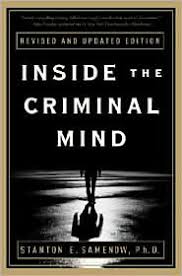
It was that kind of day until I got an email from Dr. Stanton Samenow, author of Inside the Criminal Mind and numerous other books, renowned psychologist, and my hero. He wrote:

"As a forensic psychologist, I was delighted to hear you say that there is no such thing as 'sexual addiction.' I have testified to this in civil (child custody) and criminal cases. This was a breath of fresh air."

Thank God. Someone with sense. Someone who doesn't buy into excuses for poor and illegal behavior. Dr. Samenow, like myself, believes in free will and individual choice.

But aren't we also affected by our upbringing? Of course we are. But if we blame our upbringing for everything we do, we might as well abolish the penal system and simply offer therapy. It's not that you can't keep it in your pants or that your pants are approaching little girls and unwilling women; no, it's that you are a sex addict. Yes, let's roll out the latest excuse for committing heinous crimes: sex addiction!

Who knew that wanting lots of sex meant one has to rape and murder to get enough? I guess since paying for it is breaking the law, one wouldn't want to do that; rape is the only answer. I have some "addictions" myself. I have a thing for Diet Pepsi, but I can't remember having shoplifted the sodas from convenience stores in recent months.

Manuel Garrido, father of Phillip Garrido (pictured left), the vile creature who kidnapped then 11-year-old Jaycee Lee Dugard and imprisoned her for eighteen years in his backyard, says this of his son:
"He was a sex addict, that was his problem. I believe my son killed the prostitutes."

Dad is referring to prostitutes who oddly disappeared near one of the locations Phillip Garrido worked. Dad thinks his son liked having sex with prostitutes. Dad also says he thinks Phillip and his wife, Nancy (pictured in court below),
chose to kidnap a girl to "give them babies after discovering they could not have children together."


Clearly, since Jaycee Dugard had children by Garrido when she was 14 and 17, she was raped. But was this so that Garrido could have children or sex-on-demand? He liked the idea of sex slaves, so I'm guessing the sex angle is more believable than the need to procreate. Garrido raped little girls and had sex with prostitutes. How does this logically connect to some supposed label like sex addict?

First, let's look at the definition for this supposed "disease" or "syndrome" from Medicinenet.com:

"The term 'sexual addiction' is used to describe the behavior of a person who has an unusually intense sex drive or an obsession with sex. Sex, and the thought of sex, tend to dominate the sex addict's thinking, making it difficult to work or engage in healthy personal relationships. Sex addicts engage in distorted thinking, often rationalizing and justifying their behavior and blaming others for their behavior. They generally deny they have a problem and make excuses for their actions.

"Sexual addiction also is associated with risk-taking. A person with a sex addiction engages in various forms of sexual activity, despite the potential for negative and/or dangerous consequences. In addition to damaging the addict's relationships and interfering with his or her work and social life, a sexual addiction also puts the person at risk for emotional and physical injury. For some people, the sex addiction progresses to involve illegal activities, such as exhibitionism (exposing oneself in public), making obscene phone calls, or molestation. However, it should be noted that sex addicts do not necessarily become sex offenders."

Behaviors associated with sexual addiction include:
Compulsive
masturbation
Multiple extra-marital affairs
Multiple or anonymous sexual partners and/or one-night stands
Consistent use of pornography
Unsafe sex
Phone or computer sex (cyber sex)
Prostitution or use of prostitutes
Exhibitionism
Obsessive dating through personal ads
Voyeurism (watching others) and/or stalking
Sexual harassment
Molestation/
rape

Phillip Hodson, fellow of the British Association for Counseling and Psychotherapy, thinks the concept of sexual addiction is rot. He calls supposed sex addition a behavior better described as obsessive, compulsive or greedy. He further comments that successful men - say, someone like Roman Polanski (little girls), Michael Jackson (little boys), or Michael Douglas (young beautiful women he hoped his wife didn't find out about) - because "some very successful men have a habit of thinking they can get away with anything, especially behavior they view as exciting," he says.

Michael Douglas' first wife divorced him because he was a womanizer. She must have been right because he was likely already bedding Catherine Zeta-Jones, an actress young enough to be his daughter (young thing pictured left with old thing). Apparently sexual addiction for Douglas is so target-specific, he never hit on women his own age.

But Douglas was merely a cad. He wasn't breaking a law, and he wasn't using the label "sex addict" as anything more than a way to excuse his greed for hot women and bad behavior.

Phillip Garrido's defense lawyer will likely try to toss this label into court. Ryan Jenkins, the millionaire reality-TV star who stuck his murdered wife in a suitcase, had already used "sex addiction" to avoid a jail sentence -- for beating up another woman before beating up Jasmine Fiori, his wife.
Apparently, he suffered from alleged sex addiction just as much as his victim suffered from its result. When girls wouldn't give it up, he got ticked off.

Using this logic, all crimes would fall under the same category: "entitlement," as in "I should get what I want or else."

Jenkins had no trouble getting sex, but because he couldn't get it from everyone he wanted whenever he wanted, he thought he was deprived. What a greedy little bastard! He had zero empathy for the women; apparently, their needs and desires didn't matter. Jenkins was found hanging in a hotel room in British Columbia in August, choosing suicide over life in prison. I guess he wouldn't be able to feed his kind of sex addiction behind bars, poor baby.

Phillip Garrido could get sex. He could get a lot of sex from prostitutes if he weren't such a cheap schmuck. What does killing these women have to do with getting sex, unless you don't want to pay or you like murdering women? He also could get sex from his wife, who clearly made a fine doormat. But that wasn't good enough for him. So what was his real problem? He gave us a clue when he told one of his rape victims that the Romans were lucky to have sex slaves.

Garrido wanted a sex slave. Not because he can't control himself, but because he likes control over others. Sex is not the problem.
Mr. Hudson puts it correctly when he talks about the adrenaline rush being the real issue. Sex provides an adrenaline rush. So does sex with women 20 years younger than you, sex with your next-door neighbor's wife, raping little girls. Ditto for knocking over a convenience store, robbing people, and killing the innocent. Even that chocolate I love causes an adrenaline spike.

Everything we like to do and feels good to us comes with an adrenaline boost. But the difference between Garrido's adrenaline rush and mine is legality. This is why we make laws. It's true that the adrenaline rush I get whenever I chomp down a Toblerone dark chocolate bar could encourage me to eat my way into diabetes and heart failure, hurting myself, hurting others. But this self-destructive behavior is not illegal. I overeat, cause myself pain, cause others pain, they run away, and I pay the price.

Garrido has broken the law, and no phony addiction label should be used to house him in a mental facility until he gets his supposed addiction under control.

Sexual addiction seems to be the rage for explaining away kidnapping, rape, and murder. Even if one decides to follow a path that might lead to destructive behavior (excessive masturbation, sex with strangers, sadism, etc.), the choice to step over the legal line and force violent perversions on others is not a psychiatric matter. It's a legal one. Let's keep it that way.


Friday, September 4, 2009

The Addict, The Enabler, and Us

by Diane Dimond

As Michael Jackson is finally laid to rest, you may ask: Who is to blame when a drug addict dies?

We now know the L.A. County Coroner considers Jackson's death a homicide caused by acute Propofol intoxication and the effects of five other powerful prescription drugs found in his system.

If the L.A. District Attorney chooses to charge Michael Jackson's personal doctor, Conrad Murray, it could very well be for manslaughter. Realistically speaking it was more like assisted suicide.

Michael Jackson had flooded his body with drugs for years. He went into drug rehab in 1993, he was often very obviously over-mediated during his 2005 child sex abuse trial, and during the run-up to his massive comeback concert tour this year we've now learned he was engaged in an orgy of drugs and self destructive behavior.

So, doesn't Michael Jackson bear some of the responsibility for his own death?

Before you answer let me tell you about a sworn affidavit, attached to a now unsealed search warrant, which outlines excruciating details about Michael Jackson's tragic final days. In the last hours of his life he was injected by his doctor or given oral doses of no fewer than four heavy-duty drugs. The last medication was Propofol, a drug used as surgical anesthesia. There are indications that when the doctor was not in the room Jackson may have sneaked even more medications in his continuing quest to end his insomnia. It's typical addict behavior.

At Jackson's bedside when he died there was a cornucopia of prescription pills, ordered up by several different doctors using fictitious patient names. It is a federal offense to prescribe pharmaceuticals under an alias. But there they were: Bottles of Valium, Tamsulosin, Lorazepam, Temazepam, Clonazepam, Trazodone and Tizanidine. Drugs used as hypnotic sedatives, to reduce pain, anxiety and muscle tension. Some treated sleeplessness. Others have a relatively high addictive potential and some are frequently sold and abused as street drugs. Finally, there was one prescription to treat an enlarged prostate, a nod to Jackson's over-50 status.

In other words, one glance at that nightstand, and a red flag should have gone up to any trained doctor that this was not a person for whom one should prescribe more drugs. But according to that sworn affidavit several doctors did – a cardiologist, a dermatologist and a general practitioner among them. Others known to have prescribed to Jackson in the recent past include at least two anesthesiologists, a plastic surgeon, a dentist and other general practitioners. Jackson had obviously been doctor shopping – but the doctors were celebrity shopping, no doubt.

Don't the doctors bear some responsibility for Jackson’s death? And what responsibility do the die-hard Michael Jackson fans bear for their blind worship? His drug addiction was no secret, yet the throngs of his followers continued to be dazzled by his stardom. Their continuing admiration sent a signal to both Jackson and his doctors that celebrity trumps all the normal rules. The status quo was working and there was no reason for the superstar to change his ways, no pressure from the entourage, because those who tried to warn Jackson to take care of his health were banished. As Jackson continued to demand more medications there were more people brought in to his long, slow suicidal process. Actually, it's a wonder he lived as long as he did.

Michael Jackson suffered from a lot of obvious maladies, many self inflicted. Not only was he abusing massive amounts of drugs, he suffered from anorexia and a body dysmorphic disorder that compelled him to repeatedly hire doctors to change his face. He had children who didn't know their mothers, he shut out much of his family lest they tell him how to live his life, and he seemed a reclusive, nomadic hermit who was never quite able to shake the taint of his child molestation trial acquittal.

Yet there were legions of fans who sent him the message that he was still the King of Pop! And there were countless doctors standing by to prescribe what he needed to get through his days.

Even in death there is blind adoration. A politician in New York is pushing to get a Brooklyn subway station – the venue for one of Jackson’s music videos – named after him. A U.S. Congresswoman pushed for an official House of Representatives commendation for the entertainer. There has been a movement to get a Michael Jackson postage stamp. What's wrong with this picture?

The truth is record numbers of Americans – tens of millions of them – are using and abusing prescription drugs. They are sick people in need of help, either for their underlying illness or for their addiction to these drugs. While I've always advocated personal responsibility, I've come to realize the responsibility must radiate outward too.

Everyone who's ever enabled a drug addict shares in the responsibility.


Thursday, September 3, 2009

Murder in Oklahoma

by Cathy Scott

With this week's release of my latest book,
The Rough Guide to True Crime, it seems only appropriate to present on Women in Crime Ink an excerpt about Bertha Pippin, an elderly woman who was murdered by neighborhood teenagers for no apparent motive.

I know Bertha's son,
Jerry Pippin, a veteran radio broadcaster who has had me on his show several times. The story of his mother's murder was barely touched on by local media, then forgotten. So I decided to give Bertha a voice and include her story in my homicide chapter in The Rough Guide to True Crime. Here it is, in part.

BERTHA LEE PIPPIN

On a rainy day in November 2000, Bertha Pippin, 85, was fatally beaten with a baseball bat inside the Muskogee, Oklahoma, home where she lived alone. Frail Bertha was utterly incapable of defending herself against her teenage attackers, one of whom was a local girl, Amanda K. Lane. Bertha paid an appalling price for taking an interest in the welfare of this troubled teen.

Bertha was a mother and grandmother. Bertha talked about Amanda and how she regularly called her the “old lady.” Despite that, Bertha expressed high hopes that by being kind to the teen, she could reform her. Bertha empathized with Amanda, because Bertha too had gone through a lot when she was young. She understood.

Her mother had died giving birth to Bertha. Her sharecropper father told her she wasn’t wanted. He shipped her off to her grandparents, simple farmers who had little money.

A few years later, Bertha went to live with an uncle she had never met. She attended a small protestant church and met her future husband, the son of a Baptist preacher. They married and had four children. They lived a quiet life while her husband made a meager living.

Bertha felt Amanda deserved a chance, but she didn’t like the boys Amanda hung out with. She thought they were a bad influence, especially after Bertha learned they abused a pit bull that lived across the street. But Bertha insisted her son Jerry not report the abuse to authorities. Bertha was afraid the boys would find out and retaliate against her. She had a good sense about people, and it turned out her feeling about the boys was right.

Bertha was comfortable living alone; only a narrow alleyway separated her from her daughter Beverly Robertson’s home. Bertha was involved in her neighborhood. Between 9 and 10 p.m. on Nov. 3, Amanda and two of her friends – Gary Rightsell and Travis Phillips – carried a baseball bat to Bertha’s house. Amanda knocked on the door, telling Bertha she was locked out of her house and needed to use a phone.

While Amanda pretended to call someone on the phone, Bertha went into the kitchen to get a glass of water for one of the boys. As Bertha walked back to her living room, Gary hit her over the head with the bat. Bertha reeled and landed on the sofa. They asked her for money. She told them to hang on because her head hurt, that she would get the money for them and she wouldn’t tell anyone. That’s when Gary began hitting her repeatedly.

Then the other teen took the bat and continued. Amanda later testified that she was ordered to hit Bertha too. Otherwise, the boys might kill Amanda’s three-year-old daughter. So Amanda too took her turn. Bertha’s body was discovered after Beverly sounded the alarm and called her husband and brother. There was blood everywhere. In Bertha’s wallet, untouched, was $300 in cash.

One of the teens, Gary Rightsell, who weighed 200 pounds, admitted to helping kill Bertha using a baseball bat they had gotten from a friend’s house. He pleaded guilty in Muskogee District Court to two counts of accessory after the fact. Rightsell cooperated with prosecutors as part of a plea bargain, and he helped in the arrest of Amanda Lane. She was convicted of first-degree murder and robbery by force or fear. She is incarcerated at the
Mabel Bassett Correctional Center in McLoud, Oklahoma, where is she serving out her life sentence.

Two months later, Judge James E. Edmondson sentenced Rightsell to 30 years in prison on both counts, 10 of which were suspended. Rightsell could have gotten 45 years of hard time in a maximum-security prison instead. He is serving time at the Howard McLeod Correctional Center in Atoka, Oklahoma.

According to the prison’s website, Rightsell is eligible for parole and scheduled to appear before the prison board in March 2009. If he's not paroled, his release date is June 2016.

Travis Phillips, owner of the baseball bat used to bludgeon Bertha, received a year’s probation after pleading guilty to a charge of obstructing a police officer in the investigation. He has been in and out of jail and prison ever since, mostly for substance abuse charges, according to the Department of Corrections in Okalahoma. Today, Travis is a free man.

A subpoena to testify was about to be served on the fourth suspect, Randy Hughart, when he was killed in 2001 during a street fight with a drug dealer. Hughart died from blunt trauma to his head, the same fate suffered by Bertha Pippin.


Wednesday, September 2, 2009

Life in Prison

By Katherine Scardino

I stood next to a man today who was about to start a journey - not a pleasant one, but a very, very long one. He was sentenced to life in a Texas prison for murdering a man during a store robbery.

He was originally charged with capital murder. But after defense attorneys and other experts investigated his personal history and the facts of the case, and after he agreed to stipulate that this crime was committed with his co-defendant, prosecutors agreed to a plea bargain. They reduced the charge from capital murder to murder. This means that some time in the far, far distant future, the convict may be eligible for parole. Had he received a life sentence on a capital murder charge, he would never, I repeat - never - be eligible for parole. There would never be a time in his life when he could walk up to the parole board and ask to be released. Every day for the rest of his life, he would be stuck behind bars.

Instead, this defendant will spend at least 30 years in prison. He is now 20 years old. Add 30 years to his current age, and he will be 50 before he is even eligible for parole - and I say “eligible” because there is no assurance that he will ever make parole.

Some citizens of our country retch at the sound of the word parole. They can't stand the idea that someone could commit such a despicable crime and even think of a time when he might walk around a free man. Today, I stood next to my client and listened while the sobbing wife of the victim told the courtroom what a good man her husband was. She said he was a fine, responsible husband and father, a hard worker, a considerate and sensitive man. She told my client that if he had just asked her husband for money, he would have given it to him. My client hung his head and cried. He told the widow how sorry he was: Sorry he ignored his common sense; sorry he was at the store in the first place; sorry, way too late, that he couldn't give his life for her husband's. There was not a dry eye in the courtroom. It was impossible not to be touched by such an open display of emotion between the two people forever affected and connected by the events of about 10 minutes one night in the hot summer month of June.

No one can bring the store owner back to life. His wife and his children will live the rest of their lives remembering that night and this day. They will never forget the day their father's killer was sentenced to life for the lesser offense of murder. One day, as a much, much older person, this killer may walk free.

But what is the right thing to do with a 20-year-old offender? He is far from being a man. He was stupid, and his stupidity created a hole in the lives of many people.

What can we do to change this society we have created? In this society, boys and girls, like my 20-year old client, are on the streets at all hours of the night. Boys can get their hands on guns of all sizes and calibers. Boys drive looking for enemies to attack. Boys think nothing of robbing a store to get what they want.

Why in the world can't we fix this? Why don't our leaders see that we have a broken society that can't be overlooked much longer? We are becoming a generation of mean, evil people with no regard for human life.

It is not this boy's fault. I defy you to say it is. The root cause is not this 20-year-old’s fault. We, as adults, as parents, as teachers, as lawyers, mayors, judges, all have a role in these young lives and we, I repeat WE, are responsible. We did not physically and actually place a gun in this boy's hands, but WE are responsible for the lifestyle, the lack of education, the lack of teaching that creates a mind that says it is OK to steal in order to get what he wants. And, as a result of all this laxity in our society, we have a situation that happened in 10 minutes one hot night last June - a situation that will be forever remembered by this wife and her small children.


Tuesday, September 1, 2009

Love Turned Toxic

by Women in Crime Ink

Announcing today’s release of Women In Crime Ink author Diane Fanning’s ninth true crime book, A POISONED PASSION: The True Story of a Young Mother, Her War Hero Husband and the Marriage that Ended in Murder, from St. Martin’s Press.

Michael Severance was a 24-year-old native of Maine, stationed in
Abilene, Texas, where he served in the Air Force as a C-130 crew chief. He survived five tours of duty in the Middle East and then he married Wendi Davidson.

Wendi, a native of
San Angelo, Texas, was a graduate of the College of Veterinary Medicine at Texas A&M, setting up a new practice in her hometown.

Wendi and Michael exchanged vows the same month that their son was born. But till death do us part had a very short shelf life. In less than five months, Michael was missing under very suspicious circumstances. It took nearly two months to find his body in pond in the middle of an isolated ranch.

A POISONED PASSION goes beyond the crime itself, exploring the people and events that transformed an excellent student raised in a rural environment into an inmate serving twenty-five years in a Texas prison for the murder of her husband.

Did Wendi’s controlling mother, who despised her new son-in-law, influence the tragic events? Did the location of the area have an impact on Wendi’s actions? And how did her profession create the groundwork for murder?

In her review, domestic violence expert, Susan Murphy-Milano wrote: "In my 20-plus years working with crimes of passion, I am always interested in the mind of the person behind the crime. For me, it is a learning tool to save lives. Very few writers have the insight and gift to take a true story and make it one hell of a page turner. In my opinion, Diane Fanning does just that in A POISONED PASSION."

Fanning followed the investigation from its beginnings as a deserter investigation by Air Force personnel to its evolution into a full scale murder investigation by several law enforcement agencies including the Texas Rangers. The story culminates with Wendi’s collapse in the courtroom and an ugly child custody battle where local sensibilities appeared to have a greater influence on the outcome than the best interests of a child.

While Fanning was writing the book, Wendi’s father, Lloyd Davidson urged the author: “Do your best to sift lies from the truth.” Fanning worked to honor that request, looking at every facet of the story from the forensics of the case to the lives of all those impacted by this senseless crime.

The two people who stirred her heart the most were the two youngest harmed by the murder—Tristan Davidson and Shane Severance. Tristan, Wendi’s oldest son, had never had a father in his life until Michael Severance walked into his life. Tristan was only three years old when he lost Michael to death and his mother first went to jail on charges related to Michael’s murder. Shane, Michael and Wendi’s son, was only five months old when his life was turned upside down.

No matter the forces that conspired to create this situation, the end result is the same. Michael Severance, a young man who served his country well and grabbed life with both hands is dead. A family in Maine staggers under the loss. Tristan, a sweet little boy, lost the only father he had ever known and now has to grow up without a mother. And Shane, the most innocent victim of them all, will never clutch his father’s hand in his own, will never hear his words of encouragement and praise, and will never grow and mature in the light of his guidance. Instead, he is spending much of his life in the home of people who despise his father and make excuses for his father’s killer.

That, by any measure, is not justice.