Friday, April 11, 2008

Mystery Man - Peter Van Sant (1 of 2 parts)

by Peter Van Sant
CBS Correspondent
and Author

This is a murder case that, from the beginning, just didn't seem to add up. The background here is very important to gain perspective on this investigation.

Amanda Knox is the classic all-American girl. She was a straight-A student at Seattle Prep, one of the top Jesuit high schools in the country. She plays guitar and has a wonderful singing voice, starring in a production of "Annie." A tall brunette, Amanda's beauty turns heads wherever she goes. Her smile radiates.

Her biological parents divorced when Amanda (pictured right) was very young, but the family remained close. Mom is a math teacher. Dad is in management at a major department store. Her step father is in finance. All are good people.

Amanda went on to attend the University of Washington in Seattle, where she discovered her true passion in life, languages. She speaks fluent German (her grandparents on her mother's side are from Germany), Italian and some Japanese and Russian. Her friends descri
be her as friendly, helpful, someone who is concerned about others. Doesn't sound like the profile of a killer, does it? I admit I'm teasing you here, but please read on.

While studying in Seattle, Amanda learned about a school in
Perugia, Italy, called the University for Foreigners. Perugia is a beautiful medieval town about a two-hour drive north of Rome. The university offers students from around the world an opportunity to study in Italy. For Amanda, who was always interested in learning about different languages and cultures, it seemed the perfect place to go.

So while attending the University of Washington, Amanda worked three part-time jobs on the side. Eventually, she saved up more than $7,000. She was accepted into the University for Foreigners, and late la
st summer, she arrived in Perugia to begin a year of study abroad.

Six weeks later, Amanda was in prison--a suspect in the murder of her roommate, Meredith Kercher of greater London, England.


Meredith (pictured left) was a lot like Amanda. She attended Leeds University in the U.K. and dreamed of studying abroad. She got her chance last year and moved to Italy, where she attended a different school from Amanda's, the University of Perugia. Meredith needed a place to stay, and she eventually found a house she could rent with two Italian students and a young woman from Seattle, Amanda Knox.

On the night of November 1, 2007, Meredith was last seen walking home after having dinner with friends. Amanda wasn't home. She was spending the night at her boyfriend's house.

The next morning, Amanda claims she went home to shower and change her clothes. She was upset that someone had left the front door open. After her shower, when she came out of the bathroom, Amanda says she noticed some blood on the floor. She tried calling her roommates, but no one answered their cell phones. Meredith's bedroom door was locked.

Amanda called her Italian boyfriend, Raffaele Sollecito, who walked over to the house. Just then, police arrived. Meredith's two cell phones had been found in someone's yard. Police had come over to the house to return them.

Amanda told the police of her concerns. They broke open Meredith's door and discovered her body lying on the floor, covered with her bedspread. There was blood everywhere, including bloody finger stains on a wall.

Meredith's throat had been slashed. Authorities believe she may have taken nearly two hours to die. In the room were some tantalizing clues, a bloody fingerprint and a shoe imprint left in Meredith's blood on the floor.
. . .

To be continued. Check back here Saturday to read the rest. And don't forget to watch the story at 10:00 p.m. EDT tomorrow on 48 Hours.


Simple Words - Beyond a Reasonable Doubt

by Katherine Scardino

Cpl. Cesar Laurean has been captured after a massive manhunt for the suspected killer of his girlfriend, fellow Marine Cpl. Maria Lauterbach. Cpl. Lauterbach died a horrendous death, which arouses the sensibilities of any reasonable person. It screams for revenge and justice.

Justice - that’s a magic word in the United States that is used freely and frequently. Do we really know what it means? To the ordinary citizen, justice probably means something like "the guilty get put in prison." But, let’s all - especially the news media - not forget one thing. The evidence used in a trial against an accused person must rise to the highest level of proof - beyond a reasonable doubt.

That is not "beyond a shadow of a doubt" as you may hear so often on television crime shows, or "probably committed" the crime. There are several levels or standards of proof for evidence in various types of cases. For instance, if a State agency is attempting to terminate a citizen’s parental rights - meaning that individual would no longer be considered, for any purposes, as the biological parent of his/her child, the standard of proof that must be met by the petitioner, the State agency, is "clear and convincing" evidence. That is still below the standard of "beyond a reasonable doubt."

Our forefathers set up this system of criminal justice for a specific reason. Remember - they were recently in America from England, where their homes were invaded, property taken, without probable cause. It just happened - and it happened to innocent people as well as guilty people. Our forefathers - like George Washington, Thomas Jefferson, John Adams - believed they could devise a system of government that would assure these new Americans that these violations would not happen in this new independent nation. We are the recipients of this wonderful criminal justice system that says a person is innocent until proven guilty - and the evidence to prove guilt must rise to the highest standard of proof - beyond a reasonable doubt.

So, when we are reading these news articles about this horrendous crime, let’s all not forget that we must give Cpl. Laurean the benefit of the doubt as to his guilt until the evidence presents itself - but it cannot be - should not be - evidence that allows for any "reasonable doubt" as to his guilt.

There are news reports about certain people being convicted, spending years in prison, and later exonerated by some piece of evidence, whether it be DNA or some other physical evidence. We know these miscarriages of justice happen, and one way to avoid a wrongful conviction is to be careful in how we look at the evidence and how we present the evidence.

I, for one, will consider Cpl. Lauren innocent until all the evidence has been presented to a jury of twelve people. That’s his right - and more importantly - it is YOUR right. Let’s cherish it. It is not a good system unless we make it so.


Thursday, April 10, 2008

Death and Taxes

by Vanessa Leggett

It's that time of year. Taxes are on everyone's mind. More removed from our thoughts, perhaps, is life's other inescapable event: Death. Eleven years ago today, in Houston, Texas, murder-for-hire target Doris Angleton (pictured left with a friend) sat at a computer normally used by her 12-year-old twin daughters. Manicured hands on the keyboard, Doris typed this message to a childhood friend a week before she died:

Thanks for the Happy Birthday. Friday nite is supposed to be a surprise thang. . . . I think its dinner at Ruggles. Anyway, its birthday week, month, I’ll take it!

We need to get together and have lunch or drinks or something. You know??? I am trying to spend some time with the girls the next two weekends cuz I will be gone the next one, and I am glad to be gone, but not away from them. Anyway………life goes on and progress is slow but sure. Tomorrow I go to a Tax attorney. I need some advice, professional type, you can imagine.
Talk to you sooooooooooon.

love,
Doris

Doris did not need to consult a tax lawyer because returns were due in five days. It was a court setting she had in mind. Two months earlier, she had filed for divorce. The man she intended to leave that spring was mega-successful bookmaker Bob Angleton (pictured right with their twins, age two). Though living on the edge had been exciting in the early years of the marriage, now that their daughters were older, Doris had grown disenchanted with the lifestyle.

The Angletons had been married for fifteen years. Each year, they paid taxes. A small percentage of them, anyway. In only the past three years of his marriage, Bob's business had grossed $64 million, of which he'd reported $2.6 million. That degree of underreporting for fifteen years could put someone in the federal penitentiary for a very long time.

Bob never served time for bookmaking. Cops looked the other way because he was a confidential informant. Doris was aware of her husband's arrangement with police. She knew all about the business. Doris also understood that because the couple filed jointly, she was just as liable for unpaid taxes as the breadwinner. Problem was, if Doris revealed their underreporting, her husband would be charged with tax evasion. Doris could be a witness against him. She was leaving, which meant she could not refuse to testify against him by citing a spousal privilege. Given these facts, it doesn't take a calculator to do the math.

On April 10, 1997, Doris met with a tax attorney at eleven in the morning. The first attempt on her life was around 8:30 that night. She would have another week to live.

If her execution would have been successful that first time, she would not have lived to see her forty-sixth birthday the next day. That morning, she sent this e-mail message to the same girlfriend, a teacher:

I am “crestfallen” at the thought of my youth slipping away. (well, i know it ain’t the greatest sentence, teach, but its early and I’m old!) How ’bout: I looked in the mirror this am and my crestfallen. (lol)

Sat. looks free, and we can toodle down to the beach house, sans men…. get together at my house in Houston----have margaritas around the corner first we can walk from here--LOL-----order pizza, but the beach house would be completely kid free****** husband free***** and carefree******

. . . Thanks for the Happy B-day!!!!

love
Doris (46th version)

She celebrated her birthday with her husband and their close friends at Ruggles, the restaurant where she and Bob had spent their first date. Doris and Bob sat at opposite ends of the banquet-size table. (Doris is pictured above with friend Tex Welsh that night at Ruggles.)

Doris had always possessed a joie de vivre. When she laughed, which was often, she would toss back her head, flash her "million-dollar smile," as friend Missy Welsh described it, and laugh with abandon. "She smiled with her eyes," remembered another friend. But the last week of her life, it seemed, the light had dimmed from her eyes. "She was getting scared of what was to come," said a lifelong friend. "Not necessarily that he was going to harm or kill her. Just this big, scary unknown."

While her eyes might have betrayed her unhappiness, Doris considered herself lucky in many respects, even that night. "Bob threw her a very nice party," one of her friends recalled. "She felt like it was their last time in public as a couple and she was grateful for how gracious he appeared about doing it, about being there, and having this party and having their friends there. She did say she tried to thank him with her eyes but he wouldn’t look at her."

Doris might not have been able to catch her husband's eye, but she had the attention of everyone else wherever she went. Though she joked that her "crest" had fallen, Doris Angleton, who modeled several times a year, had the body of a woman twenty years younger.

And Doris was as healthy as she was fit. She especially appreciated her health those last few days. Missy Welsh, Tex's wife, and a good friend, was ill. A few days after the party, Doris spent the day with Missy at a Houston hospital, where she was recovering from serious surgery. "She was still on Demerol," Doris wrote to her mother. "I don't envy her next few days."

Doris did not have a few days. When she sent that e-mail, she did not have twelve hours to live. Even if Doris had known she was at the end of her life, no doubt she would have spent that day at the hospital with her friend. That Doris had come from her first spinning class--that she was able to exercise while her friend was hospitalized--probably made Doris feel guilty. (Missy also died an early death, but not before Doris.)

On April 15, taxes were filed as expected. April 16, Doris was murdered, shot 12 times in the head and chest. Though she died, she lives on in the memories of those who loved her. Everyone who ever met her remembers her smile.

Bob Angleton was charged twice for ordering his wife's murder. He was acquitted in the first trial, and he fled the country days before the second. But taxes he could not escape. In 2005, Angleton was finally convicted. He is now serving his sentence for tax evasion on "Terminal Island," a federal penitentiary.

Aside from death and taxes, life has no guarantees. We keep our standing date with the IRS year after year. But moment by precious moment, we should enjoy our daily date with life. Don't wait to go to lunch with a good friend. Have a margarita. Order pizza. Live. Laugh. Love.

Doris died before she could meet her childhood friends for their special retreat. She was not able to spend both weekends she had planned with her daughters.

"I am trying to spend some time with the girls the next two weekends," she typed to a friend five days before her death, "cuz I will be gone the next one. . . ."


WCI Contributor R. Stephanie Good Honored Today

A Woman's Point of View

Every now and then, we share with readers views of contributors when they're not tethered to their computers. Women in Crime Ink's R. Stephanie Good (pictured left) has quite a view today. The attorney and New York Times best-selling author is a 2008 CAPS (Child Abuse Prevention Services) Community Leadership Award Honoree at the Spring Luncheon. CAPS is recognizing Stephanie today in New York for her work with the FBI in identifying and assisting in the prosecution of Internet sex predators who prey on children. Stephanie shares this honor with Abigail Disney, President/Founder of the Daphne Foundation. Congratulations, Stephanie. Enjoy the view.


Mystery Man - Clue Box

Our special guest contributor will be making an early appearance this week, on Friday. WCI's next Mystery Man is a veteran journalist who has covered stories around the world – from Twin Falls to Dallas to Germany to Africa to Afghanistan. But he started in a tiny town outside of Seattle, where he made money working at the shipyards as a teenager. We don’t have room for his list of awards – but they include several Emmy and duPont awards, among the most prestigious in the industry. During the last 20 years, he has covered every kind of story out there – from why helicopters crash to how lions could cure AIDS; from the collapse of the Soviet Union to the reunification of Germany. And don’t forget the murders, hurricanes, and scores of celebrities. He recently won another Emmy for his work on a documentary detailing the inside, horrific account of terrorists who took over and destroyed a school in Beslan, Russia. The documentary aired on Showtime. After years of reporting, he has now added Author to his résumé – writing a book of one of his most bizarre stories. He has six kids, two who are following after their father’s footsteps. And one more clue – he has a national television story airing on his blog topic on Saturday night. We’re thrilled he’ll be blogging for us as our MYSTERY MAN with a special-edition, two-part series (this story was too juicy for just one day). So check back here for Part 1 tomorrow. Then watch the show after reading Part 2 here on Saturday. We'll provide program details when we unmask our Mystery Man on Friday.


Wednesday, April 9, 2008

The CSI Effect

by Jenna Jackson

Some of the most popular shows on television right now—CSI, Law and Order, Criminal Mindsare having a real effect on courtrooms across the country. When I started at CBS News 10 years ago, most of the people I would call for a story had no idea how DNA testing actually worked—they had no clue it was blood spatter, not splatter.

These days, people are far more savvy. Nearly every day, I'm asked a question that throws me—what kind of DNA typing was done at a scene, whether a person was polygraphed and by which expert. People know to ask detailed questions about criminal cases—and they learn most of what they know from watching TV dramas.

But most of the time, I have to explain that although CSI portrays a criminal investigation one way (DNA takes minutes, instead of months), real life is a lot slower and more complicated.

I think juries have become much more savvy, too—and they expect a lot more. This can be good and bad. It has certainly made trials more interesting to watch. Lawyers on both sides of the courtroom are forced to ratchet up the drama when presenting their cases—juries watch enough of these shows that they expect a show in the courtroom.

They also often want real, physical evidence to connect a defendant to a crime in order to convict. This is making things a little tougher on prosecutors, who for years have had the clear advantage from the opening of a trial.

Juries seem to expect a case where all the loose ends are tied up—but most real-life cases aren't delivered to a prosecutor in a neat little package. This is especially true in cold cases where evidence at the scene may have been scarce or not properly collected—and where witnesses have disappeared or died.

I recently covered a case in Houston where there was absolutely no physical evidence connecting the defendant to the murder scene. These types of cases are difficult for all sides—and tend to leave unanswered questions even after a verdict is returned.

But there is a case right now—half a world away in Perugia, Italy—where physical evidence was collected at the scene of a brutal murder. A suspect was arrested within days—but the physical evidence doesn't necessarily match the suspect in this case. She just matches the police theory of the crime, which can sometimes be an entirely different thing than concrete evidence. Amanda Knox (pictured above), a Seattle college student living in Perugia to attend college, definitely gave police reason to be suspicious. But as every good detective knows, people can act suspicious for a number of reasons.

48 Hours is airing a one-hour show on this case Saturday at 9 p.m. CDT. It centers around two beautiful college students—one, a victim of a vicious murder, and the other, a possible victim of an overzealous police force. I didn't have anything to do with producing this particular case, but it is so intriguing because of the issues it raises: how an American is treated as the target of a criminal investigation in a foreign country; how police can sometimes get tunnel vision and focus on one suspect to the exclusion of other possibilities; and how scenarios are created that make false confessions possible and almost probable.

Because there were so many questions in this case, 48 Hours hired a private eye to conduct his own investigation. He came up with a stunning theory of his own: Amanda Knox was being railroaded by the Italian authorities.

This case is one of those that makes you realize you can't always trust how a story looks in the beginning—once everything unfolds, it can turn into an entirely different tale. Even after nearly a decade with this show, I learn that lesson every single day.

Be sure to check out this week's Mystery Man for more details—he has a unique, behind-the-scenes vantage point of this particular case.


Tuesday, April 8, 2008

Reporters' Most Sickening Habit

Hunt for Justice by Cynthia Hunt

We’ve all seen it dozens of times.

The reporter runs up to the murder victim’s mother and says, “How do you feel?”

At that point, we all cringe in reflexive disgust . . . even vomit in our mouths just a bit.

One Good Reason to Hate the Media

More than any other question friends, viewers, and people I have just met will angrily ask me about this reporter’s habit is “Why do reporters ask that question? It’s none of their business. How do you think families feel—a loved one was just killed.”

It’s more than difficult to defend the lazy “how do you feel” wording that collectively sickens us all. But I will admit in the course of the hundreds of murders I have covered that I always try to be the first journalist to knock on the door of a victim’s family. Let me explain.

Pictured left: Cynthia Reports from the Murder Scene Where Three Children Were Shot to Death

The News Producer’s Rundown Always Reads “Victims’ Family Reax”

The first question newsroom managers ask after a murder is, “What does the victim’s family have to say?” Young reporters quickly learn the necessity of making the dreaded knock on the door of the victim’s family, or, even worse, the awkward phone call. I dislike calls the most because it’s excruciatingly difficult to express compassion over the phone. As reporters, we are entering this person’s life at their most painful moment. More often than not, we are greeted like the vultures that some of us are.

Why, then, do I rush to contact the family?

Giving Victim’s Families the Only Control I Can

I learned after my first few heart-wrenching encounters with the families of crime victims that the experience of the death of a loved one in a violent crime causes a complete loss of control in the lives of individual family members. I soon realized the only thing I can give the family is some control over my coverage.

Often, reporters convey less than accurate or even erroneous information regarding a given victim of violent crime. It’s no one’s fault. The investigators are focused on finding the killer, not verifying the little facts they try to tell headline-hungry reporters about the victim.

But all things matter to the family; which picture we use of the victim, how we describe his or her life, what we say about the family’s feelings. Of course, justice matters too. We journalists play a vital role in hunt for justice by telling the world what it needs to know to help police catch killers.

I never pressure the families for interviews or ask them how they feel. I simply let them know my cell phone number and that they are welcome to call it 24/7 if they wish to have any input into the coverage. It’s important to me that they understand that journalists can report only what they are told by trustworthy sources. I tell families that they have an open door to me and that I welcome their contribution to my coverage.

Pictured Left: Cynthia Tries to Comfort Mother of Three Murdered Girls

Frequently, my invitation leads to more factual, compelling stories that give the families some small sense of comfort. More powerful stories increase public awareness of the crime and how to prevent future tragedies. My experience is that what began as a very unwelcome intrusion often transforms into a beneficial relationship that may last years as I cover the case and its criminal prosecution. Additionally, in rare cases, as you have seen, journalists’ interviews with family members can sometimes reveal that the family member and killer are one in the same.

Mother of Three Murdered Daughters Leaves Impression

In the case of the sweet mother I was interviewing in the picture posted earlier in this story, I think for her the interview was cathartic. I interviewed Sheila Patterson only days after her three youngest daughters (pictured below) were slaughtered in their home by a gunman on a jealous rage.

Sheila’s two youngest daughters Britteny, 10, and Ashley, 11, were shot-to-death as they slept. The gunman then murdered Sheila’s fifteen-year-old daughter Nikesha right in front of her. Sheila believed Nikesha was trying to protect her mother when she was gunned down.

The killer, 35-year-old Anthony Francois, broke into the home and slaughtered the three sisters after the oldest Patterson girl, 16-year-old Shemeka, broke up with him. Francois shot Shemeka in the face but she survived to testify against him. A Harris County Texas jury convicted Francois and sentenced him to Texas Death Row where he remains today. During the victims’ impact statement, Sheila told Francois she forgave him because she worried that he couldn’t get to God with hate in his heart.

On the hunt for justice, may we never stop questioning and listening to victims’ families—mothers like Sheila Patterson who survive the worst this world has to offer—and still manage to restore our faith in the best man has to give.


Monday, April 7, 2008

Mystery Man - Still No Clue

We wish to apologize to our readers for not being able to reveal our Mystery Man as promised this past Saturday. Many of you may have been curious as to his identity after reading the clues we posted last week, here and here. But, alas, the reason we were unable to unmask last Saturday's guest contributor remains as much a mystery to us as it has been to our readers. We hope whatever has him down won't keep him down for long. But, really, what fun would a mystery be without a red herring every now and then? Now it's on to the next chapter. Our brand new Mystery Man will be making his appearance this Saturday. Who do we have lined up? Check back this week for clues. We will not disappoint!


Saturday, April 5, 2008

Stacy Dittrich on Internet radio

After the Ink Blotter chat today, tune in to The War on Crime's radio program between 5:00 and 6:00 p.m. EDT. WCI's Policewoman/Novelist Stacy Dittrich is a guest on this week's show. Listeners can call in during the live broadcast: 347/838-9781. Visitors can also participate in an interactive discussion board. Sunday is your day to sound off. Meet us here at the Ink Blotter at 4:00 p.m. EDT then click over to http://www.thewaroncrime.blogspot.com/ and listen to Stacy. Other guests include CNN's Nancy Grace, and Susan Murphy-Milano, author and advocate for battered women. Today the women are discussing cases including the murder of Amy Giordano; the disappearance and suspected killing of Stacy Peterson; the recent appellate court decision concerning the 1982 conviction of former Black Panther Mumia Abu-Jamal; and Women in Crime Ink. The War on Crime's Levi is hosting. They're taking calls now.


Mystery Man - The Suspense Continues . . .

When you feature a column called "Mystery Man," you expect something like this to happen. Our Mystery Man for this week wants to remain a mystery. . . . For now. That's him to the left. Now do you know who he is? . . . Didn't think so. Because that's not really our guy. (And it's not The Unknown Comic either, those who remember.) We're bagging the column for today. As soon as our Mystery Man shows his face, we'll post the column. And we might post more clues, so check back here. (If you missed prior clues, check here and here.) Thanks for your patience.


CSI: The Experience

Crime Scenes

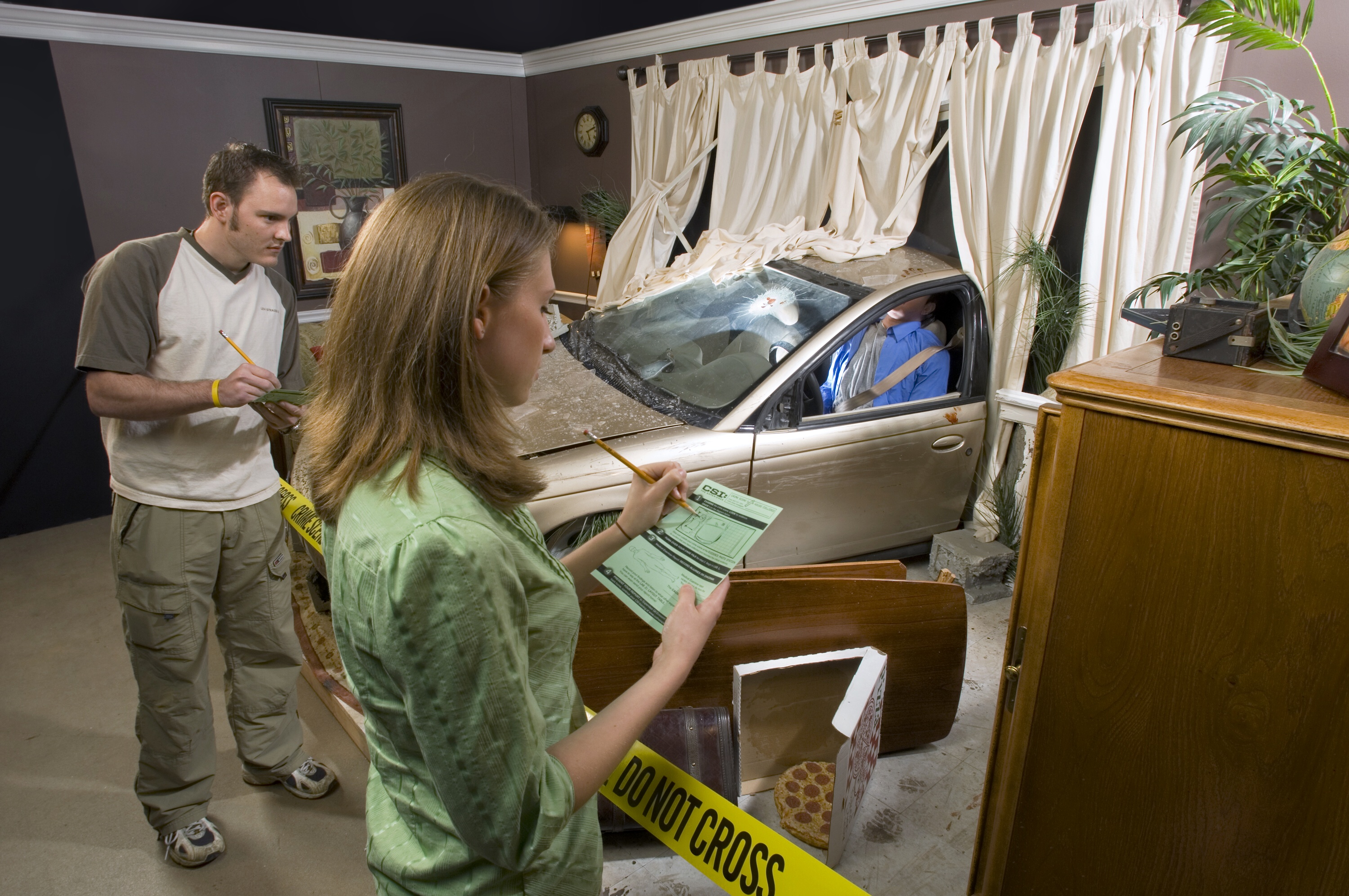
In Houston, Texas, April is the coolest month. Not really. If there's any month that fits that bill it would be closer to February, which is when one of the coolest exhibits touring the country opened in Houston. And April is the last month to check out CSI: The Experience at the city's Museum of Natural Science. If you happen to live in the Houston area, come out and solve a crime this weekend. If you're in other parts of the country, watch for this interactive exhibit in your area. From the museum Web site:

CSI: The Experience immerses guests in hands-on science while leading them through the challenge of solving a crime mystery. The interactive, multimedia exhibit brings to life fundamental scientific principles, numerous scientific disciplines, and the most advanced technology and techniques used today by crime scene investigators and forensic scientists. Through hands-on activities featuring real equipment and multimedia presentations, guests will sample the following science fields and understand the significance of each in cracking crimes.

CSI: The Experience was developed by the Fort Worth Museum of Science and History and Bob Weis Design Island Associates with support from CBS Consumer Products, the cast and crew of the television show, and the National Science Foundation. The traveling exhibit opened in Boston last year and it's already been in Chicago. Its next stop after Houston is in Columbus, Ohio. Through 2010, CSI: The Experience will exhibit in St. Paul, Minnesota; Los Angeles, California; Portland, Oregon; Fort Wort, Texas; and Philadelphia, Pennsylvania.

An overview from the Houston Web site:

Enter the Briefing Theater to watch a fast-paced introduction to CSI: The Experience on a giant flat-screen TV. Anthony E. Zuiker, creator of television’s CSI: Crime Scene Investigation, greets visitors. Then, real-life forensic scientist Ron Singer explains the scientific principles visitors will experience in the exhibit. Finally, CSI’s lead investigator, Gil Grissom (pictured right at the exhibit), steps in and introduces himself as your CSI supervisor and issues a challenge: “Keep an open mind,” he warns. “Remember, the dead can’t speak for themselves. Listen to what the evidence is saying.”

Begin an intriguing journey to solve a crime mystery by entering one of three very different crime scenes:

In “A House Collided,” a car has smashed through the living room window of a house in a quiet suburb. A man with his seatbelt on is in the driver’s seat, slumped over. The windshield is shattered and the car door is shut. In the living room, there are muddy shoeprints, drops of blood and a stain near the sofa. A pizza box is open with pepperoni pizza spilled on the floor. A beer bottle is by the car door, and a hand print of blood – or is it pizza sauce? – is found on the hood.

In “Who Got Served?” a young woman has been found dead in an alley behind an old Las Vegas motel. She is sprawled beneath a dumpster overflowing with trash and is wearing a waitress outfit with a nametag that reads “Penny.” There is a tire tread across her abdomen, and a photo of her has been ripped in half and tossed away nearby. No other injuries are visible. Among the trash, a handbag and a cell phone are visible.

In “No Bones About It!” a hiker has stumbled across what looks like a human skull sticking out of the ground, with a visible hole in it. It is partially buried by silt and debris. Other bones are scattered underneath the dirt. Among the remains, there are still tattered remnants of a coat and what appears to be a backpack.

Beginning the Investigation

After exiting the crime scenes, refer to a large wall of crime scene photos and clues that might have been missed. Then, begin to analyze evidence in two highly interactive lab areas, each featuring multiple stations that present different kinds of evidence testing.

Visitors investigating “A House Collided” will compare fingerprints of the victim to the evidence; examine blood spatter patterns; observe the shoes of the victim and tracks found in the room; compare fibers on the victim’s clothes with fibers in the room; analyze the victim’s blood-alcohol level; compare DNA of the victim with evidence; and eventually discover the cause of death.

For “Who Got Served?” visitors review the evidence found on a cell phone; examine the contents of the handbag; inspect the purse and headshot for fingerprints; establish the time of death; review DNA samples; test powder from the handbag at the scene; and discover the cause of death.

Visitors working on “No Bones About It” analyze the bullet from the skull and hairs found with the body; examine a seed found in the fabric of the tattered shirt; test the DNA of an animal’s hair; compare dental records to the victim; and discover the cause of death.

Cracking the Case

Grissom's Office - Here lies the moment of truth. At the end of the exhibit, visitors present their interpretation of the evidence and are asked to answer a series of multiple choice questions, based on their scientific findings, on touch screens located in this area. After completing these questions, they will get feedback from Grissom and see if they have cracked the case.

Visitors will understand the principles underlying the following areas of forensic science: DNA identification, toxicology, forensic anthropology, entomology, forensic pathology, forensic art, firearm and toolmark identification, information technology, latent prints, and blood-spatter analysis. Also, visitors will use information technology in their investigations to: Simulate the analyses of clues using database technology; comprehend the role of human judgment, even when using advanced technology; compare historical methods of crime scene investigations with today’s advanced forensic sciences.

Don't miss this first-of-its-kind exhibit. Visit Houston's Museum of Natural Science. If you really want to know who committed the above crimes, visit CSI: The Experience. Preview the video here or check out the exhibition guide here.


Friday, April 4, 2008

Mystery Man - New Clues

Still trying to guess who our Mystery Man is for tomorrow? A few more clues: True crime giant Ann Rule said our Mystery Man "has real talent as a writer, and his blog is great!” Other best-selling true-crime authors agree. "As far as I can tell you invented serious true crime blogging," wrote Gregg Olsen, who added, "Matt [Phelps] and I read YOU every day." Print, online, and television newsmedia have taken note as well: USA Today, Newsweek, Wired magazine, FishbowlNY, mediabistro.com's media gossip blog, and the Atlanta Journal Constitution have all featured our Mystery Man. And did we mention that he's appeared on Dateline and Court TV? Well now you know. But do you know our Mystery Man? He'll be making his appearance here tomorrow. Don't miss it.


Surviving Death Row in Texas

by Diane Fanning

When Kerry Max Cook sat down beside me at the Best Southwest Bookfest south of Dallas last week, I felt a little spooked. I was on the panel because of the role one of my books played in obtaining a new trial for Julie Rea Harper who spent a couple of years in prison after her wrongful conviction in the murder of her son. Now sitting next to me was a man who sat on Death Row in Texas for more than twenty years for a crime he did not commit. How did he survive? How could anyone survive?

At first, it was like sitting next to a figment of my imagination or a ghost from a haunted house. I was afraid to reach out and touch him as if that might make him disappear into thin air. Nonetheless, he seemed so normal. So warm. So human. What core of inner strength did he possess to make that possible?

Kerry credited the power of forgiveness. He said he couldn’t be free until he freed himself from the hatred and bitterness and forgave those who were responsible for his incarceration.

In June of 1977, Linda Jo Edwards was raped, killed, and sexually mutilated. Kerry was in her apartment a couple of days prior to her murder, leaving a fingerprint on the patio door. It was not enough to prove he was there at the time of the crime—not until an expert witness took the stand at the hearing and lied: "I would estimate that those fingerprints were approximately between six and twelve hours old.”

No one can date fingerprints and that was not the only dishonest testimony. The victim’s roommate told police that the man in Linda's room that night had silvery hair that feathered over his ears. At the time Kerry's hair was brown and to his shoulders. On the witness stand, however, she identified Kerry as the man she saw.

"Shyster” Jackson, facing a second-degree murder charge, testified that Kerry confessed the murder to him.

When Jackson recanted in 1979, he admitted the prosecutors showed him the crime-scene photos to help him create the story of the “confession.” His charge was reduced to involuntary manslaughter and time served.

Kerry was found guilty and sentenced to Death. Investigating Kerry’s case, Jim McCloskey of Centurion Ministries and David Hanners, a reporter for the Dallas Morning News uncovered the prosecutorial misconduct that lead to Kerry's conviction.

When Kerry finally got a new trial on these grounds, in 1992, the judge allowed the state to use tainted evidence but forbade the defense from presenting testimony to discredit that evidence. That jury could not reach a decision.

W new trial, in 1994, was even worse. This time, the respected co-founder of the FBI's Behavioral Science Unit, Robert K. Ressler, was not allowed to testify as an expert witness for the defense to counteract unscientific criminal profiling evidence presented by the state’s "expert."

This time, the jury found Kerry guilty and re-sentenced him to death.

In 1996, the Texas Court of Criminal Appeals overturned that verdict stating that: "prosecutorial and police misconduct has tainted this entire matter from the outset." The justices spoke of "fraud" being used to achieve “a conviction at any cost.” They referred to Prosecutor David Dobbs’ "reckless disregard of the law" in withholding exculpatory information and providing misleading information. They called the prosecution of Kerry Max Cook an "abuse of state power."

Even though the appeals court discouraged any further prosecution, the Smith County District Attorney's office moved forward. They sent the victim's panties to the state lab to get an expert opinion on whether they were cut or ripped from the woman's body. The state lab could not answer that question but they did find semen stains and were able to extract DNA evidence. As a further sign of prosecutorial persecution, the state objected to any delay of trial to wait for the results.

The state’s case, however, was falling apart. In an unprecedented move, they allowed Kerry to plead no contest and maintain his innocence. A month later, the results of the DNA tests were released. The semen did not belong to Kerry. It belonged to James Mayfield, Linda Jo Edwards’ lover, who testified that he had not seen her for three weeks prior to her murder—a man whose dubious alibi was accepted without question—a man with motive. Nonetheless, Dobbs dismissed the possibility of Mayfield’s guilt.

In 2005, police and prosecutors in Smith County lashed out once again, providing to Court TV the evidence the appeals court declared fraudulent. On Body of Evidence, host Dayle Hinman presented Kerry Cook as a guilty man with no mention of his exoneration. Repeated requests to alter the show or drop from the rotation have gone unanswered. The inaccurate episode continues to air in 2008.

Kerry Max Cook amazes me. I’ve interviewed serial killer Tommy Lynn Sells on Death Row. I know the darkness of his mind. I know the spiritual and physical bleakness of that environment. Despite the horrors of his life there, Kerry is a kind and gentle man.

To learn more about Kerry’s experience, read his book: Chasing Justice: My Story of Freeing Myself after Two Decades on Death Row for a Crime I Didn’t Commit. It is a powerful story.


Thursday, April 3, 2008

Mystery Man - Clue Box

We hope you enjoyed our debut guest contributor, Texas Monthly's Skip Hollandsworth. Who's our next Mystery Man? Here are this week's clues: If the Alabama opera company he performed with hadn't gone bankrupt in 2004, true-crime aficionados might not know his name. He can sing a full-voice high C, and arias in his repertoire include "Nessun Dorma" and "Che gelida manina," from Puccini's "La Bohème." It's been said that he "invented the genre of true crime blogging as it exists today." To his surprise, blogging led to a career as a professional journalist. On CourtTV our cybersleuth revealed ways criminal acts can leave online evidence, and in 2006, our guy made Rolling Stone magazine's list of the "top five true crime sites on the 'net" not once. but twice. Need more? His very first blog, a profile of the BTK Strangler, was so prophetic an Associated Press article written after Dennis Rader's arrest called it "creepily" accurate. Let's see how accurate you are at guessing the identity of our next Mystery Man, whose column appears tomorrow. Meantime, don't forget to check back here later today for another clue.


Stacy Dittrich on Nancy Grace!

Don't miss Nancy Grace on CNN tonight. WCI's Policewoman and Novelist Stacy Dittrich will appear as a guest. The topic? Your guess is as good as Stacy's. She won't know until hours before the show. "It's very exciting and a little intimidating," she told the Mansfield News Journal, in a recent article announcing new developments in the veteran police officer's writing career. Two of her crime novels are slated for publication, the first in October. One of those books caught the attention of the Academy Award-winning producer of The Devil Wears Prada, another book-to-screen adaptation. That movie producer contacted Stacy's agent. The Devil's Closet could be adapted for Lifetime as a movie of the week, or even as a TV series featuring Stacy's heroine, Detective CeeCee Gallagher, whose storyline has been lifted from Stacy's real-life work as a Richland County Sheriff's deputy in Mansfield, Ohio. Stacy is a former detective specializing in sexual crimes. In her fifteen-year career in law enforcement, Stacy has been involved in federal task forces as well as numerous homicide investigations. Several years ago, she trained under former FBI Behavioral Specialist Roy Hazelwood in the area of sexual homicides. She is also a certified voice stress analyst and an instructor for law enforcement. So how did Stacy's police work and crime writing lead to a gig with Nancy Grace? From a CNN producer doing exactly what you're doing right now--reading Women in Crime Ink. Just two days after we launched, CNN's Debony Miller found Stacy on our blog. "We are currently in the process of expanding our Investigator roster," read Miller's e-mail to Stacy, "and we were wondering if you would be interested in appearing on the show." She was. And if you're interested in watching her, you can catch WCI's Stacy Dittrich on Nancy Grace on Friday at 8:00 p.m.


MySpace Millenium

by Stacy Dittrich

There is a monster lurking in your computer. Actually, there's no telling how many monsters are hiding behind that screeen, since MySpace, the social networking conglomerate, boasts close to a half billion members. Clearly, I'm a hypocrite of the highest levels since I happen to be included in the above number. However, I'm an author and use the forum for networking and advertising my books. But I'm also a police officer. The requests to become my "sex slave" and "whipping boy" (yes, those were sent) were deleted. More importantly, I'm thirty-five years old and can handle it. I'm not ten.

Granted, while working my "day job," I am continuously shaking my head in confusion and bewilderment at the lack of common sense I see in people. Case in point: A woman called me to report a sixty-year old sexual predator was sending her daughter explicit e-mails. Okay--tell me more. "He lives in Texas and was sending them to her MySpace page." How old is your daughter? "She's ten."

Huh?

My response: "A ten-year old on MySpace is like throwing meat at a pack of hungry wolves . . . shut her page down!" I failed to add the word "moron" to the former, but admittedly was thinking it. I have a twelve-year old daughter who is absolutely forbidden from the Web site. Period. Unfortunately, having Mom and Dad as police officers, she tends to be a little more "restricted" than most. The word "MySpace" is written on our police reports at least once a week. Fights, stalking, assaults, telephone harassment, and sex crimes have been committed in the space of the cyber-hangout.

It gets worse when parents become involved. I've witnessed parents sending messages to their son's ex-girlfriends, referring to them as whores, sluts, and the like. I've seen them threaten children as young as twelve. Which brings me to the Megan Meier case. She was the thirteen-year old who committed suicide after a six-week MySpace relationship with a guy who was "enamored" of her. Turns out, the boy was the mother of an ex-friend of Megan's who gave her a "Ha! Joke's on you!" message, prior to her suicide. She was never charged with a crime. Megan's mother (pictured right with photos of Megan) gave the following statement regarding her daughter's torment: "When adults are involved and continue to screw with a 13-year- old, with or without mental problems, it is absolutely vile."

She certainly had a lot more restraint than I would have.

It's not only MySpace anymore. Knock-off social networking sites are producing the same results. The British fave, Bebo, has allowed numerous teenagers to post their own memorials with seventeen of them committing suicide within the past year. Now, the videogame industry is jumping on-board. With interactive games like Halo that make it extremely difficult to track members, sexual predators are all over it. One juvenile who engaged in a sexual relationship with a twenty-seven year old that she had met on the game committed suicide. It's unrealistic to believe that her tragedy will be an isolated incident. . . .

Federal task forces are already enacted for the social-networkers. But, these are the same members of law enforcement who are grappling with identity theft, fraud, etc. They are overwhelmed and can't possibly monitor every social network. Mainly, it's up to parents to watch the computer activity of their children and teenagers. (One of our contributors has been on the front line of keeping MySpace from becoming TheirSpace.) Yes, in your children's eyes you may be the "bad" guy but . . . your vigilance may end up saving their lives.

Stay Safe!


Wednesday, April 2, 2008

Tina Dirmann on Montel tomorrow!

Dear readers,

I recently had the opportunity to sit down with Montel Williams on his daily talk show to discuss the case featured in my most recent book, Vanished at Sea (released in January). I want to thank Montel for taking the time to highlight this most heartbreaking story, which took place in Newport Beach, California. This beautiful seaside community is where retired couple Jackie and Tom Hawks lived on their yacht, appropriately named Well Deserved -- because the couple had worked a lifetime to buy her. They weren't rich, just cautious with their money. But after a few years of life at sea, the couple decided to sell their dream boat, to be closer to a new grandbaby. A murderous young couple, Skylar DeLeon and his pregnant wife, Jennifer, posed as buyers and coldly conspired to drown this gentle couple, whom they'd never met.

With little evidence of what happened on the boat that night, investigators and the Hawks' relatives scrambled to get to the truth, to find justice for Tom and Jackie. The Hawks' son, Ryan, appears on Montel with me. As does Orange County District Attorney Tony Rackauckas.

The show, titled "Shocking Motives for Murder," airs Thursday. Check www.montelshow.com for the time and channel in your area. Watch a preview of the program here.


Monster Mom

by Tina Dirmann

It's the most horrific of all crimest—he abuse of a small child at the hands of a parent.

As a former crime reporter, I've scanned countless evidence photos, taken by police to record the bruises, scratches, and scars marring small bodies. And yet, those were usually the lucky ones. Often, cases of abuse go too far. And by the time authorities get involved, it's a homicide.

Even though I haven't been a daily cop reporter for many years now, my mind still flashes back to those abuse cases as I take in the latest headlines. "Woman accused of not feeding 4-year-old," read one newspaper report. "Four year old Florida boy nearly starved to death," announced a television newscaster.

Deputies in the Florida Panhandle found this little guy near death, weighing in at just 10 pounds. I turned my eyes from the television and looked on my small cat, curled up on the couch, and couldn't help but think that my little feline probably weighed more than that 4-year-old boy. Normal weight for a child that age is about 35 pounds.

Turns out, he was also severely handicapped and denied medication needed to control frequent seizures.

How could you do it? I thought as they threw up the picture of his 19-year-old mom, Erin Brittany Markes (pictured above). She went by, day to day, knowing that her little boy was hungry, thirsty. His body was trembling at regular intervals from savage seizures.

The act is so unfathomable. Why? That's the only question after hearing a case like this. How could she?

It brought me back to the time I was a young journalist, covering an abuse case in San Bernardino County, California. In that case, the step-father of a 4-year-old little boy told the toddler to stand still and lift his arms so, he looked like a little letter "t."

"Make like an airplane," his step-father said.

And then he proceeded to pummel the kid in the stomach so hard, he ruptured the boy's insides, eventually killing him. Why would his step-father do that? The kid had apparently fallen asleep on the couch and soiled himself in his sleep. The urine soaked through and wet the couch cushions, infuriating the step-dad. It was, after all, a new couch.

I struggled to remain "neutral" or "objective" in that case. I remember looking at that father and just thinking, "Monster. Monster." Instead, I dipped my head into my notebook and dutifully quoted his defense attorney. It was an accident, he said. He didn't mean to kill that little boy. He loved that little boy. And the irony? Closing arguments in the case fell on the Friday before Father's Day.

He was convicted, I'm happy to report. He got 15 years in prison. I wanted to write that it wasn't enough, as I typed up my report on sentencing day. It stings today, as I think he's probably out on parole by now. Living his life.

The good news in this case is that the boy in Florida, in hospital care since Friday, is recovering. He's gained 3 pounds, local authorities said, and the bed sores covering his torso are being treated. The mom, who faces 15 years in prison if she's convicted on multiple child neglect charges, has told police the boy went unfed because she needed more help. True, she did have her son when she was 15. Just a minor herself. Still, I imagined reporters on this case rolling their eyes as they typed up her comments, struggling to hold on to their own objectivity while the investigation unfolds. I'm just glad this time, I won't be among their ranks, trying to make sense of a senseless story.

I once wrote an entire book about two teenage boys who conspired to kill their mom, decapitating her with a kitchen knife. As I investigated the case, I discovered the boys had suffered extreme mental abuse all of their lives at the hands of their mother. The abuse didn't excuse the brutal slaying, but slowly, I understood where all that anger came from. I interviewed one of the young men in jail and he told me what it was like to be young, defenseless, and abused.

"Every day I died a little inside," he told me. "To me, what we did, was just an act of self defense."


Tuesday, April 1, 2008

Jimmy Hoffa's Bones Found in NYC Earthquake?

by Kathryn Casey

We all knew it was bound to happen, just didn’t know when.

Who could have predicted that a 3 on the Richter Scale earthquake would hit Manhattan last month, rocking Broadway harder than the Rockettes and pummeling Wall Street as soundly as rising interest rates? Then the bizarre quietly happened on the upper West Side. In a historic building, a former hotel that’s been refurbished into multimillion-dollar apartments, one of the few remaining original basement walls split open and bones were seen walled up behind it.

Whose bones? That’s where this story gets truly interesting.

A team of forensic anthropologists swarmed the site, wondering if they'd discovered the remains of an early New Yorker. When a rope was found around the skeleton's neck, NYPD summarily hung yellow tape and kicked everyone else out. It could have taken months even years to identify the victim, but one of the detectives found a stash of clothes at the skeleton's feet and noticed, “Looks to me like that stuff's from the seventies. Look at all that polyester."

“Hey, didn’t John Gotti keep a room here when it was that dump of a hotel?” asked another cop. “Seems to me that he did.”

“Wouldn’t it be a hoot if we finally found Jimmy Hoffa?” said a third, with a snort. “I always figured Gotti was involved in Hoffa’s disappearance.”

Teamster president and ex-con Hoffa, of course, vanished without a trace from outside the Machus Red Fox Restaurant in Bloomfield Township, Michigan, on July 30, 1975. The feds had long suspected that Hoffa’s disappearance could be tied to the Mafia. He was well known to have underworld connections. In fact the afternoon he disappeared, Hoffa was scheduled to nosh with Detroit mobster Anthony “Tony Jack” Giacalone and New Jersey labor leader Anthony “Tony Pro” Provenzano, a member of the Genovese crime family. To the officers on the scene that day, those facts made the Gotti connection plausible if not probable.

Also backing up their suspicions, this wasn't the first time NYC had been suggested as Hoffa's final resting place. In 2006, Lynda Milito, wife of Gambino crime family member Louie Milito, claimed that her husband once told her he had killed Hoffa and dumped his body near Staten Island’s Verrazano-Narrows Bridge.
Rumors aside, it wasn't until police checked records and determined the clothes found with the skeleton matched those Hoffa was last seen in – a dark blue short-sleeved shirt, blue trousers, white socks and black Gucci loafers – that the possibility Hoffa's remains had finally been found seemed realistic. At that point, the FBI closed down all access to local police and secretly moved in and took over the investigation.

Now, of course, DNA can’t be processed overnight. But the FBI put a priority stamp on the request. Results came back this morning, and they were astonishing. “What we have here is April Fools Day,” said Sergeant Phil Esterhaus. “Hey, be careful out there! You could get spoofed.”


KILLING FOR SPORT - Available in paperback today!

WCI's Profiler Pat Brown's Killing for Sport is available in paperback today! No April Fool's. Pick up your copy in bookstores everywhere.

Killing for Sport is also available in CD format and on audiocassette, both unabridged.

Join Pat on Sunday here at Women in Crime Ink, where she will be discussing her book during our Ink Blotter live chat from 4:00 - 5:00 p.m., EDT.