Showing posts with label 48 Hours. Show all posts

Friday, January 28, 2011

'A Change Is Gonna Come'

by Katherine Scardino

My client, Anthony Graves, walked out of the Burleson County Jail on October 27,  2010, after having been incarcerated in jail and prison for a whopping total of 18 years.  Out of those 18 years, Anthony was on death row for 14.  Can you close your eyes and imagine how long 14 years is?  And, being locked in a box for that long for a crime that you know in your heart you did not commit.  I cannot imagine the confusion and terror that must build inside after only a very short period of time, not to mention 18 years.

Anthony Graves is free. But what now? Although no amount of money can replace nearly two decades of an innocent man's life, it seems obvious that the state of Texas should take some responsibility for this egregious wrongful conviction and imprisonment. In 2001, Texas passed a law that provided exonerated people monetary compensation for every year they were wrongfully imprisoned. This law awarded exonerated prisoners $25,000 for every year of wrongful incarceration, with a maximum allowance of $500,000 per person. Of course, this was only for wrongful incarceration claims that were approved through the state comptroller's office. From 2001 to 2006, only about half of the claims submitted were approved.

In May 2009, Texas passed the Tim Cole Compensation Act.  This legislation was named after and inspired by Timothy Cole, an inmate who was wrongfully convicted for rape and who received a 25-year sentence.  Mr. Cole died in prison in 1999, at age 39, from a heart attack, after spending 13 years locked up.  Naming a piece of Texas legislation after this man hardly seems like enough to do much for his family’s feelings.  But, this act did, in fact, increase the annual amount a wrongfully convicted man receives for each year, spent behind bars for doing nothing, from $50,000 to $80,000. In addition, the act also provides health insurance and college tuition. However, if someone accepts the state compensation, they lose their right to file a civil lawsuit against the State of Texas. Also, any wrongly incarcerated person who went on to commit other crimes would not be eligible for the compensation.

Currently, Anthony Graves should receive $80,000 for each year he was incarcerated.  That adds up to right under $1.5 million dollars.  I suppose we could discuss how much is really enough, but that may be for another day.  Unfortunately, there is a snafu with Anthony's claim to the state for compensation.

Last October, the district attorney and his special prosecutor held a press conference and stated that after a thorough investigation of the case, they were dismissing the indictment of capital murder against Anthony.  They both said that Anthony Graves was actually innocent of the charge of capital murder.  An Order of Dismissal was prepared by the district attorney and presented to the judge for her signature.  The order stated the following: “We have found no credible evidence which inculpates this defendant.” It was signed by both the district attorney and the judge.  Anthony Graves was released from the county jail that day, and we picked him up and took him home.

Now, several months later and after applying to the proper authorities for the funds under the Tim Cole Compensation Act, we have learned that there may be a problem.  The state has not yet officially responded to our application for funds, but the defense attorneys are anticipating a serious roadblock. We have been told that the words "actual innocence "must be included on the order of dismissal.

To try and straighten out this technical difficulty, we timely prepared and submitted to the district attorney of Burleson County an amended order of dismissal that included those two magic words--words that he had used in front of cameras last October.  Bill Parham, the DA, refused to sign the amended order, which would have assured that Anthony would be eligible for these funds. This is despite the fact that he had no problem discussing Anthony's innocence with the media on the day of the news conference. 

So, here we are, waiting and hoping for a miracle.  Anthony Graves has been learning a lot about life since October.  He has a new computer, a cell phone, a flat-screen television, and most recently, a used car to call his own, and even a job.  Most of those items were gifts to him from his lawyers, family and friends.  It is hard to walk out of jail or prison after 18 years and be expected to simply get a job.  He did not even know how to send an e-mail, God forbid.

But, he will overcome these hardships. Anthony Graves always has met, pondered and mastered the greatest adversities imaginable.  There are some good things that are happening to him, also.  He has spoken at several functions around Texas about his life experiences to try and convince young people to be careful about who they run with and what they put in their bodies.  He wants to do what he can to change lives.  And, he can.  

CBS’ 48 Hours is doing a special program on Anthony's conviction and release.  They have interviewed many people having to do with his case--even the DA who caused the entire fiasco.  Anthony told the reporter that when he was on death row, he entertained himself by singing, and eventually she convinced him to sing the song for her. I spoke with her yesterday and she described for me the scene when Anthony began singing for her and seemingly forgot the cameras were on.  He closed his eyes, and as tears fell down both cheeks, he sang  from his soul A Change is Gonna Come.   She started crying; I started crying.  There but for the Grace of God go I--or you.  

There been times that I thought I couldn't last for long
But now I think I'm able to carry on
It's been a long, a long time coming
But I know a change gonna come, oh yes it will 

- Sam Cooke


Friday, December 4, 2009

Out of the Darkness

By Diane Fanning

Ten years ago this month, Krystal Surles encountered a living nightmare -- serial killer Tommy Lynn Sells. In "Live to Tell," the news-magazine 48 Hours revived that night of terror in interviews with the survivor, now 20; her family; and lead investigator John Allen, a Texas Ranger.

As I watched the show, the crime-scene photographs I'd pored over eight years ago throbbed and burned behind my eyes: The foot-long boning knife found in a field (below left) by Sells' home; the dead body of Krystal's friend, Katie Harris, bloodied and slumped on the floor. The trail of 10-year-old Krystal's blood leading out of the bedroom. The small, bloody hand prints marking her path down the hall. The dried river of red that ran out the doorway, down the steps and into the ground of the front yard. The long gravel road that led to the house, far away, where Krystal found refuge and salvation. Out of that darkness emerged an amazing young girl and a survivor in every sense of the word.

I felt thrust back in time to the cluttered room where I sat alone at a makeshift desk, flipping through one photo after another. I felt again the same horror, shock and building nausea that accompanied that two-dimensional glimpse into Krystal's nightmare.

I asked myself again: How did I manage to write that book? How did I navigate through one deadly crime scene after another? How could I look at those portraits of evil and sit for hours interviewing the man responsible -- a man Texas Ranger John Allen described as an animal in a human body?

The simple answer to both of those questions is Krystal Surles.

An urge to write this story washed over me after I watched her in the courtroom video just nine months after the crime. She walked in, head held high, past Sells and into the witness box. She looked sweet, pretty and innocent in a pink and white striped shirt. But the angry, diagonal scar the knife left across her neck made it clear that her innocence had been stolen long before she raised her finger and pointed at the monster who murdered her friend and left her for dead.

She awoke every night throughout the trial, screaming from nightmares brought on by memories of the bloody horror and her own harrowingly narrow escape. Yet she was able to do what she must to get justice for her friend Katie.

One small child, with the courage of a dozen grown women, stopped the two-decade killing spree of an evil, crafty criminal. She said she survived because Katie's soul came to her that night, giving her the will to fight for her life. No matter where her courage came from, the existence of so much of it in such a little girl took my breath away.

Now, Krystal (right) is a young woman speaking of her past but looking to her future. She possesses an abundance of poise and confidence. But the faint scar that traces a line across her neck speaks of the poignant pain and eternal grief she bears from witnessing the death of her friend.

Krystal Surles was my hero then. She is my hero now. God bless you, Krystal -- no matter where you go or what you do, may your everlasting courage serve you well all the days of your life.


Diane Fanning is author of Through the Window, the book that chronicles Tommy Lynn Sells' two-decade killing orgy ended by Krystal Surles' bravery. The book helped win a new trial and acquittal for a woman wrongfully convicted of one of Sells' murders.


Monday, April 27, 2009

Classified for Murder?

by Michelle Feuer

I don’t usually end up in happy places without there being an unhappy story to match. Last week, my job producing for CBS 48 Hours Mystery brought me to a town that I love—Aiken, South Carolina. It’s beautiful horse country where the equestrian scene is one of the finest in the world. The horse farms blow your mind and the polo matches are inspired grace. Sadly, I was not in Aiken to enjoy polo, but to learn more about alleged Craigslist killer, Philip Markoff.

Why was I in the South when the story happened in Boston? Turns out that a young medical student named Morgan Houston was in Aiken studying for the medical boards and she gave the first interview to the Daily News about her old friend, Philip Markoff.

Markoff and Houston had attended the State University of New York together. On Thursday, when I arrived at her parents' house after a 6:00 a.m. drive from Atlanta, local reporters were swarming and the whole scene was out of character for the nice, conservative, and peaceful South Carolina town.

After a long, long day of chaos, she was ready to sit-down and chat with us for our "CRAIGSLIST: Classified for Murder?" show that aired on Saturday night. You can see excerpts of her interview with Richard Schlesinger on the 48 Hours Web site as well as photos she gave us of Markoff during his college days.

Another exclusive find by CBS was our interview with Trish Leffler, a Las Vegas masseuse who advertised her services on Craigslist. Leffler says she was bound with a plastic cord and robbed at a Boston hotel by Philip Markoff four days before Julissa Brisman’s murder. Check out the partial transcript of our interview with her here.

What blows my mind about Leffler’s story is that she says the police came and took all the evidence from the hotel room, plus her cell phone. Markoff and Leffler had communicated by cell phones prior to the robberies, and they had sent messages via computer on Craigslist. Could they have prevented Julissa Brisman’s murder at the Marriott four days later if they had simply checked the Craigslist account faster and more thoroughly? Also, Markoff was captured on security camera footage both at the Westin and at the Marriott. Did they not take the crime seriously because of the nature of Leffler’s job?

New York Magazine just came out with the article I wanted to write—the conversation with Megan McAllister, Markoff’s 25-year-old fiancée. McCallister has come out publicly already saying she believes her man and insists he was set up. I can’t wait to hear more from Megan. And I cant wait to see if police are able to find more crimes committed by Markoff.


Friday, March 27, 2009

Just Because A Guy Is Rich Doesnt Mean He Has Class

by Michelle Feuer

Rihanna’s battered face flashed me back to a case I worked on for CBS 48 Hours Mystery.

Twenty-eight-year-old Mary Heather Spencer, simply known as Heather, had that mysterious quality that made all men fall for her, plus she was gorgeous, smart, and kind. The girl voted “Most Beautiful” by her classmates could have gotten any guy she wanted, but she chose horribly wrong. For a year-and a half, Heather dated George Bell III (both pictured left), the third generation of the prominent Jackson, Mississippi family known for their carpet and rug business.

George was thought of as charming and intelligent by many who knew him, but things started going wrong in his life. His business was failing and his frustration led him to cocaine and steroids. In June 2007, he beat Heather so badly that she needed 57 stitches in her head. She refused to press charges against him. “She wanted to see the best in him, because that's the kind of person she is. She sees the best in everyone," said her mother. "She thought with her help, she could make him a better person." He went unpunished, but family members supposedly paid for him to go to rehab. The number of police reports was lengthy.

Just three months later, Heather was murdered by George Bell III. I watched in court as he admitted to kidnapping, sexually assaulting, then beating and strangling his girlfriend to death. He was sentenced to life without parole on the murder charge, and 30 years for the kidnapping. He cried as he read his apology statement to Heather’s mother, Linda Francomb, and Heather’s brother, Xan.

Linda Francomb, for a long time, questioned the involvement of Robbie Bell, George's own mother. In October 2007, Hinds County District Attorney Faye Peterson indicted Robbie Bell as an accessory after the fact, but new DA Robert S. Smith and the attorney general’s office dropped the charges in March 2008 for lack of evidence “after an exhaustive investigation and finally, discussion with the victim’s family,” according to the attorney general’s office.
On June 2, 2008 Linda Francomb filed a
wrongful death lawsuit against Robbie and George Bell III.

“During the late evening hours of September 10, 2007, and/or early morning hours of September 11, 2007, while Defendant Robbie Bell, George Bell, III, and Mary Heather Spencer were present, Defendant George Bell, III became enraged, and did violence to the person of Mary Heather Spencer,” the Francomb suit states. “Such violence inflicted severe, but survivable injuries upon the person of Mary Heather Spencer … (who) died as a result of the failure to receive treatment sustained as a result.”Spencer’s family has stated repeatedly that she did not immediately die after the attack, citing a coroner’s report that allegedly states she died six or seven hours after the attack. “Had aid or assistance been furnished to Mary Heather Spencer, Mary Heather Spencer would not have died,” the suit continues. The Bell response, however, states that Francomb has no evidence supporting the allegations that Robbie Bell was in the house when the crime occurred, or that Spencer was alive when Robbie Bell entered her home that evening. The response demands that any evidence to the contrary be produced, or Francomb’s suit should be dismissed. Because Spencer was already dead when Robbie Bell came home, the response says, Robbie Bell is not liable for Spencer’s death.

Today, Heather’s mom is trying to save other women from the same outcome. Please check out Linda Francomb’s new foundation: Heather's TREE (Training, Resources, Education and Empowerment) to combat domestic violence. "If I could help another young woman out of a relationship, make the right choices, give them opportunity to find way out…I want to help them anyway we can.”

Run, Rihanna, run.


Friday, March 13, 2009

Table Talk

by Jenna Jackson

I look better on paper.

I just do. I figured that out when a good friend of mine asked me to speak at a recent Table Talk evening for the University of Houston. This was a huge event–about 500 people, mostly women–and she wanted me to be a part of it. I was honored.

But, I told her then, I look better on paper. It sounds really cool to work for 48 Hours, but most of the time, when I show up somewhere, people ask me for ID because I don’t exactly look the part.

She laughed and ignored me, so I said sure I’d do it. All it consisted of was talking to the ten people at my particular table. It was very informal and easy.

I was completely relaxed. Until she told me, a week or so before the event, that I had been assigned the table who bid the highest donation in the entire event. They picked me, she said. I reminded her AGAIN, and this time vehemently, I’m much better on paper!

She again ignored me, and today I went to speak to this table. Once I arrived and saw how many people surrounded us–and how incredible and intelligent my tablemates were–I repeated to them my mantra: "I’m much better on paper. Hope I’m not a disappointment!"

Turns out I was the one with the lesson to learn. I should have known it from the incredible ratings CSI–and even 48 Hours these days–have garnered on a regular basis. People love what I do for a living. They love what we, as a blog, do for a living. People are riveted to crime stories, especially true ones.

These women at my table were smart, lively, charismatic. And curious. They were completely curious about what I do every day–how I get people to talk to me, whether I’m ever scared, whether I believe them. I told them stories about people who I'd met over the years that I didn't even remember.

It was refreshing to me. And having to explain to them why I do what I do on a daily basis made me believe in it all over again. As depressing as it can sometimes be to speak to people who are going through their toughest times, it is also inspiring. These people are courageous. They choose to keep moving and pushing forward, despite the fact that they lost a loved one–or that their loved one is accused of something unthinkable.

In each crime we cover at 48 Hours, each family is a victim. The actual murder victim’s family, clearly, has lost someone beloved to them. I do not know how people survive this and have the strength to move forward. This can never be replaced or understood. And the killer’s family–almost without fail–is shocked, saddened and (many times) in disbelief about the act/s their loved one is accused of committing.

The thing that I learn day after day is that nothing is black and white; almost no one is good or evil. Everything is gray.

And, today, at this luncheon for a very good cause–the University of Houston’s Friends of Women’s Studies–I was reminded of how important it is to know and understand and appreciate human nature and all that goes along with it.


Monday, March 2, 2009

The Murder of Wilma Ward

by Michelle Feuer

I’m reminded this month that sometimes it’s not a bad thing to become obsessed and completely consumed with one’s work or passion. Obsession leads to progress, however uncomfortable it may be. This reminder came because of a coroner whom I met through my adventures with
CBS 48 Hours Mystery.

His name is Gary Watts and he is the
coroner in Richland County in Columbia, South Carolina. I should mention that he was introduced to me through 60 Minutes über producer Andy Court. You won’t believe the cold case full of twists and turns that Gary Watts and his team cracked open.

On October 17, 1983, Wilma Ward reportedly committed suicide in Cayce, South Carolina, by stabbing herself to death with a letter opener. Yes, you read that correctly, a letter opener! Back in the 1960s and 70s, Wilma, who was an office manager/bookkeeper, was allegedly having an affair with the Capital Sign Company's owner, Lloyd Blackwood—a married man. To conceal their so-called love child, Rachel (formerly Rachel Ward, now Rachel Wadford) was passed off as Wilma's younger sister. Turns out, Wilma was Rachel's mother—not her sister.

All of this would have remained a secret forever had it not been for Rachel's 2007 chance encounter with a former office worker and colleague of Wilma's. He told her about the affair and suggested that Wilma had NOT committed suicide.

Rachel accepted the fact that Wilma had taken her own life, but the circumstances had always troubled her. She never felt that she had all the answers to what really happened. Rachel was confronted with a mystery: Did someone murder her mother, and why?

Rachel called the Richland County Coroner, Gary Watts. Watts (pictured right) was able to recover the original ME's report and quickly doubted the validity of the suicide ruling. How could she have committed suicide by stabbing herself MULTIPLE TIMES? Watts immediately summoned two of Columbia's most experienced investigators, David Bell and Gene Mincey, to form a Cold Case Squad. Mincey was in retirement, but came out to help. With the case files, evidence, and photos all missing, they had to find and re-interview all of the original employees of Capital Sign Company.

In 1983, the original case investigator theorized that 5'3, 100 pound Wilma had attacked her lover (Lloyd) with a metal pipe—and then stabbed herself. Watts and the Cold Case Squad came up with an entirely new theory. Investigators believe Wilma's colleague, Jack Simpson, may have committed the murder. Simpson was a friend and longtime employee of Wilma's alleged lover and boss, Lloyd Blackwood. And the twists kept coming. Mincey and Bell learned there could have been an active IRS investigation into Capital Sign Company where Wilma was the bookkeeper/office manager for Lloyd. One theory is that Wilma was accepting under-the-table payments from Lloyd to stay quiet about their affair (company funds allegedly paid for certain household items of hers). Another theory is that Jack Simpson may have learned about the affair and had been trying to extort money from the company.

On October 20, 2008, Watts led a public Coroner’s Inquest, in front of a sworn-in jury. The jury heard testimony from key witnesses as questioned by Gary Watts. The Inquest lasted a full day, but in under an hour the jury came back with a decision. They concluded that Wilma Ward had NOT committed suicide, but was murdered. They even named the suspect as Jack Simpson who was arrested in November. This 1983 case may now go to the Grand Jury. Confusing to even the most enthusiastic crime buffs? In South Carolina during a Coroner’s Inquest, the jury can actually be asked to name a suspect. Keep in mind there was no defense whatsoever; it was all testimony as called by Gary Watts and his team. Jack Simpson was called to testify, but did not appear.

Something else worth mentioning from the national news lately . . . a couple of weeks ago marked the 20th anniversary of University of Florida student Tiffany Sessions’ disappearance. Let’s never ever forget this extraordinary young woman whose family still searches for answers. Please visit her family’s Web site or their Facebook group, The Tiffany Sessions Project, to learn more.


Sunday, March 1, 2009

WCI Welcomes Two New Contributors

Women in Crime Ink is bringing fresh ink to our page. This week, we are introducing two new regular contributors: true-crime historian Laura James and 48 Hours producer Michelle Feuer.

Online true-crime fans will recognize the name Laura James as the woman behind the acclaimed crime blog CLEWS (the old-fashioned newsie's spelling of "clues"). CLEWS is described as "a literary blog where the chairs rest at the intersection of history, journalism, law, and murder, and the shelves are filled with the finest true-crime literature." As a lawyer, a former reporter, and a life-long crime reader with distinguishing literary taste, Laura fits the bill for a literary blog that caters to the true-crime genre. Her first book, The Love Pirate and the Bandit's Son: Murder, Sin, and Scandal in the Shadow of Jesse James, is scheduled for release in May.

True-crime TV junkies would remember shows produced by our other addition, although Michelle Feuer is a woman who works behind the scenes, rather than on-screen. As a producer for 48 Hours Mystery, she pursues her passion for developing remarkable stories that reach millions of people. Michelle started her broadcast journalism career overseas, covering foreign news while based out of NBC's London bureau. Working for Dateline, she became known for her documentary-style pieces when she embedded with the Bronx Homicide Unit and the Boston Crime Lab. Michelle has been nominated for four Emmy awards and a Gracie, and she won an ABA Silver Gavel award (a distinction shared by WCI's Diane Dimond). At the invitation of WCI contributor Jenna Jackson, Michelle's colleague at 48 Hours, Michelle wrote a guest piece for us in December. We are proud to announce that she will be writing for us regularly.

Please join us in welcoming our newest contributors to Women in Crime Ink. Make sure to read Laura's first piece on Thursday and Michelle's tomorrow. As WCI celebrates our first year online this month, look for another stellar addition to our roster soon!


Wednesday, December 24, 2008

YOUR TURN: Why Does Everyone in Betty Neumar's Life Die?

by Michelle Feuer

I am thirty-five years old and I should have babies—not grandmothers—on the brain. As a producer for CBS 48 Hours, I rushed short notice to a story in Virginia for a colleague whose grandparent died, which, oddly, was on the same day that my 90-year-old grandparents were coming in from L.A. to Atlanta for a visit. All these grandmothers made me remember a case that I started in May, but which came to a complete halt. The jarring stop contrasts with the international media coverage and piles of investigative work by Pulitzer Prize-winning reporter Mitch Weiss, and the endless stream of oddities that I haven’t found answers to.

Bad Luck Grandmother or Black Widow?

The case of 76-year-old grandmother and hairdresser Betty Neumar made headlines last spring. In May, a source in Augusta, Georgia told me Betty had been arrested for soliciting the murder of her former husband, Harold Gentry, way back in 1986. Solicitation of murder, a murder that happened in 1986? Why should we all be so interested? (This is the second Women in Crime Ink story on the case.)

CBS 48 Hours allowed me to dig deeper. Guided by reports from then-AP reporter Mitch Weiss, who was on the ground in Albemarle, North Carolina (where Betty had lived with her husband, Harold Gentry), I learned that Betty Neumar has five dead husbands—and a dead son.

The Body Count Begins

Betty was in Ironton, Ohio when she met her first husband, Clarence Malone, whom she married at age 18. Shocking for the 1950s, Betty filed a public complaint against him claiming abuse. I could never find a divorce record, but family members now say the couple split eighteen years before Clarence Malone was found dead with a gunshot wound to the back of his head at his auto repair shop in 1970. Betty and Malone had son Gary together who was later to be adopted by Betty’s second husband (see below). No one was arrested for Malone’s murder.

Also known as “Bee,” Betty stayed in Ohio and married James Flynn (Husband #2, who adopted her young son, Gary). And the question marks just keep getting bigger when looking into this stage in her life. Betty reportedly told investigators that James Flynn died on a pier somewhere in New York in the 1950s, and that she had no other information.

Decades later, her son, Gary, would die of a "self-inflicted gunshot wound" after his mother took out a life insurance policy on him, according to her grandson Jeff Carstensen.

Before you can understand the death of her son Gary, you have to understand her move to Florida and marriage to Husband #3, Richard Sills.

Did Husband #3 Know Too Much?

Richard Sills was a Navy guy and in July 1965, Sills was found dead in the couple’s home in the Florida Keys. Betty reportedly told investigators that they were arguing when Sills snapped, took out a gun and shot himself.

Again, the investigation didn’t lead anywhere at the time. After Betty’s arrest this spring, NCIS investigator Mark Barstow found military records about the case, but without an autopsy it wasn’t clear how many bullets entered Sills’ body. Recent reports suggest that Sills may have been shot twice, not once, although there is no solid proof for such claims. The records are simply gone or never existed at all.

The way it has been explained to me is that due to the Florida statute of limitations, Sills’ body cannot be exhumed. Does his death scream motive for Betty’s son, Gary Flynn who died in 1985? Gary Flynn was reportedly in the house at the time of Sills’ death. Was he going to blow the whistle?

More Nuptials, More Funerals . . .

Husband #4,
Harold Gentry, has been the most publicized death and the one that sparked the big dig into Betty's background. In 1968, the couple married in Georgia. At 36, she was the older woman; he was 29. Didn’t he ask about her past? Yes. According to Harold’s brother, Al Gentry, Betty told Harold that she’d been married before, but that her first husband had died of cancer. She worked as a school bus driver, waitress, and did hair. He was gone a lot, driving trucks.

The marriage lasted for two decades until Harold was found dead in the house with multiple gunshot wounds. Al Gentry and his brother, Richard, said Betty collected at least $20,000 in life insurance, plus other benefits from the military and sold the couple's house and other items. The death remained unsolved.

After Gentry’s death, Betty moved on to
Husband #5, John Neumar. They stayed married for fourteen years until he died in October. The cause of death was due to sepsis. Laboratory analysis of the urn and ashes came up with nothing of interest.

Betty’s attorney in North Carolina, Charles Parnell, spoke to CBS 48 Hours on-camera, but sticks strictly to the subject of Betty’s solicitation case. She is currently out on bail, despite suggestions by prosecutors that she may have at least 28 aliases and an overseas bank account. We’d all love to hear Betty’s side of things—especially because there is relatively no paper trail to sort out truth from possible falsehood.

Today, Harold Gentry's brother, Al, still never leaves the house without a gun. He believes that Betty Neumar isn’t done yet. Is he right? Regardless of the answer, the truth should not be buried with Betty Neumar.


Michelle Feuer is a producer with CBS 48 Hours Mystery and lives in Atlanta, Georgia. Her passion is developing shows for CBS which end in remarkable stories being told to millions of people. She refuses to have a boring day and tries to be in the outdoors as much as possible. She is always inspired by her colleague, Jenna Jackson, who got her to blog for Women in Crime Ink.


Saturday, November 1, 2008

Blood and Money on Horseshoe Bay

by Jenna Jackson

Horseshoe Bay is about 45 miles outside of Austin–
a slice of paradise in the Texas Hill Country. People with a lot of money move there when they are ready to relax in a private, gorgeous setting. Several celebrities, politicians, judges, NFL players live there. The police force generally deals with issues like speeding or boating after having too many drinks. Until November 2005, there hadn’t been a murder in this tiny community in 17 years.

That all chan
ged when police received a call on Monday, November 14, 2005. Charles Clinton White, a 73-year-old millionaire, was missing. Charlie (pictured above) hadn’t shown up for his regular golf game–and he hadn’t shown up to meet his jet for a planned trip to Dallas. When police arrived at his waterfront house, they discovered several of his friends gathered outside, all worrying. When investigators went inside, they found Charlie White–beaten to death and strangled.

Initially, there was a large pool of possible suspects for the police. Because of White’s reputation as a ladies’ man, there could be any number of women angry with him. But he was also in great shape for a man in his 70s, and this didn’t seem like a crime committed by a woman. But maybe it was a business deal gone bad, the police speculated–his briefcase had been dumped on top of his body. That was a tantalizing clue.

When they started digging into White’s life, the police found several extremely loyal friends–but they also did find many potential enemies. It turned out that some of the people angriest at Charlie White were (at least at one point) members of his family.

Through their intense investigation, the police discovered White’s killer within a matter of days–they arrested his youngest son, a good-looking 38-year-old ski instructor, Darin White. In one of the four angles of his mug shot, Darin is grinning like a little kid.

This may seem like a clear-cut case. But the arrest of Darin White was only the beginning of this case. Darin’s story began the real investigation into his life–and his father’s.

In my job as a producer for CBS News /48 Hours, I have covered this story for three years. I’ve gotten to know every person involved in this case: Darin, the police, the attorneys, the victim’s friends. I never would have guessed all the twists and turns this case would take. Through two trials, the little town of Horseshoe Bay (and especially all of the people involved in this case) have endured more than their share of exhaustion and drama. Definitely enough to last them another 17 years.

The case–and our show–finally has an ending. If you happen to be at home Saturday night at 10 p.m. ET, turn your television to CBS to watch a tale that involves very real people who have been through a very real drama . . . but one that is truly stranger than fiction. (And if you aren't home, DVR it for later!) Don't miss "Blood and Money on Horseshoe Bay." You won’t be disappointed. (And check out our
Web site for the inside scoop from correspondent Peter Van Sant.)


Wednesday, October 8, 2008

An American Girl on Trial for Murder Trial in Italy - The Amanda Knox Case

by Jenna Jackson

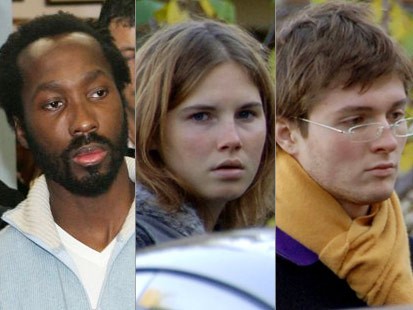
Last spring, we brought you the story (or at least the beginning) of the Amanda Knox case. She’s in Italy–accused of killing her roommate.

On November 1, 2007, Meredith Kercher, 21, was found semi-naked with her throat cut in her bedroom of the student house she shared with Knox (pictured center) in the Italian hilltop town of Perugia.

Her Italian ex-boyfriend,
Raffaele Sollecito (above, to Amanda's right), and another man, Rudy Guede (left), are accused of sexually assaulting, brutally murdering and stealing money from Kercher, Knox's British roommate in Perugia, the ancient learning hub near Rome where Knox was spending a year abroad from the University of Washington.

Pre-trial hearings are ongoing in this case–and a murder trial is finally on the horizon.

Peter Van Sant is a correspondent with me at 48 Hours–he has been working on this case for months. For those who missed the Mystery Man column he wrote for us in April, here it is. For our regular readers, here's a primer on an upcoming trial worth following.


by Peter Van Sant

This is a murder case that, from the beginning, just didn't seem to add up. The background here is very important to gain perspective on this investigation.

Amanda Knox is the classic all-American girl. She was a straight-A student at Seattle Prep, one of the top Jesuit high schools in the country. She plays guitar and has a wonderful singing voice, starring in a production of "Annie."

A tall brunette, Amanda's beauty turns heads wherever she goes. Her smile radiates. The twenty-one-year-old's biological parents divorced when Amanda (pictured right) was very young, but the family remained close. Mom is a math teacher. Dad is in management at a major department store. Her step father is in finance. All are good people.

Amanda went on to attend the University of Washington in Seattle, where she discovered her true passion in life, languages. She speaks fluent German (her grandparents on her mother's side are from Germany), Italian and some Japanese and Russian. Her friends describe her as friendly, helpful, someone who is concerned about others.

Doesn't sound like the profile of a killer, does it? I admit I'm teasing you here, but please read on.

While studying in Seattle, Amanda learned about a school in Perugia, Italy, called the University for Foreigners. Perugia is a beautiful medieval town about a two-hour drive north of Rome. The university offers students from around the world an opportunity to study in Italy. For Amanda, who was always interested in learning about different languages and cultures, it seemed the perfect place to go.

So while attending the University of Washington, Amanda worked three part-time jobs on the side. Eventually, she saved up more than $7,000. She was accepted into the University for Foreigners, and late last summer, she arrived in Perugia to begin a year of study abroad.

Six weeks later, Amanda was in prison—a suspect in the murder of her roommate, Meredith Kercher of greater London, England. Meredith (pictured left) was a lot like Amanda. She attended Leeds University in the U.K. and dreamed of studying abroad.

She got her chance last year and moved to Italy, where she attended a different school from Amanda's, the University of Perugia. Meredith needed a place to stay, and she eventually found a house she could rent with two Italian students and a young woman from Seattle, Amanda Knox.

On the night of November 1, 2007, Meredith was last seen walking home after having dinner with friends. Amanda wasn't home. She was spending the night at her boyfriend's house.The next morning, Amanda claims she went home to shower and change her clothes. She was upset that someone had left the front door open. After her shower, when she came out of the bathroom, Amanda says she noticed some blood on the floor. She tried calling her roommates, but no one answered their cell phones. Meredith's bedroom door was locked.

Amanda called her Italian boyfriend, Raffaele Sollecito, who walked over to the house. Just then, police arrived. Meredith's two cell phones had been found in someone's yard. Police had come over to the house to return them.Amanda told the police of her concerns. They broke open Meredith's door and discovered her body lying on the floor, covered with her bedspread. There was blood everywhere, including bloody finger stains on a wall.

Meredith's throat had been slashed. Authorities believe she may have taken nearly two hours to die. In the room were some tantalizing clues, a bloody fingerprint and a shoe imprint left in Meredith's blood on the floor.

Amanda Knox was questioned by police. She was later taken back to the crime scene with her boyfriend. Police wanted to see how they would react. They held each other and kissed several times, quick pecking-style kisses. Since Amanda's house was now a crime scene, she didn't have access to her clothes. Later, the two went to buy underwear for Amanda. The clerk claimed they were talking about having steamy sex that night. Authorities thought the behavior was cold and insensitive.

Four days after the murder, Amanda and her boyfriend were brought back to the police station for questioning.

After an all-night, 14-hour session in which Amanda was denied sleep, food, or an attorney, she agreed to sign a statement saying she HAD been at the house that night and that she thought she remembered her boss, Patrick Lumumba, killing Meredith Kercher. You should read her statement. It's written in bizarre English, clearly not dictated by Amanda.Amanda, Patrick Lumumba, and Raffaele Sollecito were all arrested.

Police developed a theory of the crime. They claimed that Amanda, Patrick, and Raffaele wanted Meredith to participate in kinky four-way sex. When Meredith refused, she was assaulted and murdered. The theory was fed to the news media in Italy and Great Britain. For weeks, tabloid newspapers gave the case sensational front-page coverage. Italian television also did extensive coverage. Much of the country saw Amanda as "The Dark Angel of Seattle." That coverage made its way to the U.S. as well.

Through her parents, Amanda has proclaimed her innocence. 48 Hours Mystery hired a renowned private detective, Paul Ciolino of Chicago. The investigator went to Italy to examine the case against Amanda. Ciolino has spoken with witnesses, key investigators, and people who knew all the suspects involved. He has come up with a startling conclusion.

This is a railroad job from hell," says Ciolino, a cigar chomping, pug-faced detective, who specializes in wrongful arrest cases. "There's not a shred of evidence putting this girl at that murder scene. But they've gotta convict her now, or they look like fools."

48 Hours Mystery has learned disturbing new details of what happened during Amanda's 14-hour interrogation that led to her "confession," which was not recorded or witnessed by a third party.

Paul Ciolino also questioned one of the most important witnesses in the case, a woman whose story helped form the police theory. What the woman tells Ciolino, while a 48 Hours Mystery camera is rolling, turns the case upside down.

In Italy, a person can be held without charges for up to one year. Amanda has still not been charged with any crime. She sits today in a maximum-security prison, allowed to see her parents twice a week for a brief time. Her parents say she is frightened. This is as disturbing a case as I've ever covered. (Click here for the full story.)


Monday, July 21, 2008

Out of the Closet

by Diane Fanning

Just when I thought law enforcement had forgotten Tommy Lynn Sells, along comes a former deputy with Missouri's Cape Girardeau County Sheriff’s Department asking about a long forgotten body. And once again, Sells' name was dropped as a possible suspect. I thought by now he’d been considered in every single cold case that remained open in his home state in the 1980s and 1990s. Apparently not.

Back when Sells was arrested, on January 2, 2000, investigators across the country dusted off files of cold cases eager to see if Sells was a possible perpetrator. After 48 Hours aired the show about the serial killer, Texas Rangers Johnny Allen and Coy Smith came into their offices to discover hundreds of requests from detectives all across the country wanting to know if Sells could have been in the right place at the right time to commit an unsolved murder in their jurisdiction.

The inquiries and interview requests continued to flood into Texas up to Sells' trial in September 2000, when he was convicted of the murder and sexual assault of Katie Harris and the attempted murder of Krystal Surles in Del Rio, Texas. Sells was sentenced to death.

Some law enforcement agencies no longer wanted to waste resources on looking at Sells—after all, unlike some states, Texas is very serious about the enforcement of their death penalty. Other investigators, though, who hungered to find closure for family members and satisfaction in their quest for justice, continued travelling to Texas to question Sells.

I fielded a lot of requests for information, too. I heard from detectives, family members, prosecutors, defense attorneys, private investigators, and some from uninvolved but curious true-crime buffs. Among the latter group, I received hundreds of emails about the Darlie Routier case. Although she sits on Death Row for the murder of her two sons, many people still believe in her innocence. They wanted to know if Tommy Lynn Sells was in the Dallas area at the time of that crime. While there may be doubts about Darlie’s guilt, Sells had an ironclad alibi—he sat behind bars in a West Virginia prison. There was no way he was responsible for killing those two boys.

This summer, though, as Sells approaches the eighth anniversary of his death sentence, interest in the Death Row inmate seemed to have died down. The only question most people still asked was: Have they killed him yet?

Until this month in the boot heel of Missouri, that is. Renewed interest in a 1981 homicide case raised his name again. The remains of an unknown white male, aged 20 to 40 and ranging from 5-feet-nine to five-feet-eleven inches tall, were found in a wooded area on April 6, 1981. The corpse was clothed in green pants, a short-sleeved khaki shirt (above) and a pair of black loafers adorned with a buckle. His skull, however, was missing.

Two years and one week later, a mushroom hunter found the missing head in a nearby creek. In the area, there were only three missing men who fit the description of the victim. A comparison of dental records discovered no match to any of them. So, the remains and the clothing moldered away in a basement closet archive at the Southeast Missouri State University for the next two decades. Forgotten by all but one man.

Now he’s come forward, resurrecting the case, looking for justice. Will the authorities be able to tie it to Tommy Lynn Sells? The odds are stacked against them. In 1979 and 1980, when Sells wasn’t on the road, he was in Missouri. In 1981, though, his home base was Little Rock, Arkansas and he was just 17 years old. He has confessed to committing homicide at that young age but he never mentioned this case.

If not Sells, will they be able to identify anyone as the killer? Will they even be able to give the victim a name? It sounds unlikely after 27 years but scientists make a habit of transforming the impossible into the routine every day.

Forensic Science is an amazing and rapidly expanding field. What seemed like fantasy five years ago is now common forensic investigative technique in labs across the country. Who knows what microscopic trace evidence is nestled in the folds of his shirt or on the buckle of his shoe (above), waiting for a diligent individual to uncover.

One day, the unknown man in green pants may find justice after all.


Thursday, July 10, 2008

Career Choice—A Life of Crime?

by Jenna Jackson

I have a new intern for the summer. He’s a college student, working on his degree in journalism, and is trying to decide what he wants to do for a living once he graduates. It’s been a loooooong time, but I remember the pressure of that time. You’re about to end one major phase of your life and begin another—and you feel like you have to make a decision that will shape your future.

I kind of finked into my decision. I wanted to be a dance teacher—and had been working toward that most of my life. I injured my knees my senior year in high school, though, and that put an end to that. So I took the other scholarship I’d been offered at
Sam Houston State Universitya journalism scholarship. I needed the money, and that was the only other offer, now that my dance scholarship was gone.

That decision started me on a career that has taken me places I never imagined. For me, it has been a good career so far—and a good fit. But there are days when working almost exclusively on murder stories takes a toll. I almost forget how strange this world can be until someone new and unaccustomed to it comes along.


My intern, Matthew, is a blank canvas. He is smart, motivated, talented in many areas – and just trying to figure out what will fit him best. (He already runs a small but successful photo business, Matthew Crawford Photography.) And he is young—it has been an experience to me just to watch him take in this weird world I call a career. Many days, we’re sitting in my home office, making calls and sending e-mails. Exchanges and conversations that are completely normal to me cause him to look a little shocked at times. It has made me stop and listen to what I’m actually saying to people.

Nearly every conversation I have consists of details of a murder. I spend my days meeting with or talking to victims, suspects, lawyers—someone, who in some way, has been affected by a brutal crime. I always feel for the people to whom I’m talking—but it is also a job to me, and one I’ve been doing for more than a decade now. So sometimes I forget what an impact it has on people who aren’t used to this world.

Right now, I’m working on a couple of different cases, getting them ready (with a team of other people) to air on
48 Hours in the fall. In one, a man with no violent history is accused of executing his pregnant wife with a shotgun (Belinda and David Temple at left). My fellow blogger, Kathryn Casey, is writing a book on this bizarre case. In another, a 38-year-old man is accused of beating and strangling his own father, who he said had it coming because of years of abuse.

I had Matthew read the files so that he would be familiar with these cases—he has now listened to me talk to many of the people involved—and has sat through some on-camera interviews. During one interview session, one of our correspondents asked him (only half jokingly) why in the world he’d want to get into this dark business.

I am happy with the decisions I’ve made—I have a career that is never boring. And I get to meet incredible people fighting the odds every day. But I also am probably more cynical (and paranoid, especially when it comes to being a new mother) than the average person because of the tragedy I see every day.

I hope Matthew gets a good look at this business, so he can decide which direction he wants to go in his career. And I’m glad he’s seeing the full scope of it—because even though it’s a very rewarding career, it definitely takes a certain kind of person to stay with it. And it can take a toll on you emotionally—better to know that from the beginning and make the choice that choosing this 'life of crime' is still worth it.

To me, it is. I have the honor of meeting people going through their hardest times—and I’m the one who is allowed to help them tell their stories.


Saturday, May 3, 2008

Don't Forget Your ID Saturday Night

Be sure to watch Investigation Discovery tonight, when you can see the work of two of our partners in crime: 48 Hours Producer Jenna Jackson and Crime Writer Vanessa Leggett, who was interviewed for "Texas Confidential," a story that originally aired on CBS's 48 Hours. The one-hour program details the murder of Houston socialite Doris Angleton, the wife of a multi-million dollar bookmaker who catered to Houston's elite. Doris's husband, Bob Angleton, was also a police informant. Doris had filed for divorce two months before she was gunned down in her home. Police were convinced Bob conspired with his estranged brother Roger to commit the perfect crime. Three people have been jailed in relation to the murder case: the suspected conspirators, Bob and Roger Angleton, and even the writer, Vanessa Leggett. But to this day no one has been convicted of murdering Doris Angleton. To find out why, watch ID on Saturday, May 3, at 7:00 p.m. EDT. For preview and program description, visit here.