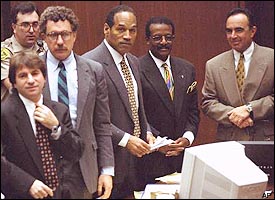
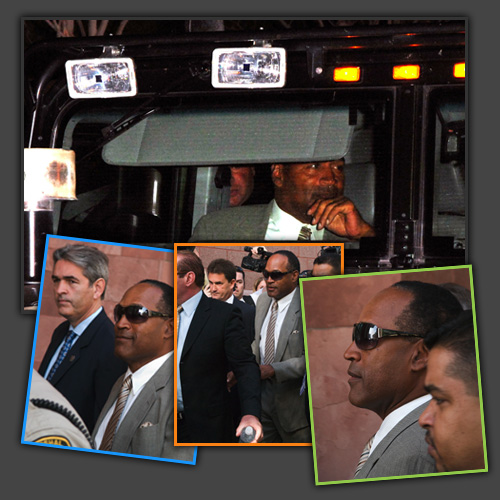
It has finally happened. A jury in Las Vegas, Nevada did it. They told O.J. Simpson that he is guilty of a crime. Some people have been waiting for this for many years. A Las Vegas jury found O.J. Simpson guilty of all counts: conspiracy, robbery, kidnapping, and all done knowingly with a weapon. This verdict came thirteen years to the day that a Los Angeles jury aquitted him.
In 1995, when the jury in California found him Not
 Guilty of murdering his wife, Nicole Simpson, and her friend, Ron Goldman, most of the sane world was astonished. How could this have happened? I understand totally how it happened, and I will remind you that a jury must find guilt “beyond a reasonable doubt.” You can say that it was his slick “dream team” of lawyers. I am sure that had something to do with it. Yet it has been my experience that you can be the slickest lawyer in the world, but you cannot change the basic facts.
In my office, I keep a pretty fairy wand that was given to me about 12 years ago. It was supposed to help me “change the facts” of cases. I have used it consistently, but to date, I have seen no real results. A lawyer can take the facts and try to mold them in a way that sounds better for your client, but the basic reality is still there.
A lawyer can provide the jury with reasons why his or her client was present during the killing or during a robbery, and hope that the jury will not believe that he was a participant or knew that the co-actor intended to kill or rob someone. But that is all you can do. A fact is a fact.
This Nevada court and the judge made some half-hearted attempt to keep the California murder trial out of this Nevada courtroom. But everyone, I’m sure, knew that would be realistically impossible—unless the “slick” defense lawyer could find a jury of 12 people who had been living under a rock in the Nevada desert for the last 15 years.
The lawyers were not supposed to mention the prior trial and verdict, but remember in the opening statement by the prosecutor, he said something like “make this the first real verdict” for O.J. Simpson. Well, it was clear what was meant . . . and the jury delivered for him.
I watched O.J. during the reading of the verdicts. O.J. has aged considerably since his last criminal trial. He was listening and waiting for the two-word verdict, but it did not come—ever—on any count. It was “guilty” all across the board. His face looked pained and I am sure Simpson, 61, is worried about the remainder of his life. This jury could sentence him to life in prison. He would be eligible at some point for parole, but at his age, for all practical purposes, it would be forever.
Why does this verdict make me a little sad? Is it because I am so used to fighting for the underdog, the oppressed? Am I so much a defense lawyer that I cannot see the guilt in anyone? I am beginning to wonder about myself. Do I want all defendants to win regardless of the facts of the case? No, I do not think that is it.
From what I saw and reported to you during the trial, it appeared that there was enough evidence that was presented to the jury that should have produced a “reasonable doubt” and the verdict should have been Not Guilty. The issue of whether O.J. knew that his co-defendant had a gun was not clear—at least to me and what I saw. Simpson’s attorney put up a good defense, but as with most criminal cases, the defense generally does not have many—or any—witnesses.
The defense here had one witness—and it was not O.J. Does it matter to juries whether the defendant testifies? I believe it makes a huge difference. My general rule is that in serious criminal cases, unless they have a prior criminal history a mile long, I make every effort to put the defendant on the stand to testify in front of the jury. If he is firm in his statement to you, his lawyer, that he did not do this crime—or, in O.J.’s case, that he did not know that the other guy was going in that room with a gun and all he wanted to do was retrieve his own property—then why not put him on the stand? A jury always, I repeat—always—wants to hear from the defendant. And a juror who is really honest with you will say that if the defendant does not testify, they will wonder why not.
A defense lawyer talks to the potential jurors during the jury selection process about whether their client will testify. You try to get a jury who understands every citizen’s constitutional right NOT to testify, but it really does not matter. In the average person’s mind, if you are “innocent” (which is another article in itself), then you should get on the stand and say so.
But what got me, and I bet what each individual juror was thinking, was this: Why in the world would O.J. not
 call the police to do this job for him? Why in the world would he think that it was acceptable for him and his cohorts to barge into this hotel room and do what he did? Why does he keep committing crimes—little or big? Does he think that he will always avoid repercussions of his actions? Does he think he is above the law? Maybe he did. But I bet he has changed his tune now. Waiting on sentencing can be very stressful and demeaning. Let’s see if he goes to prison, and for how long. For victims of crime, waiting on justice can be unbearable. I bet the Goldman family is raising several glasses of champagne. . . . What do you think?


 This phone call came during jury deliberations and—in all fairness to the newspaper reporter—he was thinking that because I had been