Showing posts with label Mexico's drug war. Show all posts

Friday, August 2, 2013

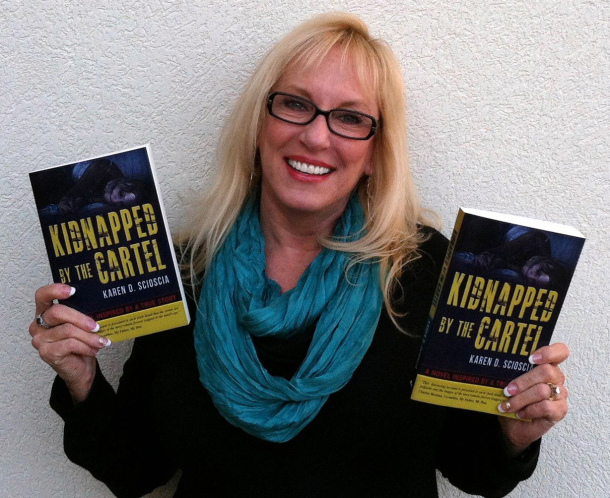
Writer Karen Scioscia Discusses Her Book 'Kidnapped by the Cartel'

In our ongoing series of WCI interviews, we're talking today with Karen Scioscia, novelist, columnist and freelance writer. Her debut novel, Kidnapped by the Cartel: A Novel Inspired by a True Storywas released earlier this year. She also has a passion for acting and is a card-carrying member of the Screen Actors Guild.

Women In Crime Ink: Welcome, Karen. First of all, when did you begin writing, and what inspired you?

Karen D. Scioscia: My father was a college professor who taught English and speech until he was 83 years old. He also wrote and directed many plays. My maternal grandmother wrote a weekly column in a newspaper in Florida until her death at age 96. Writing is in my genes.

WCI: How often do you write? And how do you manage to fit in writing amidst all your other commitments? 

KS: I write whenever I can. The best times for me creatively are first thing in the morning and later in the evening. The mid-day hours are filled with so many of my other endeavors. I am also out conducting interviews during the day for my newspaper column.

WCI: In what genre do you most enjoy writing?

KS: True stories, or “based on” true stories, are my favorite. My novel, Kidnapped by the Cartel, released this year, was inspired by a true story.

WCI: You wrote the book after a family member was kidnapped and missing for 11 days. How difficult was that on your family and, eventually, for you to do research write about it?

KS: The goal was to find her and get her back. It was a harrowing experience for everyone. I was involved in the search for several days. My heart went out, after this experience, to everyone who's ever had a family member abducted. Family members encouraged me to write about this.

I found out that this was not an isolated incident. In my research, the things I was hearing were even more harrowing than what we had gone through. So, I created a character, Amanda, in my book. It's a compilation of all the different things I learned and the research I did.

WCI: What else draws you to that genre?

KS: I find people so interesting and everyone’s life is some kind of story. Some folks are just more fascinating -- good or evil -- to read about than others.

WCI: What are your current projects?

KS: I am currently writing two articles for the November edition of Mob Candy Magazine. It's a special issue focusing on women involved with the Mafia. My stories are on Mob girlfriend and courier, Virginia Hill, and Marion "Kiki" Roberts, a dancer who got herself tangled up with the wrong people.

I'm also in the beginning stages of an exciting novel about terrorism and the container shipping industry. The research part is fun and challenging. I also write a weekly column for the Charlotte Observer and I'm a contributor to Yahoo.com. I'm working on budgeting my time!

WCI: What has been the reaction to your book from readers?

KS: I’ve had a very favorable response. The book was on Amazon’s “Hot List of New Books” the first week it came out. Readers have said things like, “I couldn’t help but feel the pain and horror the parents felt when searching for their daughter,” “great attention to detail,” and “I highly recommend this book.”

WCI: What are two of your favorite books, and why?

KS: Tough question to answer since I have so many books I like a lot, but I’d have to say Outliers by Malcolm Gladwell is one of my all-time favorites. So interesting and thought provoking, it was difficult for me to put down. I like almost anything by the late, great Nora Ephron. She had the ability to make you laugh and think at the same time.

WCI: What are your writing plans for the future?

KS: I enjoy writing books, so I’ll be working on another one. I intend to keep up my newspaper column, plus Yahoo.com, and I’m thinking of taking a screenwriting class.

You can learn more about Karen Scioscia on her website by clicking here. Her book, Kidnapped by the Cartel, can be ordered here.


Sunday, March 18, 2012

Unemotional Monotone and Many Shoulder Shrugs for Survivor Producer Accused of Killing His Wife

by Dr. Lillian Glass

Reporters from 48 Hours went into the prison in Mexico to interview Bruce Beresford- Redman, the Survivor Producer accused of killing his Brazilian born wife Monica and the mother of his young daughter and son.

In my view as a body language expert, I see many signals of deception n his very unemotional and monotone interview. The interview is loaded with shoulder shrug which can often be a huge “tell” in terms of determining whether or not someone is being truthful or not.

He starts of f the interview by saying “I didn’t kill my wife”. There is a shoulder shrug at the end of this statement.

Then he says “We were getting along splendidly.” As he said this he shakes his head “No “as opposed to shaking it “Yes”. When someone’s body language and nonverbal actions contradict their words, they are usually lying. Then we see another shoulder shrug of deception at the end of the statement. Also the word “splendidly” is very unusual. It is not a word commonly used. Oftentimes when someone I trying to manufacture the truth they will throw in these flowery words which can be a red flag .

He says “The next morning she wasn’t back. I was really nervous. As he says this there is another shoulder shrug complete without any vocal emotion.

Here are some of his other comments during the interview and associated body language “tells”.

“She sort of disappeared” is also said with a shoulder shrug. How does one “sort of disappear”? That is a very telling comment in my view.

“I collapsed (shoulder shrug indicating possible deception) and went numb. Actually he shold gave said he went nub and then collapsed, not the other way around.

As he describes his wife for the cameras as being funny and warm, he shakes his head no. Still shaking his head No he says “ She was as lovely a person on the inside as she was on the outside.” There was an accompanying shoulder shrug as he said this. He concludes with “She was amazing.” As he shakes his head “No.” He also shakes his head “No” as he says “She had this accent like listening to honey through gauze.” “He goes on to say “It was beautiful. It was mellifluous,” as he shrugs his shoulder once again.

“There weren’t issues going on at the time,” was also followed by a shoulder shrug.

Her cell phone was so damaged and shattered that you had to shout to make yourself heard, so she didn’t take it with her.” This statement was also followed by a shoulder shrug.

And finally, the shrugs go on and on as he said “ I want to help find someone who killed my wife.”

When one looks at the body language of his sister in law, it says it all. Her eyes are opened very wide as she speaks and you can see the white around her eyes indicating fear and anger as she speaks of her sister. She never wanted to believe that Bruce had anything to do with her sister's death as she stated, but now every part of her body says the opposite.


Monday, November 1, 2010

A Mexican Savior or a Sitting Duck?

by Diane Dimond

Remember the name Marisol Valles Garcia. She’ll either go down in history as a selfless heroine or she’ll soon be dead. Maybe both.

Twenty-year-old Marisol lives in the small and violent Mexican border village of Praxedis Guadalupe Guerro, population 9,149. Marisol is a criminal justice graduate student, married, and the mother of a little boy. The baby calls her Mama. The rest of her village now calls her Chief, their Chief of Police. It’s a job no one else in her village would take for fear they’d lose their lives if they put on a badge. The last man in Marisol’s position, Chief Manuel Castro, was kidnapped, tortured and beheaded last year. But Marisol says she took the job because she’s just tired of everyone being afraid. She said after being sworn in, “We have to reclaim our lives!”
It’s no wonder her villagers are scared. Their Juarez Valley community sits smack in the path of a war zone where two rival drug gangs fight for control of a nearby highway. And the senseless violence there is taking place just half a mile from the Mexican-Texas border, just about 100 miles south of Corpus Christi.

Tens of thousands of murders have been attributed to the marauding lawlessness that’s gripped Mexico so far this year. The outlaws are trafficking the most valuable of illegal commodities: drugs, guns and other human beings. They let nothing and nobody get in their way.

Children have been gunned down while having fun at a birthday party--innocents standing in the wrong place at the wrong time--and several Mexican police officers in communities all along the border region with the United States have turned up dead, many with their corpses' mutilated as a signal to others of how ruthless the criminals can be if someone tries to stop them. The death toll is sure to rise by the end of the year.

But Marisol Valles Garcia waves off the idea that her new job--for which she’s paid just $640 dollars a month--is akin to a suicide mission. She simply saw a desperate need for a return to peace and safety in her home village and so, she says, she stepped up to accept the challenge.

“There is a lot of fear in this town, but we can’t live like that,” she recently told a reporter.

Perhaps just as courageous is her bare-bones staff equipped with paltry resources. Marisol commands just 13 officers, nine of whom are women. They have just one patrol car and four guns. That’s it. That’s the sum total of their arsenal, and the Chief has decided she won’t carry a gun because she’d rather her officers have them out in the field.

“The best weapons we have are principles and values, which are the best weapons for prevention,” she told CNN en EspaƱol. Marisol readily admits she’ll have to rely on the Mexican Army to handle the traffickers and her influence will be limited to local crime prevention and minor infractions. For now, Chief Garcia says she’s content to concentrate on her own backyard and try to re-instill in her neighbors the idea that they can take back control of their community. This woman either has her head in the clouds or she’s on to something. I’d like to think it’s the latter. I’d like to think more brave souls will stand up with her and re-claim their peace of mind.

Why should we Americans care? Isn’t this Mexico’s problem? The answer is clear: Americans are getting caught in the crossfire. It’s only a matter of time before the violence spills across our border in even more vicious ways. Just last week, a Texas national guardsman was killed in the bloody border city of Ciudad Juarez which was once known as a popular party destination. Just why 21-year-old Jose Ramirez defied the military’s suggestion to stay out of the area is unknown, but he became the latest of at least three American service members killed in Juarez since the drug war began.

Last November, Staff Sgt. David Booher, an airman from Holloman Air Force Base in New Mexico, was among six killed when gunmen suddenly shot up a bar. In 2008, Lance Cpl. Gustavo Zubia Lopez was shot and his body thrown off a cliff in Juarez after he ventured across the border to get his car repaired.

Look, we’ve spent one billion dollars so far trying to build an ill-conceived fence between our two countries to keep the violence “over there.” After four years, only 50 miles of the fence have been completed. Maybe our tax dollars would be better spent funding more Chief Marisol Garcia-type projects--providing vehicles, weapons and tools to empower the local Mexican population along our border. I’d much rather my money go to Marisol than to an ineffective fence.

The situation brings to mind the biblical saying that “A little child shall lead them.” Maybe in this case it’s a determined 20-year-old woman who could use some help.