Showing posts with label prison. Show all posts

Wednesday, September 14, 2011

Do Prisoner's Deserve Free Medical Treatment?

by Diane Dimond

They are charged with breaking laws or victimizing fellow citizens. We respond by making sure they get a lawyer – often on the taxpayer’s dime. If they plead “not guilty” we stage expensive trials for them so they can provide evidence to a judge or jury. If convicted, they are imprisoned.

So, after all that do we have an obligation to provide prisoners with any and all medicines they might need to keep them healthy?

While so many Americans are struggling to meet health insurance and prescription costs – services for prisoners constantly increase. And make no mistake about it, America has so many incarcerated people we are spending boat-loads of money on convicts’ medical care. Their services cannot be cut. But health care programs for the general public have been cut back time and time again.

Let’s take the state of Ohio as a general example of what it means to maintain the health of convicts. The Ohio prison system has about 51,000 prisoners and it spends nearly 223 million dollars a year for their medical care. About 28 million dollars of the Ohio total is spent on inmate’s prescriptions.

In Oregon, the latest annual figures show it took 100 million dollars to take care of some 14,000 prisoners. That’s 7 times more than the state spends on education.

Texas, like every other state, has seen a spike in the number of elderly inmates who often require even more expensive medical treatments. That phenomenon and Texas’ regular medical care costs for prisoners ballooned to a staggering 545 million dollars last fiscal year. This at a time when other crucial state programs are facing mandatory budget cuts.

Every year the price tag of tending to old and dying prisoners skyrockets. Realize these inmates must often be transported to hospitals or nursing homes where they are treated with the latest lifesaving methods and, yes, even though they are incapacitated from their illnesses the law says they must be provided with round-the-clock security guards.

Wrap your head around this set of facts if you can: In California, a state drowning in red ink, the prison system recently identified 21 inmates whose annual health care bill is just under two million dollars – EACH. There are another 1,300 guests of the California penal system who require medical attention costing $100,000.00 apiece. Those cold hard facts caused California to adopt a bill last year to grant medical paroles so the sickest inmates could get out of prison and into federally funded health care facilities. That, of course, only shifted the burden on paper – from the state to the federal level.

So, armed with these staggering statistics ask yourself: Do prisoners deserve all this free health care when so many of us struggle to pay for health insurance or, sadly, go without? The answer in a humane society is yes.

But yes to a point.

Are you sitting down as you read this? If not, please take a seat. In Massachusetts a cross-dressing inmate who murdered his wife in 1990 has been suing the state for health care costs related to his desire to have a sex change operation. Robert Kosilek (who has changed his name to Michelle) has already received hormone injections, electrolysis hair removal and, most recently, a mammogram – all at taxpayer’s expense. Kosilek remains housed in an all-male prison and her standard issue prison wardrobe has been augmented with several bras and “some make-up,” according to corrections officials. Still, after a costly ten year court battle, Kosilek says these steps have not been enough to ease her depression and the fight continues for the state to pay for a full-on sex reassignment surgery. The case is still pending in Massachusetts’ U.S. District Court.

Earlier this year in upstate New York, 55 year old Kenneth Pike, convicted of raping a 12 year old family member and sentenced to up to 40 years in prison, desperately needed a heart transplant. He had already undergone triple heart-bypass surgery and had a pacemaker implanted while incarcerated. After the media reported the public might have to pay for an $800,000.00 transplant surgery for a convicted child predator, the outcry was immediate. The Department of Corrections explained it was, “Constitutionally obligated to provide health-care services to inmates” and Pike’s family argued he should be treated like any other patient in need. In the end, the controversy was so red-hot Kenneth Pike declined the surgery. At last report he is still alive.

In 1976, the U.S. Supreme Court ruled that prisoners were entitled to the same medical and dental treatment as everyone else in their communities. Since then countless state courts have upheld that ruling and repeated that prisons that withhold treatment can be held liable for violating the U.S. Constitution’s ban on cruel and unusual punishment. Well, I know lots of folks in my community who can’t afford to go to doctor when they feel sick and they may go to the dentist only when they have a raging toothache.

Whether our politicians want to admit it or not, health care has become a luxury for millions of Americans. Excluding, of course, those convicted of a crime.


Wednesday, February 9, 2011

One Man's Poison

By Lisa R. Cohen

I've been on hiatus from this website for the last several months, making a documentary set in a maximum-security prison. That means months of filming on location on lockdown, then months in the isolation of the edit room, which can often feel even more like lockdown. I've been out of the loop for so many cultural events, and I've only just emerged to find myself shamefacedly fascinated by the Charlie Sheen phenomenon.

Of course, part of its appeal lies in what I like to call the rubbernecking by the side of the highway accident syndrome. Part of it is an antidote to the grim subject matter I've been immersed in–the prison has a unique hospice program that enables inmates to redeem themselves by caring for fellow inmates in their final days. It's actually been an awe-inspiring year, but it is dark. And part of it is the conflagration of intriguing moral issues raised by Sheen and his antics.

A brief recap, for anyone who's been hiding in a cave or an edit room, Charlie Sheen has enjoyed years of bad-boy behavior and playing a vanilla version of same bad boy in his hit TV show Two and a Half Men. His bad-boy behavior includes assaulting one of his ex-wives, trashing hotel rooms, frantic 911 calls, alcohol and drug-induced rages and near-death experiences. He ended last year with a bang, apparently locking a naked porn star in the closet, then totaling his room at the tony Plaza Hotel, finishing off with a hospital stay for a psych evaluation.

He started the New Year with an even bigger bang. Celebrity websites were filled with recent accounts, including a convincing first-person account by a fellow partier, on camera, of a weekend binge of porn stars and eight balls of coke, another 911 call, another hospital, and another round of rehab. The cover story, stomach trouble after laughing too hard at an old TV movie, was laughable enough to send us all to our local ERs.

As the tabloids continue to wring the story for its juicy details (how can you resist when the porn stars are as eager to bear witness as they are to bare themselves; see Kacey Jordan, right), the rehab stint is now a house call. The celebrity's father, Martin Sheen, wants to do a Britney and protectivly wrestle away Sheen's assets. Sheen himself has cried foul. He thinks the media has more important things to do such as covering the Egyptian uprising or the war in Afghanistan, for example. Leave Charlie to self-destruct on his own.

He has a point.

Whose business is it if Charlie Sheen wants to commit slow suicide, faster and faster nowadays? How can you force a 45-year-old man to do what he doesn't want to do? Are the CBS suits the bad guys here, for enabling Sheen's habits? Well, maybe, but if he does his job, as supposedly he has, and wants to self-destruct on his own time, do they have other options? Any loved one of an addict will tell you that tired lightbulb joke–how many does it take? Just one, but he really has to want to change.

Here's the thing, though. Most of the people I met in prison were spending years, some their whole lives, because they did a fraction of the drugs Charlie Sheen appears to have done in the span of one weekend. That's not to excuse the criminals serving time for it. But somewhere along the way, the phalanx of look-the-other-way friends and business associates are crossing the legal line to protect Sheen, and, in the process, they're hastening his death.

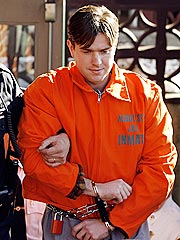
At the very least, they're teaching exactly the wrong lesson to the rest of us, including that vulnerable and highly prized demographic Two and a Half Men attracts. If you're Charlie Sheen, the lesson goes, you can break the law over and over, and just get to stay home by the pool with a Dr. Drew type and some hookers. The rest of us? Orange jumpsuits.


Monday, June 30, 2008

"Life" for Neil Entwistle Means Death in Prison (One Way or Another)

by Michele McPhee

SHIRLEY, MASSACHUSETTS—Within weeks of his arrest, Neil Entwistle suffered a kick to the stomach so swift and brutally hard, the Englishman crumpled to the ground and whimpered. The man who delivered the blow, a fellow inmate, continued to shout “Baby Killer!” as correction officers restrained him.

Correction officers in Massachusetts are now charged with making sure that those kinds of attacks on Entwistle do not become a daily occurrence as he begins his prison sentence. Last week, Entwistle was convicted of killing his 27-year-old wife, Rachel, and his baby daughter, Lillian Rose, 9 months. He was sentenced to life in prison without the possibility of parole. The bodies of the infant and her mother were found nestled alongside each other in the family’s rented Massachusetts home on January 20, 2006.

"It’s our intent to protect him as we protect any inmate. We’re not going to treat him special, but we’ll insure that he gets equal protection like every other murderer and rapist,’’ said Steve Kenneway, President of the Massachusetts Correction Officers Federated Union. “We are trained to overlook the crime. Our job is not to judge the inmate. Our job is to keep them safe and protect society from them.

“I won’t, however, speak for the inmate population–which is why he will probably be housed away from them,’’ Kenneway said. “People convicted of crimes against children are very, very difficult to protect from the inmate population.’’

Because of the notorious and high-profile nature of his crime, Entwistle was moved last Friday to the special management unit, a segregated section of the maximum-security prison at Souza-Baranowski, by Massachusetts Department of Correction Officials. He was issued a pair of red scrubs with the letters DOC emblazoned on the back and was brought into the unit with handcuffs and shackles early Friday morning, prison officials said.

A correction officer will be assigned to monitor Entwistle, who has threatened suicide twice since his arrest two and a half years ago, around the clock. The isolation can provoke some inmates to find ways to commit suicide. In 2005, Andrew Armstrong, a convict serving time for a brutal home invasion, was found hung in the very cell where Entwistle was assigned on Friday, prison sources said.

That cell is 7-feet-by-13-feet with a steel toilet and sink; a bed steel-mounted to the wall, just shy of his height. Entwistle was issued state-owned sheets, a pillow, and a blanket. The cell has a metal footlocker; a desk; and stool and one metal shelf hanging on the wall. He will be completely isolated with no contact with the general population at the prison, said Cara Savelli, a spokeswoman for the DOC.

Each of his meals costs Massachusetts taxpayers $1.42 a day and taste like “the worst school cafeteria grub you can think of,’’ said convicted drug dealer Jimmy Connors, who was recently released from the prison and spent time in the special management unit.

“They have to keep him away from everyone. Everyone knows who Neil Entwistle is. He’s the coward who killed his own baby,’’ Connors said of Entwistle. “Baby killers, child molesters, are tortured in there.”

One of those child molesters in fact was murdered in the unit where Entwistle is now. Pedophile Roman Catholic priest Thomas Geoghan, 68, was strangled to death by a fellow inmate in a segregation unit at the prison nicknamed “The Shoe") in 2003. Geoghan’s killer was a homicidal maniac named Joseph Druce who confessed his hatred for child molesters. In a bizarre, macabre security video he was captured re-enacting the priest’s murder.

“I did it to save the kids,’’ Druce told investigators after the slaying, which occurred on August 23, 2003. Roughly 150 children claim they were molested by Geoghan during his 30-year career in six Catholic parishes.

In the video pantomime of the priest’s slaying, the clip starts with Druce standing in a cell naked but for white boxer shorts, his sinewy body scrawled with crude jailhouse tattoos. His pock-marked face is covered with a scraggly brown beard as he talks to himself in a mirror.

He then re-enacts the murder. He jammed the door of Geoghan’s cell with a paperback book so correction officers could not stop him. He punched the priest in the face. The priest fell to his knees at which point Druce (pictured left) bound his hands behind his back with a white T-shirt. Druce pushed the priest to the floor, face down and proceeded to strangle him with a tube-sock tourniquet that he tightened with the priest’s own sneaker.

As the priest slowly suffocated, Druce then climbed onto the steel-mounted bed and jumped on the elderly man’s back, stomping him three times. The video simulation mirrors what prosecutors have described in the slaying. An autopsy showed Geoghan's cause of death to be ligature strangulation and blunt chest trauma; broken ribs and a punctured lung.

It’s a brutal act, and one that prison officials say they do not want to see repeated on Neil Entwistle. The 29-year-old Worksop native will spend the rest of his life behind bars trying to avoid attacks like the one that killed the pedophile priest, which led to accusations that correction officers were complicit in Geoghan’s murder. Several correction officers were suspended from their jobs after Geoghan’s slaying.

Of course, Entwistle is not the only man serving life in a Massachusetts prison for killing his own child. There is an official tax-exempt organization called Lifers Group Inc. in the prison system comprised of a bloody fraternity of the state’s most notorious killers who advocate for convicts' rights and petition lawmakers for special protections. The leader of the group, Kenneth Seguin, is serving life in prison for slitting the throats of his two children before plunging their bodies into a pond. After that gruesome murder, he went home and buried an ax into his wife’s head. Another Lifers Group leader is Gordon Haas, a former department store manager who smothered his wife and two small children to death with plastic bags.

“Neil Entwistle will be among his peers in jail,’’ said a correction officer assigned to the prison. That officer declined to be named. “Guys like this really make us sick, but we are paid to protect them.”


Wednesday, June 25, 2008

Witness

by Jenna Jackson

I got an email a few days ago that made me start thinking about something I have not thought about in years. Executions.

A group called the
Texas After Violence Project e-mailed to ask me to interview with them about my experience with the death penalty. Thankfully, I’ve never lost anyone I love to murder – or to an execution. But as a young reporter, I witnessed more than 20 lethal injections.

When I was in college at
Sam Houston State University, I worked full time at the local newspaper, the Huntsville Item. I got some of my best reporting experience to date at that tiny paper. Even though it was a small paper in a small town, we covered big issues – because it’s located in the state’s prison capital – Huntsville, Texas.

I worked the prison beat, and part of my beat included covering executions at the nearby
Walls Unit. I was 20 years old – and I spent many evenings at the old brick prison. It was usually just the same handful of us there – me, an AP reporter and a UPI reporter. Most nights, just before 6 p.m., the three of us would follow the prison PR guy across the courtyard and into the death chamber. Outside the gates of the courtyard, it would be silent. Every so often, an execution would garner publicity – and the street just outside that gate would be packed with people … protesting or just watching.

But most of the time, an execution was a non-event. That always struck me as one of the strangest parts of this ritual. I was a reporter covering a story – so I never voiced my opinion on whether I thought the death penalty was right or even effective. But I did always think if someone was going to be killed – whether at the hands of another person or by the state – it should be noted.

And because of that, our paper’s policy was that we published a story on each and every execution. Some weeks, there were several. On a couple of occasions, there were two in one night.

Because of those many nights I spent watching men be put to death, I actually came to believe that executions should be public. We as a society condone them – and we should see the effects of those laws. I’m not even sure it would change people’s minds to see them – but I think the option should be there.

But as it stands now, there are only a handful of people allowed into the death chamber to witness an execution. The inmate can choose a couple of people to come in on his side of the partitioned chamber – and the victim’s family can have a few people on the other side. The reporters usually were ushered into whatever side was the least crowded.

There was one night in particular that I remember where we three reporters were the only people – apart from prison staff – who were witnessing the lethal injection. The man strapped to the gurney had killed an entire family, so there was no one left on the victim’s side to attend. And he apparently had no family who was invited or wanted to come see him die. That was one of the saddest nights – simply because there was no one left to care whether this man lived or died.

When I got the e-mail from the Texas After Violence Project, I thought I really didn’t have much to tell them. I witnessed several executions, but I was never personally involved in any of these cases. But after thinking about it, I guess it affected me more than I knew at the time.

Their web site says the project was formed in 2007 “to listen.” As a reporter, I’ve always thought the more information people have, the better off they are – so, although I’m not sure what I can add to this project, I am going to call and tell them what I know.