by Katherine Scardino
I am not sure whether I want to write something about O.J. Simpson. After the criminal trial in 1994, we all probably said something to the effect of "I hope I never hear this man's name again for the rest of my life."
I know there were people who watched every minute of that murder trial in California over a decade ago—you know, the one that lasted almost a year! And with an equally startling verdict.
During that trial, I remember being called by a member of the press in Houston, Texas, where I live, and asked to basically "guess" what the jury was going to do.
 This phone call came during jury deliberations and—in all fairness to the newspaper reporter—he was thinking that because I had been practicing criminal law in Houston for a while, and had tried more than a few criminal cases, I might have some insight or clue as to what the jury would do.
Well, in my most J.D.-educated tone, I told him I thought that surely this jury would find Mr. Simpson guilty of murdering his wife and Mr. Goldman.
I had watched enough of the trial to feel that he was guilty. But I also recog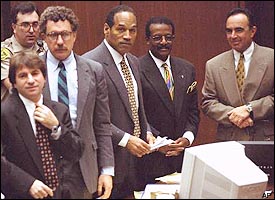 nized that Barry Scheck, Johnny Cochran, and the other members of his defense team did a fantastic job of "smoke and mirrors" and that the two prosecutors were totally outclassed and outlawyered by that so-called Dream Team. That is not supposed to matter . . . but in the glare of that circus, it was obvious.
All the same, I still felt that the State had put on enough evidence for the jury to legitimately find this man guilty.
Now we are in the midst of criminal trial number two for O.J. Simpson. This one is a crummy sequel to the first case. He is currently on trial in Las Vegas, Nevada for armed robbery and kidnapping. I have been following the newspaper about as much as you probably have—and with about as much interest.
Then I started thinking, which is a dangerous thing for me to do . . . but here are my thoughts. First, don't be mislead by the fact that he is accused of "armed robbery." He is not being charged with robbing these people of the property that he maintains was his.
No, O.J. Simpson is being tried for robbery because when he and his cohorts stormed into that hotel room, he snatched a cell phone, hat, and sunglasses (which probably actually fell off the man's face) from one of the people in the room.
Second, the "kidnapping" charge arose from a statement Simpson made on the eight-minute audiotape of this incident: "No one leaves. Do not let anyone leave this room." So that is the kidnapping part of his felony charge that could mean a life sentence for O.J.
Then, as if this is not enough, in the opening statement by the prosecutor, he told the jury to let this be the "true verdict."
Of course, the judge had instructed the jury that the California criminal trial was not to have any impact on their consideration of the facts in this case. Right! And, the prosecution was not to mention that trial. So, this prosecutor simply implied to the jury that regardless of the verdict in California, this verdict should be the "true verdict."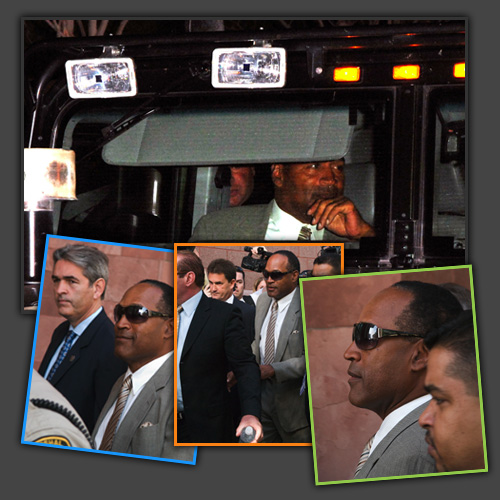
And he also mentioned in his opening statement that the jury will hear the "true O.J. Simpson" as opposed to O.J.'s public persona.
While not mentioning the murder trial, he alluded to it in the words he chose to use in front of this Las Vegas jury.
So where is this going? I am tending to believe more and more that this is a set up by O. J.'s alleged "friends." Otherwise, why the full audiotape of this entire incident?
And we have to remember, that "rant" of O.J. Simpson may just be that. He is not being charged with using profane language or with losing his temper because he wanted his "s----" back.
There is always the possibility of a jury finding him guilty because of his history, the language he used, the anger he exhibited, the fact that many people around the world, not just the United States, believe that O.J. is guilty of murder and got away with it.
And this trial may be the last chance a wrong can be made right.
O.J. Simpson might get life in prison for knocking a man's sunglasses and cap off his head, and by saying that no one could leave the room. (Lord, I hope we have not resorted to revenge verdicts.)
Let's keep watching. I'll write more as the case progresses. . . .
Tweet