Toxicology finds a high level of alcohol and cocaine in victim’s system, but not in the fetus she is carrying, and DNA links the victim to a gang member -- but she had no apparent gang connections. The detectives ask a forensic scientist to help retest the samples. The new test results soon lead the detectives to realize forensic evidence is being altered.
Tuesday, March 2, 2010
Forensics Expert Susan Vondrake Stops By
Toxicology finds a high level of alcohol and cocaine in victim’s system, but not in the fetus she is carrying, and DNA links the victim to a gang member -- but she had no apparent gang connections. The detectives ask a forensic scientist to help retest the samples. The new test results soon lead the detectives to realize forensic evidence is being altered.
Wednesday, November 4, 2009
It's not CSI Folks!
by Kathryn Casey
Over the decades, I've spent a considerable amount of time in courtrooms. It’s part of the job. Awhile back, I sat in on a long trial, seven weeks. (There I am below right.) On the first day, I heard a phrase I hear in nearly every trial I attend these days. The prosecutor had the crime scene specialist on the stand, and the D.A. said something on the order of, “It’s not exactly CSI, is it, Sir?”
The investigator said, “No, it’s not.”
It may seem odd that a television program was a topic of testimony in a murder trial, but the CSI-type shows come up more often than not in courtrooms. Prosecutors increasingly feel compelled to defuse the myth, to explain to jurors who watch the sophisticated CBS series and others like it that not all the gadgets and techniques they see in television are gospel, and that even the ones that do exist often aren’t available in run-of-the-mill, budget-strapped cop shops.
What types of crime solving methods? You know, like the holographic facial reconstruction on Fox’s Bones. At times, it can actually be pretty comical. I once had lunch with a homicide cop and a crime scene officer, while they laughed about a CSI Miami episode in which a murder was solved based on an ant bite. Bite evidence is, of course, not unusual. But in this case, the TV sleuths measured and mapped an ant bite on a corpse, reconstructing the little critter’s minuscule mandible, then linked the resulting information not only to a certain species but – forgive me if this is wrong I am getting it second hand – to a specific ant colony. Wham! Crime solved. Wow. I was impressed. But everyone else at the table found the plot less than plausible.
Why is the CSI effect a bad thing in a courtroom? Prosecutors fear jurors who watch such unrealistic, forensic heavy programs may expect too much. They may expect absolute physical evidence to convict.
Of course, there’s another side to the coin. Many defense attorneys object to the CSI comment. Why? For the defense, it’s not usually a bad thing for juries to assume all the stuff on CSI is real world. If they believe the
TV show is gospel, jurors figure their local P.D. hasn’t met the standard of “beyond a reasonable doubt” in a case without iron-clad forensic evidence. After all if CSI is viewed by many as a real-world guideline for how a crime scene is investigated, what’s to be made of a police department without equipment to measure an ant bite and conclusively tie it to the correct ant hill? Of course that assumes a police department has an unlimited budget, a state-of-the-art lab, and the likes of David Caruso on staff.
Maybe it’s not surprising or new that we’re getting drawn in by dramatic presentations on television and confusing them with real life. I remember the first murder trial I sat through as a fledgling reporter, more than two decades ago. I’d grown up watching Perry Mason on my family’s black-and-white television, and I was shocked that witnesses weren’t allowed to ramble on without waiting for lawyers’ questions and, even more so, that neither the prosecutor nor the defense attorney cornered a single witness on the stand and spurred a confession.
Actually, to this day, I’m still waiting to be in a courtroom where a suspect yells out: “All right, I did it!”
TweetThursday, May 28, 2009
TV Crime Drama—the 'CSI Effect' Again and Again
This week I got a press release that some researchers at the Mayo Clinic who compared CSI and CSI: Miami to actual U. S. homicide data. No surprise, they discovered clear differences. Timothy Lineberry, M.D., a psychiatrist at Mayo Clinic, says, “We make a lot of our decisions as a society based on information that we have, and television has been used to provide public health messages.”
Those two particular shows, CSI and CSI: Miami, were used because of their en
ormous viewing audience, somewhere around 43 million viewers every year. Mainly the Mayo Clinic investigators used the Center for Disease Control’s National Violent Death Reporting System to compare data with the television portrayals. They discovered the biggest discrepancies involved relationships, alcohol, and race where characterizations of perpetrators and victims were concerned.Apparently, actual statistics say that drugs and alcohol affect both victim and offender at the time of the crime in reality—and that was one of the differences from what the TV shows portray. The other main difference they found was regarding what race was more likely to be involved and on the television shows primarily they used Caucasians who did not know their attackers. In real life, however, whites are not the majority of offenders and, often, real victims know or were intimately involved with their attackers in the past.
"If we believe that there is a lack of association with alcohol, that strangers are more likely to attack, and that homicide doesn’t represent particular groups of people, it’s difficult to create public health interventions that the general public supports. We make a lot of our decisions as a society based on information that we have, and television has been used to provide public health messages." — Dr. Lineberry
, years ago when people did not know as much about forensics they were little concerned about what types of evidence were brought into court and how they were collected. One could say that in the “old days,” the prosecutors took advantage of that notion at every turn. Obviously, we know now that the landscape has changed. Juries are more inclined to ask about a lack of evidence but, they also are more misinformed in many instances and take an unrealistic stance—such as expecting DNA evidence for car thefts—when that was never being done.So the game has been upped. And in my last two articles, we’ve been talking about the recent denigrating reports from the National Academy of Sciences on behalf of Congress about forensic science and how the researchers found the industry lacking. It's not good, we know.
But the TV producers do do those things; take more than poetic license with drama: portray white, rich, good-looking victims—because they need the show to sell to advertisers and if we saw the real low level of most crime, we’d change the channel—not sexy or appealing enough.
Wednesday, May 13, 2009
DNA Matters, Except When it Doesn't?
by Laura James
--Attorney Jed Stone
In four rape - murder cases - involving female victims who were eight, nine, eleven, and sixty-eight - the DNA from the semen did not match the man charged with the rape and murder.
The prosecutor is pursuing these cases anyway, waving away the DNA evidence and the science upon which it is founded as a "red herring."
Unfortunately, I know it's not really that rare. A DNA exclusion did not prevent Michigan authorities from imprisoning Nathaniel Hatchett for rape. Twelve years is what it took before someone who knows something about DNA refused to accept the prosecutor's flimsy arguments. Shame, shame on the judges who permitted this man to go to prison for rape when the seminal DNA excluded him as the rapist!
I am seeing more and more of these cases - representing more and more prosecutors who won't let a lil' ol' thing like DNA get in the way of a conviction. Alas, some juries are willing to accept this. Indeed these cases are becoming so common I wish someone would coin a term for it. "DNA non-match" cases isn't very catchy.
Friday, January 9, 2009
C.S. … I Don’t Think So!
by Diane DimondEmmy Award winning TV producer Jerry Bruckheimer has let me down. He’s let all of us down.
For years we’ve been riveted by his prime time programs: The CSI franchise based in Miami, Las Vegas and New York, Cold Case, Without a Trace and others. I am one of Bruckheimer’s biggest fans.
But on a recent episode of CSI Miami Bruckheimer’s quality control broke down. He allowed his writers to get away with poetic license that could seriously damage law enforcement efforts.
In an episode called “The Tipping Point” a thug declares of his ‘hood, “God gave up on this neighborhood a long time ago.” And, indeed, we learn the population has been scared into silence by the violent actions of the local gang. But then a do-gooder named Reverend Mike is murdered. Investigators are stymied until one brave young person calls Crime Stoppers with vital information.
This is a wonderful message for those urban numbskulls who still think cooperating with police is “snitching.”
But what do Bruckheimer’s writers have the authorities say when they learn there is a Crime Stoppers tip? Are they thankful? No.
“Those people are just trying to make a buck off the county. Can we trust them?” one ignorant character asks another.
Within minutes we see the tipster, a worried young woman named Yolanda, exiting an elevator at police headquarters asking, “So, you can guarantee no one will know I’m the one who called?” And she is reassured by the lead detective that all tips are confidential. Later, as the officer scrolls through a computer list of other Crime Stopper calls (and we clearly see a roster of names and address) another CSI dumbbell dismissively questions the detective’s action saying, “The tip line? I thought it was mostly crackpots!”
Now, if any of the program’s writers bothered to check facts they would have found that Crime
Stoppers is nothing like they described. First, the reward fund is 100% donated from civilian sources and takes no county, state or federal money. Doing so would require a paper trail no one wants. Why? Because all tips are strictly confidential! No one would ever ask for a caller’s name or address and that information is never stored on some computerized master list. When someone with a tip phones Crime Stoppers they are given a unique tipster ID number and told to keep calling back to see if they are due a reward check.For CSI Miami to show tipster Yolanda being outed and brought into a public cop shop is impossible. It would never happen.
And, so what occurs next in the episode is completely inconceivable. Somehow the street gang finds out Yolanda has been talking to police. She’s hog-tied and left inside a building that’s about to be obliterated by a massive bomb. She’s saved at the last minute because the lead character, Horatio Caine, pulls a Dudley Do Right.
The lesson left from this CSI Miami episode was that if you snitch you’re in danger. If you talk to the police about a crime the bad guy will find out and get you. If you’re lame enough to call Crime Stoppers you must be a “crackpot”. How many young people saw that episode and lodged that lesson in their brain? And I’ll bet it’s not just Crime Stopper personnel who cringed at the program. Good detectives everywhere welcome anonymous tips, especially in murder cases. They’ve already got to fight the rap-music message that “snitchin’ ain’t cool.” They don’t need a popular prime time TV show (dedicated to crime fighting, no less!) helping spread that self-destructive line.
Look, I’m a writer. I value the First Amendment, character development and all that. What I don’t value is lazy writing that leaves the wrong impression when the real facts are so compelling.
As I, coincidentally, wrote in this space recently Crime Stoppers has been in existence for more than 30 years. Its success is directly attributed to good citizens who do the right thing. In the U.S. more than 800 thousand cases, like murder, rape, armed robbery and child molestation have been cleared thanks to Crime Stopper tipsters. More than a billion dollars in property has been recovered, 4 billion dollars worth of illegal drugs.
At the end of the CSI episode the bad guys are busted because Yolanda picked up a phone. She got a thousand dollar reward after her information led to arrests. That’s a scenario CSI got right. It happens every day in all 50 states and 24 countries where Crime Stoppers operates.
Come on, Hollywood. You don’t have to make it up. Just follow the facts – especially when you’re dealing with something as crucial as Crime Stoppers. And please, Jerry Bruckheimer, don’t re-run that episode!
Wednesday, July 9, 2008
What Is It About Crime?
Last night, I went to a book store in my city, Houston, called Murder by the Book, and it was a thriving place. One of my associates in Women in Crime Ink, Kathryn Casey, has written a novel called Singularity, and she had a book signing at this shop, which specializes in crime stories. Kathryn’s book is a murder mystery.
I looked around the shop and noted how many people were there and started wondering: What is this draw people have toward crime, blood and guts?
I think we get a sense of completion from crime novels, television shows, and movies. There is a beginning, middle, and an end - all nicely tied in a bow. We are at some point introduced to the killer, and usually there is an ending which includes a police officer with handcuffs leading the bad guy off to jail.
Life for most of us is a mess. It’s like a jumbled up set of facts and circumstances that usually do not end with a nicely tied bow. There are lots of loose ends, unanswered questions.
Tell us why you read crime stories. What is it about them? When we're winding down from our day, and reach for a book on our nightstands, why select A Descent Into Hell, for example, instead of Restful Sleep? What brought you here, to a Web site which focuses on all things crime?
Wednesday, April 9, 2008
The CSI Effect
by Jenna Jackson Some of the most popular shows on television right now—CSI, Law and Order, Criminal Minds—are having a real effect on courtrooms across the country. When I started at CBS News 10 years ago, most of the people I would call for a story had no idea how DNA testing actually worked—they had no clue it was blood spatter, not splatter.These days, people are far more savvy. Nearly every day, I'm asked a question that throws me—what kind of DNA typing was done at a scene, whether a person was polygraphed and by which expert. People know to ask detailed questions about criminal cases—and they learn most of what they know from watching TV dramas.
But most of the time, I have to explain that although CSI portrays a criminal investigation one way (DNA takes minutes, instead of months), real life is a lot slower and more complicated.
I think juries have become much more savvy, too—and they expect a lot more. This can be good and bad. It has certainly made trials more interesting to watch. Lawyers on both sides of the courtroom are forced to ratchet up the drama when presenting their cases—juries watch enough of these shows that they expect a show in the courtroom.
They also often want real, physical evidence to connect a defendant to a crime in order to convict. This is making things a little tougher on prosecutors, who for years have had the clear advantage from the opening of a trial.
Juries seem to expect a case where all the loose ends are tied up—but most real-life cases aren't delivered to a prosecutor in a neat little package. This is especially true in cold cases where evidence at the scene may have been scarce or not properly collected—and where witnesses have disappeared or died.
I recently covered a case in Houston where there was absolutely no physical evidence connecting the defendant to the murder scene. These types of cases are difficult for all sides—and tend to leave unanswered questions even after a verdict is returned.
But there is a case right now—half a world away in Perugia, Italy—where physical evidence was collected at the scene of a brutal murder. A suspect was arrested within days—but the physical evidence doesn't necessarily match the suspect in this case. She just matches the police theory of the crime, which can sometimes be an entirely different thing than concrete evidence. Amanda Knox (pictured above), a Seattle college student living in Perugia to attend college, definitely gave police reason to be suspicious. But as every good detective knows, people can act suspicious for a number of reasons.
48 Hours is airing a one-hour show on this case Saturday at 9 p.m. CDT. It centers around two beautiful college students—one, a victim of a vicious murder, and the other, a possible victim of an overzealous police force. I didn't have anything to do with producing this particular case, but it is so intriguing because of the issues it raises: how an American is treated as the target of a criminal investigation in a foreign country; how police can sometimes get tunnel vision and focus on one suspect to the exclusion of other possibilities; and how scenarios are created that make false confessions possible and almost probable.
Because there were so many questions in this case, 48 Hours hired a private eye to conduct his own investigation. He came up with a stunning theory of his own: Amanda Knox was being railroaded by the Italian authorities.
This case is one of those that makes you realize you can't always trust how a story looks in the beginning—once everything unfolds, it can turn into an entirely different tale. Even after nearly a decade with this show, I learn that lesson every single day.
Be sure to check out this week's Mystery Man for more details—he has a unique, behind-the-scenes vantage point of this particular case.
Saturday, April 5, 2008
CSI: The Experience
Crime Scenes In Houston, Texas, April is the coolest month. Not really. If there's any month that fits that bill it would be closer to February, which is when one of the coolest exhibits touring the country opened in Houston. And April is the last month to check out CSI: The Experience at the city's Museum of Natural Science. If you happen to live in the Houston area, come out and solve a crime this weekend. If you're in other parts of the country, watch for this interactive exhibit in your area. From the museum Web site:
CSI: The Experience immerses guests in hands-on science while leading them through the challenge of solving a crime mystery. The interactive, multimedia exhibit brings to life fundamental scientific principles, numerous scientific disciplines, and the most advanced technology and techniques used today by crime scene investigators and forensic scientists. Through hands-on activities featuring real equipment and multimedia presentations, guests will sample the following science fields and understand the significance of each in cracking crimes.
CSI: The Experience was developed by the Fort Worth Museum of Science and History and Bob Weis Design Island Associates with support from CBS Consumer Products, the cast and crew of the television show, and the National Science Foundation. The traveling exhibit opened in Boston last year and it's already been in Chicago. Its next stop after Houston is in Columbus, Ohio. Through 2010, CSI: The Experience will exhibit in St. Paul, Minnesota; Los Angeles, California; Portland, Oregon; Fort Wort, Texas; and Philadelphia, Pennsylvania.
An overview from the Houston Web site:
Enter the Briefing Theater to watch a fast-paced introduction to CSI: The Experience on a giant flat-screen TV. Anthony E. Zuiker, creator of television’s CSI: Crime Scene Investigation, greets visitors. Then, re
al-life forensic scientist Ron Singer explains the scientific principles visitors will experience in the exhibit. Finally, CSI’s lead investigator, Gil Grissom (pictured right at the exhibit), steps in and introduces himself as your CSI supervisor and issues a challenge: “Keep an open mind,” he warns. “Remember, the dead can’t speak for themselves. Listen to what the evidence is saying.”
Begin an intriguing journey to solve a crime mystery by entering one of three very different crime scenes:
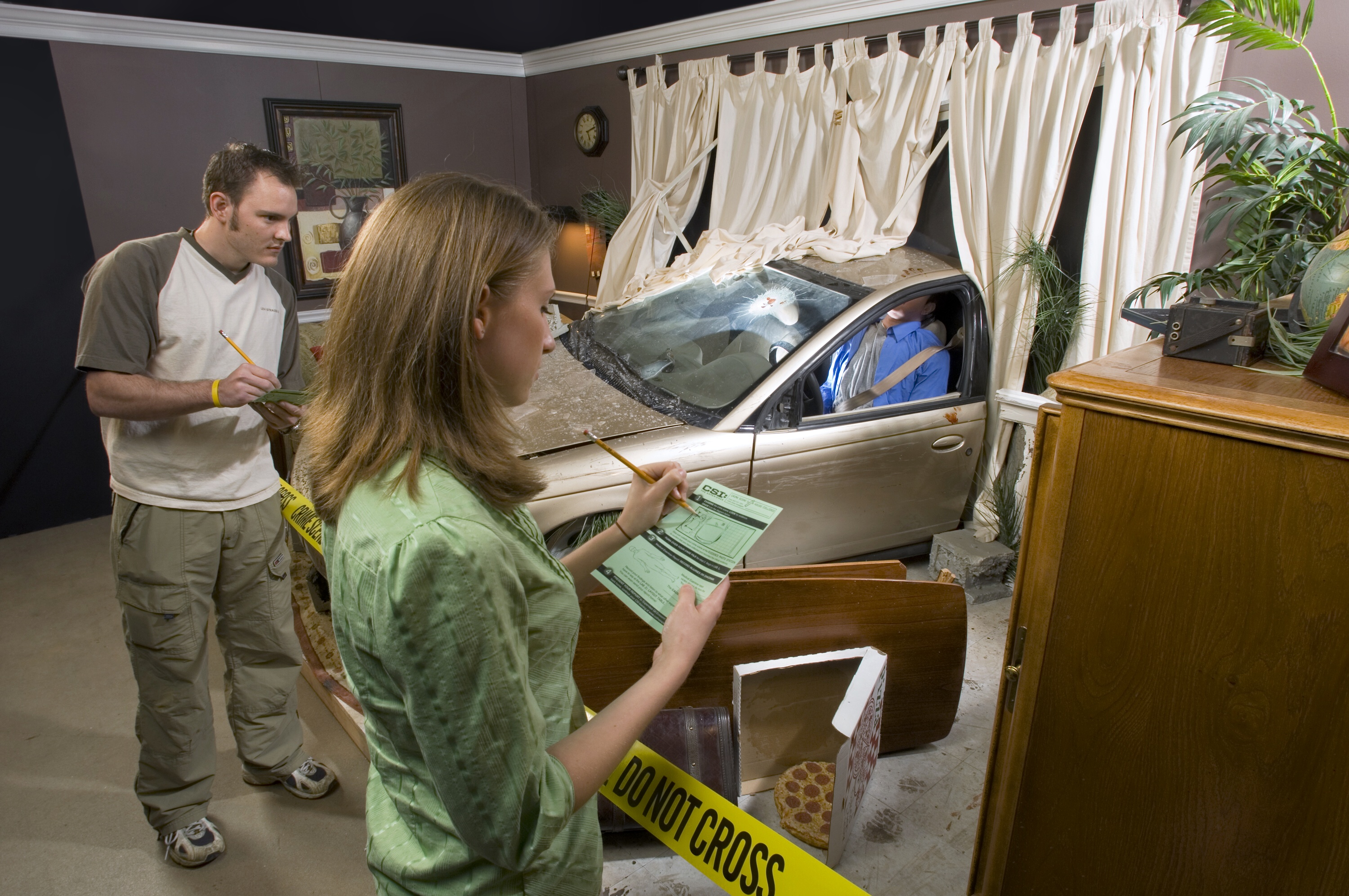
In “A House Collided,” a car has smashed through the living room window of a
house in a quiet suburb. A man with his seatbelt on is in the driver’s seat, slumped over. The windshield is shattered and the car door is shut. In the living room, there are muddy shoeprints, drops of blood and a stain near the sofa. A pizza box is open with pepperoni pizza spilled on the floor. A beer bottle is by the car door, and a hand print of blood – or is it pizza sauce? – is found on the hood.
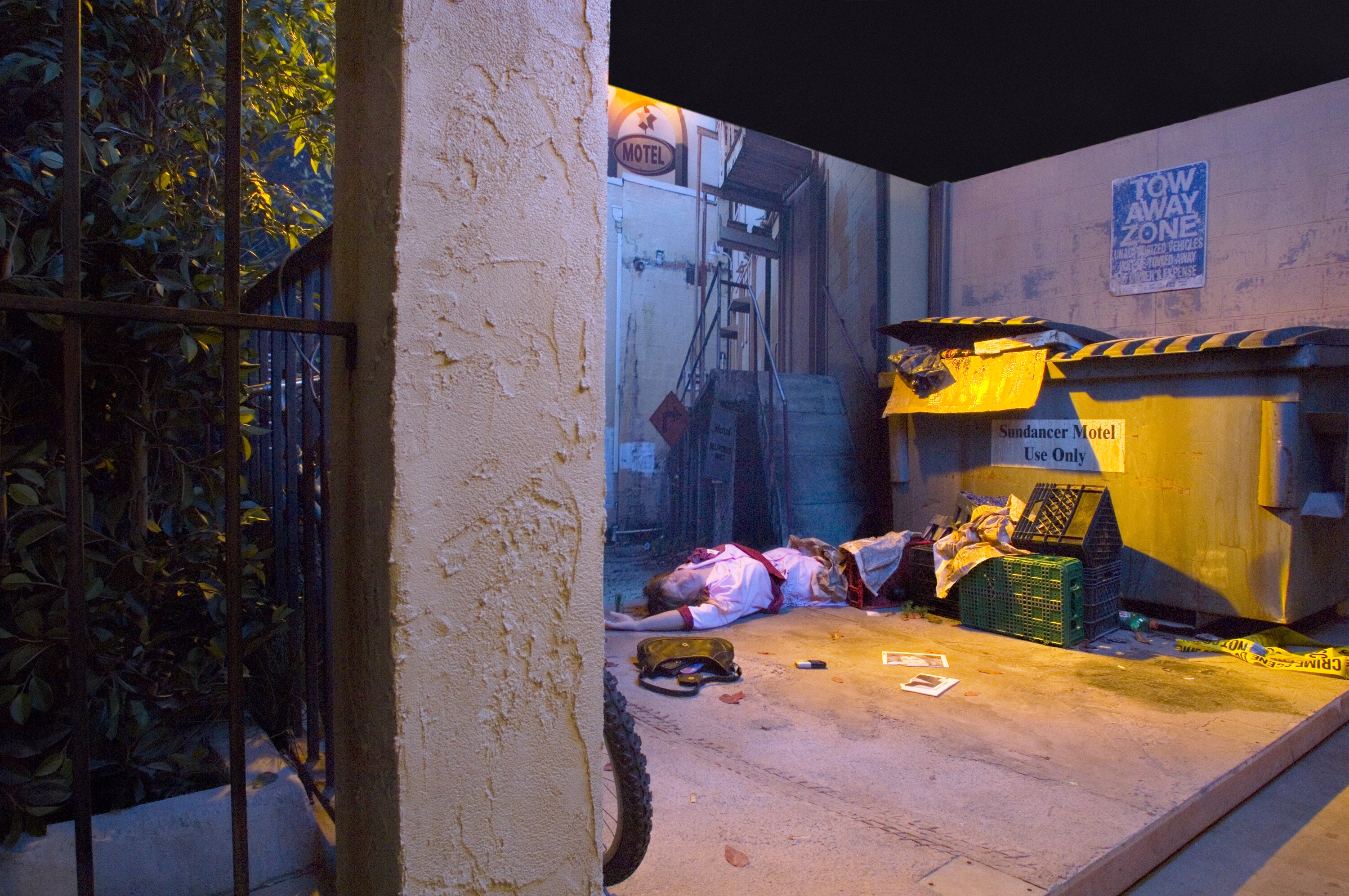
an old Las Vegas motel. She is sprawled beneath a dumpster overflowing with trash and is wearing a waitress outfit with a nametag that reads “Penny.” There is a tire tread across her abdomen, and a photo of her has been ripped in half and tossed away nearby. No other injuries are visible. Among the trash, a handbag and a cell phone are visible.
Bones About It!” a hiker has stumbled across what looks like a human skull sticking out of the ground, with a visible hole in it. It is partially buried by silt and debris. Other bones are scattered underneath the dirt. Among the remains, there are still tattered remnants of a coat and what appears to be a backpack.Beginning the Investigation
A
fter exiting the crime scenes, refer to a large wall of crime scene photos and clues that might have been missed. Then, begin to analyze evidence in two highly interactive lab areas, each featuring multiple stations that present different kinds of evidence testing.Visitors investigating “A House Collided” will compare fingerprints of the victim to the evidence; examine blood spatter patterns; observe the shoes of the victim and tracks found in the room; compare fibers on the victim’s clothes with fibers in the room; analyze the victim’s blood-alcohol level; compare DNA of the victim with evidence; and eventually discover the cause of death.
F
or “Who Got Served?” visitors review the evidence found on a cell phone; examine the contents ofVisitors working on “No Bones About It” analyze the bullet from the skull and hairs found with the body; examine a seed found in the fabric of the tattered shirt; test the DNA of an animal’s hair; compare dental records to the victim; and discover the cause of death.
Cracking the Case
Grissom's Office - Here lies the moment of truth. At the end of the exhibit, visitors present their interpretation of the evidence and are asked to answer a series of multiple choice questions, based on their scientific findings, on touch screens located in this area. After completing these questions, they will get feedback from Grissom and see if they have cracked the case.
Visitors will understand the principles underlying the following areas of forensic science: DNA identification, toxicology, forensic anthropology, entomology, forensic pathology, forensic art, firearm and toolmark identification, information technology, latent prints, and blood-spatter analysis. Also, visitors will use information technology in their investigations to: Simulate the analyses of clues using database technology; comprehend the role of human judgment, even when using advanced technology; compare historical methods of crime scene investigations with today’s advanced forensic sciences.
Don't miss this first-of-its-kind exhibit. Visit Houston's Museum of Natural Science. If you really want to know who committed the above crimes, visit CSI: The Experience. Preview the video here or check out the exhibition guide here.
Tweet