Showing posts with label Robin Sax's posts. Show all posts

Monday, September 26, 2011

Now you see it … The Eyewitness Controversy


It happens in a flash, usually without warning, and certainly for victims and witnesses, without much in the way of preparation. One minute they could be minding their own business; the next they can be in the throes of a crime. Murder, rape, and robbery–you name it–crimes literally happen in the blink of an eye.

Just as quickly, a moment can change the trajectory of a defendant’s life. That moment is the moment they are identified as the one who did it. While courts and prosecutors have long given lip service of the magnitude of this issue, eyewitness misidentification has finally become a real issue that is finally being looked that’s to a historic ruling by New Jersey’s Supreme Court.

As a deputy district attorney in Los Angeles, I handled all kinds of cases with all kinds of evidence. Much of that evidence came from the witnesses and victims to the crime. Witnesses who often swore they could never forget the face of the bad guy. But could they? Really?  

Let's have some perspective here. The most heinous crimes out there–child abuse, sexual assault, rape, domestic violence, elder abuse, and stalking–are crimes that are perpetrated by someone whom the victim knows, and often knew well. These are the cases you hear about in the news. Less discussed are the “stranger” cases, where the victim and perpetrator have no connection, didn’t know each other, and were only brought together through some random (or not so random) senseless act of violence. These are the “ID” cases.

Witnesses are supposed to be considered just like any other type of evidence in a case --blood, sperm, fingerprints-- but they’re not. We all know that the truth is, juries love witnesses. Nothing persuades a jury more than the, (cue the theme music) “Law and Order” moment when a witness takes the stand, looks over, and points to the suspect and says, “There he is. He’s the one who did it.”

In every case, the prosecutor is trying to figure out whether they can make a case. And while we try not to put the pressure on victims to perform the reality, there is a great deal of importance in determining whether the witness can testify credibly, whether their story makes sense, and, more importantly, points to who did it.

The defense attorney, on the other hand, is trying to hold the prosecutor to the burden of proof the Constitution guarantees–that is, the prosecution must prove its case beyond a reasonable doubt. So, as a defense attorney, those words of the witnesses are not about simply making a case; they are about making darn sure you have the right dude.

In my defense work, I pride myself on acknowledging that a crime may, or assuredly did occur. However, I am going to make sure that the prosecutor can prove that the perp is my dude, and not some other dude or SODDI, the known acronym in the legal world for “some other dude did it” defense.

We all know about reliability issues with witnesses. Some have an axe to grind, some have a prior relationship, others have a criminal record or unsavory past, some are drug users, hookers–you name it. But credibility issues are one thing; witness reliability when they are otherwise credible adds a new wrinkle to the equation.

And this is a wrinkle that will really make a dent in criminal prosecutions and finally confirm what defense attorneys have been groaning about for years. And that is that eyewitness identification is inherently flawed. Make no mistake, the New Jersey high court’s ruling could forever change the way police use witnesses to identify bad guys. The US Supreme Court is going to weigh in on the entire issue for the first time since 1971.

Here’s what I’ve witnessed myself over the years: When witnesses say they are 100-percent sure, I’m 1000-percent sure they are not. Why? Our minds and our memories are far from perfect. Sometimes we can’t remember what we had for lunch yesterday. Think about what can happen when a crime is involved. Think about the fear, hate and all kinds of trauma involved here. The chance for unaffected memory is next to zero.

Now, let’s add on the impact of law enforcement. Let’s say you’re a rape victim. The cop who comes in to help you catch the rapist is going to have enormous influence on you. So, if he or she shows you a photo of the bad guy, chances are you will end up agreeing with the choice. I’m not suggesting this is a deliberate act, but it happens all the time. We are only now beginning to understand how a witness experiences and remembers events, faces and time.

The New Jersey Supreme Court Justice, which ruled in the case, said it best: “A vast body of scientific research about human memory has emerged. That body of work casts doubt on some commonly held views relating to memory.” 

Barry Scheck, founder of the Innocence Project and who is famous for using DNA to overturn wrongful convictions, released the following figures from the Project’s files. Of the first 250 wrongful convictions cases overturned by DNA evidence, 190, or 75 percent, involved eyewitnesses who turned out to be flat-out wrong.

Now the courts are finally acknowledging there are issues of eyewitness identification. The question is what is the solution? Prosecutors would like to say defense attorneys could simply argue their cases (but how?), some defense attorneys will argue for exclusion, suppression or limitation of the evidence altogether. Courts allow for experts to appear to testify about the inherent flaws, or even permit jury instructions that address the issues inherent to misidentification by guiding jurors through the process. All of these may be great solutions but they are fixes to a bad identification.

When a person is facing incarceration, loss of liberty and other collateral damages, after-the-fact fixes are just not good enough. We live in a country that forces prosecutors to meet their burden of proof.  Isn’t it time law enforcement be held to the standards that correspond to that heavy burden?

So what am I suggesting? I am suggesting we do something about identification at the critical moment when the initial interview and identification is happening. That is creating a standardized “best practice” system to account for the inherent issues of misidentification, lack of reliability and suggestibility. The simplest and easiest of these can be done right now with only the cost of a tape recorder. If police are required to tape the entire interview with each witness, victim, and suspect then at least everyone can hear verbatim what went down, how the interview was conducted, and how an ID occurred. It is a transparent option that at least will allow attorneys to argue and then jurors to decide for themselves if the identification was good or bunk. There are tons of other ways too, but in a budget-conscious society, one resistant to change, let's start simple with a $15 tape recorder.

If we clean up that part of the investigative chain, we’ll all be able to live with the results as the case makes its way through the system. Memories are flawed. Law enforcement can be too. Let’s remove as much of the human-error part as possible. It’s going to be a better result for justice, which is better for everyone.


Wednesday, August 24, 2011

Casey, Michael, and Nancy

By Robin Sax  Casey Anthony, Michael Jackson, Nancy Grace … It sounds like the beginning of a bad joke, doesn’t it? I wish I could say it was. It’s not only not a joke but it’s crux of a legal argument.  Imagine this --The King of Pop -- now being mentioned in the same sentence as -- wait for it, ‘Tot Mom.'   That’s right, Casey Anthony is casting a giant shadow in a courtroom thousands of miles away from her Florida legal extravaganza. Lawyers representing the doctor accused in the Jackson drug overdose case, are demanding jurors be sequestered in this case. Why? Because, they say, interest in the upcoming Conrad Murray trial will be bigger than the Casey Anthony trial. Murray’s Lawyers have even gone on to say, “There is a reasonable expectation that Dr. Murray’s trial will be the most publicized trial in history."   Now, let me say I don’t disagree. Some of you may actually remember I left the Los Angeles County DA’s office because of this case. I knew on June 25, 2009 (the day Jackson died) what lawyers are arguing now. This case would receive gavel-to-gavel coverage. Now before you balk about my self-promotion, think about it, our society is obsessed with crime, obsessed with celebrity, obsessed with drama, characters, LA, so it’s the perfect story. Knowing this was going to be the biggest case of my time, I was NOT going to miss the opportunity to opine, as I actually have the skinny, the insight, and know the nuances of my former offiice. The LA District Attorney’s office -- the players, the case, the evidence, and strategies -- will all be under intense scrutiny. Who better to cut through the hype than a former DA like me?   OJ was called ‘the trial of the century,’ but that was before the world-wide-web. OJ was covered via good old fashion cameras, radio, and reporters. But that was before Nancy Grace, bloggers, tweets and status updates. And Casey proved it – minute-by minute coverage paid off with sky-high ratings.  And she wasn’t even famous. 
When everybody’s jaws finally returned to normal after the Anthony not guilty verdict, the experts began discussing what kind of impact this case would have on the jury system. I was one of them. Was I surprised by the Anthony verdict? Not really. I know what it’s like to stand up in front of a packed courtroom for a big trial. I know what it means to prove a case beyond a reasonable doubt, and never discount the burden of proof, something I think the Florida prosecutors did.   This one is going to be big. I just hope that the DA in LA doesn’t watch too much of its own press, drink too much of their own Kool-Aid, or get too cocky, like the Florida prosecutors did. This case, while seemingly easy on the surface, is actually tough. There are many legal nuances presented by a case involving a drug like Propofol. Then, there is the question of whether Michael was responsible for his own demise or not. And even with the best lawyers, a smart judge, and a good jury, the DAs will have to do their job. And they will have to do it even better than they think.   Los Angeles County Superior Court Judge Michael Pastor has previously said he doesn’t believe round-the-clock isolation of jurors is going to be necessary. And whether you agree or not, one must ask how much does the analysis, the talk, and the hype affect the case. Was Casey Anthony acquitted because her case got too much attention? I mean her jurors were sequestered after all. Face it people, circumstances impact all cases. Rampart haunted LAPD for years. Kobe Bryant and the DSK cases affect all rape cases. We are a knowledgeable society, and we will weigh in. But are we weighing in fairly? I mean how crazy is it - the “People versus Dr. Conrad Murray” is being dubbed, ‘The Jackson Trial.’ Michael’s family will be seated in that courtroom day-in and day-out. His parents, siblings and his children will watch, as Michael is once again center stage. His health, use of drugs, odd behaviors, and yes, the condition of his body after death, will be exposed for all to hear. TV, analysis or not, these circumstances will affect the case just as much as a camera, and yes, even Nancy Grace.  
The prosecutor in this case, Deputy District Attorney David Walgren, is a darn good lawyer. He’s fair and hard working, but in this post-Casey Anthony era, does he stand a chance? The evidence as laid out so far, seems to put Murray in a heap of trouble. But we’ve all seen what reasonable doubt can do to a jury. After Casey, I called for professional juries. The idea isn’t a new one, but it may be worth looking at. With 24 hour, seven days a week coverage of a case like this one, what pressures will Murray and his defense team face? What about the DA and his team? Can justice prevail? I don’t know about you, but I’ll be watching, tweeting, and Facebooking just as I’ve planned since 2009.  Photo credit: ...ven y siente el RUIDO 


Tuesday, July 26, 2011

Rushing to Judgment from Coast to Coast


The dust is just beginning to settle from three of the most explosive legal cases since O.J. rode in the Bronco on the 405, long before we knew anything about “Carmageddon.”

First, there is Casey Anthony, where once again our jury system has left people outside the deliberation room scratching their heads.

Then there’s the DSK debacle. Dominque Strauss-Kahn’s accuser told her story publicly, and while I find it compelling and convincing, it won’t matter for the case; it is O-V-E-R.

And in Los Angeles, law enforcement’s latest example of dropping the ball is the case of the wrong bad guy arrested in the brutal attack on that fan at Dodger Stadium. After arresting a suspect, and telling just about everyone they "had their man," police have now let that suspect go, only to arrest two others, who are what they now call the ‘real’ suspects. Some say, “Hey, he was on parole. No charges filed so no harm, no foul.” Well, maybe–or maybe not. 

If you don’t think these news stories affect all the other run-of-the-mill cases in courtrooms each and every day, think again. From my days in the Los Angeles DA’s office, I was forced to clean up a ton of debris left behind by every quick-acting, non thinking, big-mouth prosecutor or police officer. During the Rampart scandal that tainted the LAPD, I had to hear defense attorneys drone on during voir dire about whether ‘police officers can be trusted.'

After the Duke Lacrosse case, where a corrupt district attorney turned a sex crimes case into a three-ring circus, I had to listen to defense attorneys make arguments comparing my legit victim to the phony victim in that case–or even worse, comparing me to DA Mike Nifong.

In the Dodger beating case, defense attorneys are already picking holes in the case against the ‘new’ suspects.  As a defense attorney, I’d do the same. If cops didn’t get right the first time, why would this case hold water? In fact, there is no doubt in my mind in light of the DSK case as well as the Dodger fan-beating case, courts and jurors will be inundated with the themes of ‘rush to judgment’ with either direct or indirect reference to these two cases. So, what went wrong, and why the rush to judgment?

It’s easy to blame the media. Rightly so, I have appeared on and watched many a cable panel try, convict and sentence before the first commercial break. Is this what we want from our justice system? But blame the media all you want, it’s the officials who make the decisions and it’s the officials' words on whom we rely.

As a prosecutor and defense attorney, we constantly have to deal with the fall out of the media. People blame the media yet it’s the public that feeds the media machine. So, I ask you why are we so obsessed with these cases, are the officials forced to give answers, and is the rush to judgment simply a rush to appease the media watching public?


Tuesday, June 28, 2011

Medical Marijuana: The Voters Have Spoken


The stories are heartbreaking. Young mothers fighting to survive the ravages of breast cancer and the nausea of chemotherapy; seniors struggling with the tremors of Multiple Sclerosis. Illness has touched all of our lives in one form or another. Whether it is cancer, glaucoma, Crohn’s disease, or even Alzheimer’s, we have all seen people live in pain. I am not talking about minor “ouchies”–this is chronic pain: debilitating headaches, inability to eat, swallow–pain that makes the one suffering just want to curl up in a ball and die.

Doctors have an arsenal of drugs to try to help those patients, medications like OxyContin, Vicodin, Valium, and Morphine–powerful drugs that come with serious side effects like addiction. These drugs often don’t even work to erase the pain, leaving the patients in a hazed out prescription cloud.

As a society, we have all become very well versed in caring for our bodies. Eat healthy, exercise, watch your red meat, a glass of red wine is okay, as is dark chocolate. We’ve even become more open to alternative medicine such as acupuncture or homeopathic remedies, which are now are seen as real options. But not, it seems, when it comes to the use of medical cannabis – otherwise known as therapeutic marijuana.

Why do people have so much trouble with therapeutic cannabis? Many people see their mission in life is closing down cooperative after cooperative, collective after collective, and dispensary after dispensary. What’s worse, these people are our community leaders–elected officials, city councils, small town mayors. It’s mind-boggling, frankly.

California voters spoke in 1996 when they approved Proposition 215 allowing for therapeutic use of cannabis. The people have spoken, and yet their voices go unheard. The political nonsense doesn’t even end there. The government itself has acknowledged the benefits of therapeutic cannabis. Yep. None other than the U.S. Department of Health and Human Services took out a patent based on research done by the National Institute on Health. Patent number 6,630,507 states unequivocally that cannabinoids are useful in the prevention and treatment of a wide variety of diseases including auto-immune disorders, stroke, trauma, Parkinson's, Alzheimer’s, HIV dementia.

So, the voters have voted and the government has acknowledged that patients can get relief and yet the courts are clogged with the day-in, day-out state/federal war over this issue. Give me a break. Isn’t there a better project for a city or county to worry about than therapeutic cannabis? Now don’t get me wrong, I am not suggesting every farmacy is legit. But how about some standards, regulation, or at least some recognition for the people that do play by the rules?

A better example of the rub and constant governmental shut down than a case in the little city of Temecula in Riverside County. Despite the California law enactment in 1996, and an additional Senate amendment passed in 2004, Temecula unilaterally decided to ban dispensaries in the city of Temecula in 2006. Per the report that was done at the time, city staff members justified their ban by saying that there is nothing in state law that requires Temecula to allow dispensaries within its boundaries.

Doug Lanphere, tireless advocate, and the force behind Cooperative Patients’ Services, or CPS, in Temecula, is insistent on dotting the i’s and crossing the t’s. He has carefully studied all of the Department of Justice requirements and prides himself on CPS’s undisputed class act collective. He is happy to oblige in insuring patients can be treated, and the city’s concerns dealt with. He has voluntarily submitted himself to various law enforcement agencies to walk through, and approve the collective, as well as offered time and time again to meet with city officials, and police representatives in order to work together in the mutual interest of serving their community.

Colleen is a member of Doug’s cooperative and she is what keeps him awake at night–trying to figure out how to keep his doors open despite legal attack after legal attack by the city of Temecula. For Colleen, and every other suffering patient, I say give them the choice to do what the California legislature allows. Let them have access to the therapeutic cannabis. If it can help, who are we to remove that chance for some relief, and perhaps even some quality of life.

CPS has an important function in Riverside County. Unlike Los Angeles, San Francisco or other areas known for “lax” drug rules, Temecula serves a small desert community where many people move to the dry heat specifically to assist in their health matters. Patients like Colleen, a nurse, who has found cannabis the only way to beat back the agony of her ruptured spinal discs. From her morphine haze she called cannabis the only treatment that gave her some sense of quality of life, something opiates could not.

So I ask you; isn’t time to listen to the voters and let those who are ill be comforted with the therapy that works?

To stay up on CPS and therapeutic cannabis follow on Twitter at @coop420cps

photo credits: Goodnight London and harminder dhesi photography


Monday, May 30, 2011

Denial In Naples: The Case of Steven Noyes


One would think that in the year 2011, given the advances in technology, communication, and social awareness, child sexual assault would not only be accepted as something that exists but should at this point be known as a crime that takes a particularly skilled type of perpetrator to commit. Yet, everyday very smart, caring people put theirs and other children at risk by not accepting the very harsh realities of child sexual assault. 

Today’s case of denial begins in the tight-knit Naples, Florida community at a school dedicated to Christian values where a young 9 year old -- herein referred to as Doe did as we hope any child would -- reported that her beloved teacher Steven Noyes touched her. Yet as the news spread throughout the school community, as is often the case, a loud group of disbelievers, naysayers, and deniers made their voices heard.  It is the children of those people that I am most concerned for.

What motivates those members of the school community jump to the teacher's defense? Why do people in these cases automatically disbelieve the victim and support the teacher? Is it possibly because the parents cannot stomach the image of a teacher being a sexual predator? Is it all about denial? Are these people naïve or are they cruel? Eternal optimist that I am, I'm betting on naïve.  So as we sit here and pat ourselves on the back about how far we have come when it comes to sexual assault, I say it's time to accept the facts:
  • When society accepts the myths surrounding sexual abuse, it assists sex offenders by silencing victims and encouraging public denial about the true nature of these assaults against children.
  • Even "really great" and "really nice” teachers can be sexually inappropriate. As a matter of fact, the "nicer" the teacher is the more likely that the teacher is using charm and kindness as a way to groom and seek victims.
  • Statistics show that the number of false allegations of sexual assault are far less than the number of truthful allegations of sexual assault. Yet, the default mode is to disbelieve, rather than to believe, the victim.
  • 1 in 4 women will be assaulted in the course of her lifetime. It is because of the blame, denial, and fear that many do not report the crime.
  • Not everyone who comes in contact with a child molester will be abused. In truth, sex offenders tend to carefully pick and set up their victims.  Thus, while sex offenders may feel driven to molest children, they rarely do so indiscriminately or without a plan.
  • Sexual assault survivors are never responsible for the attack, no matter what, no matter how much alcohol was consumed. Responsibility lies with the perpetrator; the survivor is never responsible for the assailant's behavior.
THE PEOPLE
Jane Doe  is an outgoing, kind girl, who still to this day doesn’t even get the sexual nature of a breast-touch, or even breasts as sexual body parts.  She had loved the Village School of Naples since she started there in kindergarten. 
Her parents are the kind of folks you’d want in your community and in your school-- trust me, you’d want them as your friends. They are church going, softball playing parents who take pride in their value-driven life. In fact, they chose Doe’s school because of its mission of, “educating the child’s mind, body, and spirit through Christian values in an ever-changing world.” 
Since the day they were made aware that Doe’s allegations had been reported to the school, they’ve felt anything but Christian values.  And the fact that Doe had to suffer the molestation wasn’t  enough; the teacher and the school decided to question Doe’s story. Interestingly it didn’t happen right away… no the questioning came right before the school was getting a visit for re-accreditation.  Hmm… coincidence? 
The teacher’s name is Steven Noyes, a one-time Golden Halo honoree, who has responded to the investigation by hiring a criminal defense attorney who hijacked the investigation. Noyes refuses to answer questions and refuses to take a polygraph--leaving the sheriffs who want to get to the truth no choice but to suspend the investigation until Noyes changes his mind. Thankfully there is no statute of limitations on child sexual assault, so if Mr. Noyes is faced with another case --therefore corroboration -- this case should come back to haunt him.
THE INCIDENT
The facts of the case are not much different than any other sexual assault.  That is, a a sexual assault that was reported early in the cycle of abuse like Doe’s.  After all, a perpetrator doesn’t just start with out with intercourse or oral copulation.  No--they start slow. They groom and groom to test the “loyalty” and vulnerability of their victim.
Just after Christmas 2010, Doe was in her homeroom class working on her math homework and got stumped on a long division problem. She asked her teacher for help. She went up to her teacher’s desk, and that’s when it happened.

As Doe tells her mother and father, the teacher began helping her with her first question. He put his hand under her dress and on her knee. Then, he reached his hand up her back and under her shirt, coming around the front to rub her chest. He kept his hand there while he helped her with three other math problems.

Afterward Doe didn’t protest. Instead she thanked Mr. Noyes and returned to her seat. She didn’t understand what just happened to her, but she couldn’t push one thought from her mind. When she went home that night, Doe says she still feels her teacher’s hand on her chest. It’s a horribly vivid sensation she can’t shake. As Doe’s mother was getting ready for our courthouse press conference, she told me “Doe still feels that hand--to this day."


THE AFTERMATH

The parents didn’t panic, but they simply wanted answers, direction, and support. They didn’t call lawyers or press instead they approached the head of the school, Ginger Sauter, a woman they’ve gone to church with for years, as a friend. Ginger told them, “this is all my fault, I shouldn’t have let him hug the children.”

Then things quickly turned from bad to worse. A criminal investigation began on January 21, 2011, two days after the incident, conducted by an officer from the Collier County Sheriff’s Department. On January 28, the investigator received a phone call – not from Stephen Noyes, but from his criminal defense attorney – who informed the officer that Mr. Noyes, “would not be answering questions, or submitting to a polygraph examination."
On February 1, the same officer paid a visit to the Doe’s home. The little girl bravely met with the investigator, even agreeing to wear the same dress she wore to school that day. She even allowed him to photograph her in it.
Then the officer informed Doe’s mom the investigation had gone as far as it could.  He told the family that he could find no other leads, no other child to corroborate Doe’s story, and with the suspect, ”not agreeing to speak to me,” there was nothing further he could do. And so, the case would be suspended.  So sad, how this suspension somehow provides some people with an excuse to think that this crime couldn’t have occurred. As if the abuse and aftermath was not enough, The Village School of Naples added salt to the fresh wound.
The school doesn’t sit the family down to discuss what to do next. They church pastor, closely associated with the school, does not come to administer spiritual support to the family, instead the Village School quietly expelled little Doe from school!  How’s that for child-centered education? The teacher was allowed to return to his job. Imagine. You did the right thing and they don’t believe you.  In a blink of an eye, you go from honor student, to expelled student.
THE LAWSUIT


Child sexual abuse has reached epidemic proportions in schools throughout our nation and has become an alarmingly frequent occurrence. The cases that are surfacing almost daily serve as a wake-up call to everyone in America to protect our children.

The teacher, Steven Noyes, is by all accounts "beloved” and has a clean record. The same scenario goes for the priests who sexually abuse children and all of the other people who choose careers working with children, only to groom them and then sexually abuse them. That’s the typical M.O. of a child abuser. And yet it is the priest, or the accused teacher, who often is believed over the victim.


The day of our news conference, as Doe’s parents nervously walked up to the podium of microphones to face those cameras, there was a taint of disbelief in the air, as though someone had convinced the reporters covering this lawsuit Doe had made-up this story. The questions from the press came fast and furious.

"Wasn’t there a complete investigation?"

"Didn’t they close the case due to lack of evidence?"

I answered one by one.

"No the investigation isn’t over, it was suspended when Mr. Noyes refused to answer the sheriff’s questions."
Some of the questions came from a man standing among the press core.  Well-dressed and well coiffed despite the heat, we learned he was criminal attorney Jerry Berry. Berry began shouting his comments from behind the line of cameras.
I invited him up so he could speak his mind.  He began to attack us--for filing a lawsuit, for holding a press conference, and worst of all the press seemed to go along with this approach. Yes, they wanted to know, why do you want to sue the school. 

This is the story of a father who believes, and is standing up for his little girl. It’s about a mother who wants to make sure no other child goes through the pain and suffering her daughter has. The goal in filing a suit is to get answers, to hold the school accountable; to make sure that this case is not simply swept under the rug.

It is our goal to have a safe forum for people to come forward as we know that there are likely other victims out there. My co-counsel Jeff Herman said it best, “Now we wait for the other girls to come forward. The ones who also know they were touched inappropriately, but suffered in silence."

Our suit describes what happened to Doe. Over the years, Noyes reportedly the “hugging” teacher essentially groomed his young victim. He showered her with affection, drew her close and built a relationship based on trust.
Doe’s parents told me they feel he groomed them too with signs of friendship over the years, all the while insinuating Doe closer and closer into his circle. They remain solid in their conviction they are doing what’s right. And their daughter gives them the strength to do it. After she won an award in her new school, she said, “see mommy, God rewards good people.”
I hope so. I really do.


Wednesday, April 20, 2011

Cell Phones Are Not All Bad


by Robin Sax

Oprah, I’m sorry. Please don’t think I’m a bad person because of what I’m about to write here.

I have a confession to make. I love my phone, I love technology. and I love being connected, in touch, and up on the latest, even if it causes me stress or overloads my synapses or interferes with a meal here and there. Yep, I’m one of those. You know exactly the type, the ones who are seemingly always texting, tweeting, updating, emailing, and even sometimes talking. Basically, if it involves my phone, count me in.

There are many published articles that criticize cell phones for any number of reasons, with the majority focusing on the same theme that being connected is distracting, dangerous, and even lethal. Not coincidentally, lobbyists, concerned citizens and legislators have rallied around this issue. There is even a zero tolerance time in California, with the state declaring April Distracted Driving Awareness Month, and we all have heard Oprah’s truly wonderful campaign against texting while driving (I signed that pledge).


Let me be clear: I am not here to say that all of these cell phone campaigns are not worthy, but I am also here to embrace the cell phone by taking a moment to celebrate (or LOL) about the anniversary of probably the single-most used piece of technology, the cell phone. Thirty-eight years ago the first public cell phone call was made by a Motorola executive walking on the streets of Manhattan. We’ve come a long way, baby. 


Before I highlight the benefits of cell phones, I must clear up an essential misnomer. Cell phones are not phones. Cell phones are mini-computers, mini-cameras, mini-video recorders, GPS devices, and phones all rolled into one, and that’s the beauty of these devices. Yes, they help connect our worlds, but when it comes to crime, their benefits are even greater.

We know that criminals exploit technology and advance their behaviors as technology advances. Well, folks, cops can too. And it is these benefits that have saved lives, found people and provided essential evidence later on. 

Let’s take a look.

Emergency scenarios: It's not news that cell phones often record key elements and evidence in a life-threatening disaster as well provide a lifeline and assistance in an emergency scenario. Cell phones have played a role in emergency events, from 9-1-1 calls, to young people lost while hiking or rock climbing alone in the mountains.

Crime reportinting/memoralizing: Victims and witnesses who find themselves in a crime scene have been able to use those devices in many ways--instantly calling law enforcement, snapping photos, and utilizing data stored in phones (for example, registration and insurance).

Law enforcement is often able to see the last searches on a suspect’s cell phone, Internet browsers, and can even start to form a criminal profile based on the kinds of apps, games,and searches the suspect uses.

Drug crimes: Phone records, cell phone camera pictures of drugs found as well as “pay and owe lists” stored on a drug dealer’s cell phone provide a veritable treasure trove of information. And it's all kept in one place. Before cell phones, drug dealers usually kept this incriminating information on little slips of paper shoved in wallets.

Missing persons/kidnapping: With these crimes, time is of the essence. Cell phones can let authorities know where people are. The last calls made can determine who was called, where the person was going, and where a ping goes off on a cell phone tower that helps find the location of a victim.

Domestic violence: Secret cell phones allow victims to memorialize their abusers' crimes and eventually leave the abusers. Victims can get cell phones with disposable, non-traceable numbers.

Serial killers: They often like to memorialize their crimes on their cell phone camera leaving law enforcement with ready made evidence.

Sex crimes/child pornography: Cell phones are one of the best ways to corroborate child sexual assault. In addition to porn, phones store text messages and ping locations provide the corroboration that is necessary to prove a sex crimes case. Given that cell phones are used so often by just about everybody, it's nearly impossible for a perp not to lead to a mark in the phone that will lead to eventual corroboration. In addition, child pornographers as collectors often carry and store images with them, thus making it an immediate value a crime scene evidence right there in the phone itself. 

So, while I totally agree with the downsides and problems with the cell phone, please don’t blame the device. Happy anniversary, cell phone. It’s been great working with you. This is truly a relationship that can last, so long as we all do not text and drive.


Monday, March 21, 2011

Should Teens Be Charged as Adults?


We don't let children vote and we don't let children sign contracts, but once they're old enough to drive, they should be able to stand trial for murder ...?

Prosecuting children as adults is a touchy subject, especially from the perspective of one who advocates on behalf of children. A brutal, callous case that occurred in September 2010 got me thinking about this very topic. On that evening, 81-year-old George Baker was indiscriminately attacked while walking down the main street of sleepy Lynchburg, Virginia, after attending his granddaughter's wedding. The Tempe, Arizona, resident was on his way back to his hotel from the reception when two 16-year-old boys and one 13-year-old boy randomly attacked him.

A police search-warrant affidavit connected with the arrest of the three juveniles describes how, immediately before the attack, one boy had told their female companions that he was going to hit the next person he saw, thinking this would impress the girls. That boy then struck the elderly gentleman, who fell to the ground. The second boy then kicked the unconscious Mr. Baker in the head. Mr. Baker, who had extensive head injuries, died at the hospital early the next morning.

The three teenage boys were arrested after being identified by witnesses to the attack. All have been charged with murder. The two 16 year olds were charged as adults, in accordance with Virginia law.

But is that correct? And who decides? Treating a child like an adult can be a decision made either by the court or by the prosecutor. The leading U.S. Supreme Court decision of Kent v. United States actually delineates the factors that should be considered in making this determination – namely, the seriousness of the crime, the suspect's age and the suspect's criminal past. Most people do not understand that serious reflection goes into the decision to try a child as an adult. In fact, by an eerie coincidence, Virginia's current policies governing how and when to prosecute juveniles as adults was being reviewed by the Virginia State Crime Commission during the very week of Mr. Baker's attack.

The discussion surrounded proposed legislation that would allow a juvenile's lawyer to appeal the transfer of violent-crime charges to a non-juvenile court. Proponents of charging juveniles as adults cite the actual reduction of juvenile crime in Virginia since a 1996 law change, which requires the automatic transfers of murder and similar aggravated-malice charges to adult courts for juveniles over 14. Who knows whether this week's events will have a bearing on the final decision about what the state does with violent juveniles? At least the topic is being intelligently and systemically debated.

These decisions don't come easy–and they shouldn't. Children are our future, and there cannot be a one-size-fits-all approach. The only way to decide if it is an appropriate choice is to weigh the facts. In this case, the factors as we know them are:

    •    At least one of the three defendants had a premeditated plan.
    •    Two of the three are 16 – of age to drive (and even to consent to sex) in most states.
    •    The victim was a particularly vulnerable 81-year-old man who was by himself – and, by all witness accounts, doing nothing to provoke the attack.
    •    The crime showed a great degree of callousness: The boys allegedly continued to kick and beat Mr. Baker when he was on the ground and not resisting.
    •    This is not the boys' first interaction with law enforcement.
    •    The boys have been associated with a local gang.

Given all of that, is it bad that the children in this case (not every case) are being treated like adults? I say no – and kudos to prosecutors in Virginia for holding the perpetrators accountable for this despicable crime. The defendants – nicknamed The Lynchburg Teens – were tried for murder and convicted in the beating of George Baker.


Tuesday, February 15, 2011

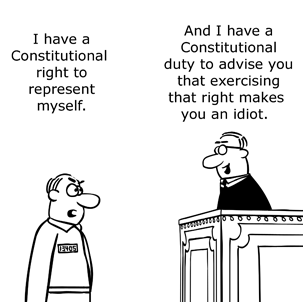
A Fool For A Client, Or Foolish Not To Consider Representing Yourself?


"He who is his own lawyer has a fool for a client” is the proverbial expression warning against self-representation, but is it really true?

A person, or even an attorney, who represents him/herself in a matter is considered a pro per or pro se litigant. Most professionals look down their nose on those who represent themselves. Even non-professionals poke fun and criticize those who represent themselves. So is it really as dumb as people say?

Pro per or pro se representation is not limited to criminal cases. One can represent themselves in civil cases, including family law, in and criminal cases. So why would a litigant or, even more serious, a criminal defendant facing a prison sentence go pro per?

Data from the 1996 report of the Pro Se project overseen by Ayne H. Crawley of the University Of Maryland Law School found that
  • 57 percent of pro per defendants said they could not afford a lawyer
  • 18 percent said they did not wish to spend the money to hire a lawyer
  • 21 percent said they believed that their case was simple and therefore they did not need an attorney
A 1998 ABA-commissioned study found some public beliefs that may influence the choice
  • 78 percent believe “it takes too long for the courts to do the job.”
  • 77 percent believe “it costs too much to go to court.”
The 1994 ABA Study of Legal Needs found that predominate reasons for low-income households to not seeking legal help were that “it would not help” or “costs too much.” Predominate reasons for moderate-income households to not seeking legal help were that “[issue] not really a problem,” “can handle it on my own” or “a lawyer cannot help.” The Conference of State Court Administrators recently characterized this trend as “unprecedented and showing no signs of abating.”

Research in California indicates that pro per or pro se representation is not solely due to financial limitations. As reported in the National Center on State Courts study of 16 large urban trial courts in 1991 to 1992 – Domestic Relations cases, “a significant portion of the family law pro pers in California are not poor or poorly educated.”

There’s an equally important adage that comes to mind when I think of pro per cases that is not nearly as tired as the "he who has himself as a client" one. That is, "if you want something done right, do it yourself."

It is no secret that lawyers have a bad rap, with complaints of lack of communication, lack of interest, lack of focus, and most commonly, very high fees. It is for these reasons, plus unjust results, slowness of the movement of the system, that make many people mistrust the system. But besides these normal complaints, I often hear criticism that attorneys do not pay attention well enough to learn the facts of the case that they are handling. Or that a client does not feel enough person attention. Plain and simple, pro pers feel that they can do a better job representing themselves because they have more of an understanding of the facts of what occurred.

What does all this say about the work product and slow, or fast, slide of lawyers reputations. I mean think about it, a defendant in a criminal case or a parent in a divorce chooses to forego legal knowledge in favor of knowing the facts of case and thinking that will do better. Is that like people choosing to perform there own medical procedures because they know their own body better and don't need the help of experts? Or is there a distinction?

This may sound silly but it is not. I don’t blame a litigant or defendant for feeling frustrated by their lawyer not knowing whats going on. How can you have faith in the system if the lawyer can’t distinguish one sibling from another in a divorce case or know who was the shooter or who was the master mind in a complex murder/conspiracy case.

So should individuals go pro per or not? Robert Kearns, the American inventor of the intermittent windshield wiper, thought so. Immortalized by the film Flash of Genius, Kearns represented himself in his own patent infringement lawsuits against Ford and Chrysler, to the tune of multi-million dollar verdicts.

But what about the other side? Brandon Moon represented himself during his own rape trial. Even though he was the only blue-eyed, white male in a lineup some 18 months after the rape, the identification was admitted in court and Moon was convicted for a crime he did not commit. Moon spent 17 years in jail before the Innocence Project got him out by proving the DNA was not his. Ted Bundy went pro per as well. It worked out worse for him as the infamous serial killer and former law student was executed on January 24, 1989. The list goes on.

Crawley's study, discussed above, told us that it is true that there has been a "rising tide" of pro se litigants flooding the justice system. And our current court model was designed for a more "traditional" full representation model, whatever that may be. So where does it leave us?

Many aspects of the system of justice, from the rules to the training of judges and court staff to the physical layout of the courthouses themselves, have been oriented to cases in which knowledgeable attorneys represent the parties. But if you are considering pro se, there are resources out there for you. In California, you can start with the court's own "Self Help" site.


Thursday, January 27, 2011

Disabled Mother Fighting for Visitation Rights


“This is disturbing and sad on so many levels,” says Nicole Leibovitz Klauzar on my Facebook page. I whole-heartedly agree.

For those of you who missed this touching piece in the Los Angeles Times on Monday, January 24, titled “A Precious, Secret Meeting,” I will give you the summary. Abbie Dorn, 34-years-old, is confined to a wheelchair after suffering sever brain damage following a grave medical malpractice incident when she gave birth to triplets about three years ago. Abbie has not held her children since the day they were born because her now ex-husband is battling to prevent her visitation with her parents and custodians, Paul and Susan Cohen. Finally, just last month, Abbie’s children were allowed to spend a few precious hours with her.

As I read this article, I felt awful that a case like this is even tangled up in our justice system. I am all about fighting and duking it out in court when necessary, of course. I earn a living at it. But, does this father really have to fight this mother and her family so hard? Why shouldn't the kids meet their mom and get to know their mother’s family and their grandparents? One tragedy, their mother’s brain damage, doesn’t have to mean another tragedy, the alienation of the kids from the mom and their own relatives. It is outrageous. I mean, what or who, exactly, are you protecting the kids from?

Vicki J. Greene, who represents Dan Dorn (the ex husband), has argued in documents and in court that “the constitutional right to visit with one’s children is reserved for fit parents only.” According to Greene, Abbie “is incapable of communication (blinking is merely reflexive) and more likely than not, would not know or acknowledge her children if they were standing before her.”

In response, Lisa Helfend Meyer, Abbie’s attorney, puts it succinctly: “Even prisoners have the right to see their children.” Arguably it is in the best interests of these children to have a relationship with their mother. But even more so, the mother has a right to visit with her children.

According to an analysis by Solomon Park who wrote Involvement in the Child Welfare System Among Mothers with Serious Mental Illness, the Americans with Disabilities Act (ADA) does not yet provide adequate protection for parents threatened with this kind of custody loss.

The ADA does establish something called community integration as a right for people with psychiatric disabilities, though. The number of parents living with a mental illness in the United States is estimated to be in the millions. These parents are at a much greater risk of losing their children, and they need additional review and protection. Research has shown that mothers with a serious mental illness were almost three times more likely, when involved in the child welfare system, to have lost custody of their children. In light of this, the father never should have brought the fight to the system. He should have put the kids first and worked out an arrangement with the family.

It has been proved that being in the parental role, however limited, still remains extremely important to individuals with severe mental disability. It has been identified as a strong motivating factor for treatment and better recoveries based on research conducted by the UPENN Collaborative on Community Integration, based out of the University of Pennsylvania.

Some commentary from the LATimes website is worth sharing. In response to the father’s actions: Without question this father is violating Jewish law by fighting this out in court. Jewish law demands that the children and their mother have a relationship. His behavior is a major source of embarrassment to the Orthodox Jewish community. Lets all pray that Abbie has a full recovery (G-d should make a miracle!) and that she raises her 3 children in a loving environment away from this vengeful father!

In response to the mother’s actual mental condition: One neurologist suggests that this woman can see images and can remember family members. Her speech therapist is making weekly progress and Abbie can respond by blinking to Yes and No questions. Shouldn’t that be enough to warrant visitation rights? If there is even a sliver of a chance that this woman can see and recognize the fact that these are her children, what is the harm of her having some sort of visitation? Let’s say some of the doctors on the “other side” are right and she is completely brain dead – still, what is the harm of visitation? This just could be more beneficial for the children to see their mother, to know that the reason she isn’t and hasn’t been there for them is that she is ill.

Here is an opportunity for the father and the families to blend and create a unique magnificent family environment for the kids. The father has moved on from the marriage, but why wouldn’t he want his triplets to see their mother and extended maternal family? What is disturbing on so many levels is that this case has been tangled our justice system for the three years. 


 The picture you see of an imaginary healthy Abbie (above) standing with her three children was not posted in the online version of this LA Times story, but it did appear in the printed. Abbie’s mother had this painting made. As I look at this composite of what Abbie “should have been” (a mother raising her triplets in a home with love), I can’t help but muse on the fragility of life and how easily it can all be taken away by chance. It also makes me even angrier at this unfeeling father who is doing a further, almost crueler, injustice to his children by pursuing all this needless and expensive litigation to prevent them from seeing their mom.

Why hasn’t a judge come in and put a stop to this nonsense? As a mother and an advocate on behalf of children it is a no brainer that the longer the time away from a family in the formidable years the worse it is for the children. Critical family bonding time has already been lost.

I guess the thing that is so troubling from a legal point of view is that this is a classic maneuver of how the justice system simply mucks up what should be very clear. I think most people universally agree, as well as all the literature suggests, that kids thrive the most when they have some relationship with their parents, and that bonding begins from the first moments of life and continues throughout development.

All kids do better knowing their parents and having a relationship with them. As a matter of fact, it is even the goal of the Dependency Courts who decide parental rights, to engage in parental reunification even in cases where abuse has been found because some familial relationship is better than none. So if the goal of the court system is to weigh the children’s best interest, and relationships with both parent are encouraged, how is it that we are even hearing about a case like this? Simply put, if you have the cash to reek havoc, some people just will. And if reeking havoc can be done under the guise of a lawsuit, then there is a better chance that the shake down will achieve the desired result—that the other side will retreat or give up.

To me, as a lawyer who has spent many years in the courtroom, there are cases that clearly need legal involvement and others that do not. Cases with unique legal issues or egregious abuse or completely unfair treatment are all examples. But, this is a simple case. There is no big custody dispute. This is a mom who merely wants to see her three kids. That’s it. See them. Let them know she is alive and be able to spend some time with them. This is not about over nights, moving, or anything but mere face to face visit time. A fight for what would be a few hours a week of time with their mom? Give me a break.

Unfortunately, so often there are people who misuse the justice system to facilitate their own selfish requests, to waste time, and to cost other people money. You know what I am talking about, we see it all the time. People bring expensive lawsuits to force people to settle, drag people to court to wear them down and air dirty laundry just for some legal advantage. I can see why it happens in divorce cases and custody cases where big dollars are at stake or there is a scorned spouse on the not so good side of an affair. But, why here?

For purposes of full disclosure, I have not read the documents in this case, but to the discerning eye on the surface there seems to be no legitimate reason for the father to mount this battle in this case. So why is he? Just to get back at his in-laws? For money reasons? Although that doesn’t make much sense. To me there seems to be only three possible reasons:
1. He is a completely narcissistic individual that has no concept of parenting and is so hateful that he would want to keep his children from knowing their mom, or
2. The guy is so naive and so misguided that he is just making idiotic choices, and/or
3. There is some financial or business interest (that has not been made public yet) that is forcing him to misuse the kids and the system for another purpose.
If it’s not one of these, I challenge you, Dan Dorn, to explain yourself, because I, and my Facebook friends and a few more thousand around the country want answers!

In California, as in most states, courts look at the best interest of the child when making decisions of custody and visitation. Here the dad has an unfettered opportunity to act in their best interest. He could use this as a chance to teach his three young children how to be tolerant, loving, accepting of disability, and unified even with a broken family. The three kids should and will know that they have a mom, and if they can establish a relationship at any time it will be better for them. They should know their history and their mother’s history, and be actively involved in all their parents and grandparents life. 

Why would dad want to prevent that? He has remarried, presumably happily, and has gone on with his life. He is not even being weighed down with the notion of sickness and health, and has bailed on his ex-wife Abbie anyway. He has a new wife and a potential new family in his future. If I were counseling Dan, I would say he is missing an opportunity and clogging our system with a case that does not belong. Dan has an opportunity to be father of the year by teaching his children about how to deal with disabilities, and by allowing for critical mother/child bonding that will effect these kids throughout their whole life.

The kids have missed out on so much already. Isn’t it time to do the right thing? Besides the obvious, that kids need their mother, isn’t it time we teach our children to be loving and accepting the disabled as well? Since we know we cannot rely on individuals to do what needs to be done, I can only hope that the court system puts a swift end to the needless litigation that is not only baseless but time consuming and costly as well.