Showing posts with label true crime. Show all posts

Friday, August 23, 2013

Texas-based Crime Writer Pens 2nd Novel


Steven Long, a Texas-based true-crime author, longtime journalist, and fearless animal activist has covered some of the most important criminal cases of the last two decades.

Now, he's taken his talent for narrative writing to the pages of fiction with the The Sauceda Trilogy. Best known for his true-crime bestsellers Out of ControlEvery Woman's Nightmare, and Death Without Dignity, which won a 1987 Gavel Award from the State Bar of Texas, he majestically spins fact-based fiction.

Below is an excerpt from Sauceda, the second of three books in Long's trilogy. It is the tale of three generations of the wealthy Patchcock family in a narrative certain to leave readers asking for more. You're in for a treat:

Excerpt from Chapter Six

Monsignor Juan Antonio Francis Xavier Villarreal was also disturbed by the drunkenness, cursing, and even fistfights that had broken out in Bean’s tiny courthouse and barroom. His wagon was as handsomely equipped as Patchcock’s, perhaps even more so. The floor of the Conestoga was covered by a Persian rug. Silver candlestick held tall tapers next to the kneeler by his bed. A Pullman chair reclined next to a table for reading the Holy Scriptures prior to saying the divine office as was his priestly duty at certain hours of the day. On the table next to his well thumbed Roman Breviary sat a copy of Mark Twain’s The Prince and the Pauper, a novel released by the popular American author the year before, but which had only now reached his rectory. Villarreal felt no guilt at reading the American humorist. He believed all priests must have a heart filled with laughs and songs as well as Psalms.

The monsignor wondered if the Baptist preacher who had joined the trip read Twain, or was he as dour as he had found so many of the sect? The man seemed pleasant enough to be sure, yet he appeared to be rough hewn and unlettered. Perhaps he didn’t read at all. The priest looked across the wagon floor at the chamber pot making sure it was empty for the night. It was. He had no intention adding to its contents so shortly after dusk and decided to put on his greatcoat and pee behind the wagon. He drew the strings open at the back and eased his great girth down onto the snow-covered sand. The bite of cold was refreshing to him as he climbed down the steps. As Villarreal stood wetting a wagon wheel he looked toward the river and saw lantern light and wondered who could be foolish enough to leave the comfort of camp to sit in the snow while the flakes continued to fall – even if there was the raucous sound of inebriates breaking the quiet of a cold winter night.

The moon was full over Langtry as Villarreal shook off the final drop of urine and tucked his manhood back into the front flap of his winter underwear expertly buttoning as he did so. He looked away from the man and at the lighted windows of Bean’s courtroom and bar then turned back to the man sitting by the river with a glowing lantern.  He then looked at Patchcock’s wagon, the candle and lantern glow from inside creating the unmistakable silhouette on the white canvass of two figures in the rhythm of making love. The priest looked away, but then looked back, stealing a furtive glance at the act forbidden to him. It was something he had never witnessed, and believed he would never have the opportunity to see. The temptation was powerful as he felt himself becoming aroused and cursed his weakness as he ran toward the river to get away from the mortal sin he was without absolute doubt committing. It was a sin that could banish him to hell and he needed the rush of cold air on his face to rid himself of the cursed sight he had just witnessed.

Halfway to the river he bent down and scooped up snow, brushing it on his face to chill himself.

“Hail Mary, full of grace,” he recited, “Blessed art thou among women, and blessed is the fruit of thy womb Jesus, Holy Mary, pray for us sinners now and at the hour of our death.”

Loathing his frailties, Villarreal cursed himself. Returning to the Holy Mother’s loving bosom had always saved him from lust and it did so again as the fever left him as soon as it had come. He looked toward the river, again watching the figure with the lantern. The man raised both arms in the air as if giving praise, and then he heard the faint singing of a Protestant hymn vaguely familiar to him in the crisp clear early night air.

“Amazing grace, how sweet the sound, that saved a wretch like me,” the preacher intoned toward the night sky.

Villarreal turned his back to the man, now knowing it was the Baptist preacher.

How different they are, he thought as he took the first step back toward the camp. No Catholic priest would be demonstrative in such a way. 

“I once was lost, but now I’m found,” the Baptist continued. “Was blind, but now I seeeeeeeeeeeeeeeeeeeeee.”

The song became a scream as Villarreal whirled to see a giant figure tower above the man, and then lift him from the ground into the air. The creature’s bare white canine teeth sparkled with their whiteness in the moonlight as the wifwolf then went for the man’s neck, instantly cutting off all sound, and then came away dripping with blood falling white upon the snow. Terrified, yet mesmerized, the priest stood motionless, then backed toward the camp as the giant beast again raised the flailing man toward his lips this time ripping away the throat and then holding the hair and flinging the body until it was separated from the head. The creature held the head in triumph as Villarreal watched horrified remembering the revulsion he had felt the first time he saw Caravaggio’s Medusa in the Uffizi in Florence.

Now instead of a Baptist preacher singing, the priest heard the howl of a wolf pierce the night sky as he bolted toward the wagon of Patchcock and Margot, then even in his fright thought better of the idea and burst through the doors of the judge’s bar.

“Holy Mother of God,” the priest shouted. “The Baptist is dead from a monster that has beheaded him. Holy Mother of God. Come with me, I must pray over him.”


Sauceda is available now from Amazon.


Thursday, May 19, 2011

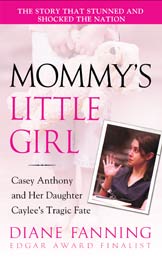
Interview with Diane Fanning, Author of Casey Anthony Book

As the jury selection in the Casey Anthony trial came to a screeching halt this week, WCI's own Diane Fanning sat down with us for a question-and-answer session. Diane authored Mommy's Little Girl, a critically acclaimed, serious look into the disappearance of 2-year-old Caylee Anthony. When court adjourned May 18 in the midst of jury selection, Diane shared her insights about the murder that grabbed the nation's attention as Caylee's mother Casey was charged with the death of her little girl.

Q: Diane, what's your take on the difficulty in seating jurors in this case?

DF: The latest is that Judge Belvin Perry suspended jury selection at lunch time on Wednesday, May 18. Many in the jury pool say she's guilty. One potential juror was released because he posted on Facebook that he was writing a book; another, because she admitted watching Nancy Grace's daily TV [case] coverage

The Casey Anthony case has received more pre-trial publicity than any case, including the O.J. Simpson trial. Surprisingly, though, Mommy's Little Girl has been the only book published on this case. This widespread publicity has made it difficult to find jurors who have not already reached a conclusion in this case. I think the judge would have had a bit easier time if he had paid attention to the media survey that showed the least media coverage in the state was in the Pensacola area. I think he made a mistake going just 100 miles away in Clearwater for the jury panel.

Q: Do you think the media attention in this case has tainted potential jurors?

 
DF: I think it has had an impact on some, but it is still possible to find people who have not been as absorbed in this case and are still capable of making a decision based on the information presented in the courtroom. Personally, if I were on Casey's defense team, I would challenge strongly for cause against any juror who has read my book.

Q: A cottage industry -- mostly T-shirts with a variety of sayings, good and bad, key chains, coffee mugs -- has exploded. Have you seen anything like this before?

DF: Certainly not to this extent. The products started coming out within a month after Caylee was reported missing by her grandmother, Cindy Anthony. Early products included voodoo dolls with Casey's face on them. Now they are everywhere. The two most common you see are ones that say "Justice for Caylee" and others with "Casey Did It." If I were Casey's parent, I would not be bothered by the former, but I would by the latter.  For some reason, though, it is the "Justice for Caylee" merchandise that has raised the Caseys' ire and legal action.

Q: Given your book, Mommy's Little Girl, and your probe, what is the most damning evidence against Casey?

DF: I do not think the jury can ignore Casey's lies or her behavior after Caylee's disappearance. She partied like a single 21-year-old without a care in the world. She never reported her child missing.  Forensically, I think the combination of the testing in the trunk of her car, the anecdotal remarks like the spontaneous utterance of Cindy Anthony ("It smells like a dead body in that car") and the response of the cadaver dogs definitely placed the blame for the death on Casey. The duct tape around Caylee's skull proves murder with malice. Casey's computer searches on ways to kill a child months before Caylee's death seal the premeditation.

Q: As Casey sits through the jury selection process each day, she fusses with her hair, flexes her hands, smiles and jokes with her team of attorneys. What do you make of her behavior?

DF: She is obsessed with herself and she is nervous. Can you imagine sitting in a courtroom looking into the faces of people who say to the court they are capable of sentencing you to death? Casey's stress must be over the top, as well it should be for any guilty person.

Q: Cindy and George lost their granddaughter, but, with the trial and a possible conviction, they face losing their only daughter, should the death penalty be handed down. Do you think that's why they're supporting Casey?

 
DF: They should not abandon their daughter no matter what she has done. But they have gone beyond that by proclaiming her innocence and even obstructing justice when you consider the hair brush incident.  Cindy intentionally gave law enforcement a hair brush that had been used by Caylee and others instead of giving them the one that was Caylee's alone. I think they have adopted the idea that they have lost a granddaughter and now do not want to lose their daughter, too.

Q: Casey refused to see her parents before the jury selection began. Why do you think that is?

 
DF: Only her mother asked for a visit and she did so on the day before Mother's Day.  I think it was heartless to deny that to any mother. But I think the reason Casey did it is because her legal team told her to do so. They knew Casey could not control her temper, could not control her mouth, and was incapable of doing anything during that visit that would not place her in a bad light.

Q: In your in-depth coverage of this case, what was your experience like when dealing with police, private investigators and contacting the family for interviews?

DF: I was knocked into a concrete wall by a member of Jose Baez's entourage. I was threatened by private investigator Dominic Casey. George and Cindy refused to speak to me. The State's Attorney Office was very helpful, and interviews with relatives outside of the immediate family and with friends and neighbors were very worthwhile.

Q: What was the family's response to your book?

A: The family has made no response to the book. I do know from someone who was close to them that they read the book, but I know nothing more. However, I am fairly certain that they did not like it at all.

Thanks, Diane!

Watch for updates about the Anthony case on Diane Fanning's blog, Writing is a Crime, as well as here on WCI.


Monday, April 25, 2011

The Holly Bobo Case: Serial Killer, Bad Boyfriend, or Staged Abduction?

by Pat Brown

Another story of a beautiful, missing woman has taken over the media. Twenty-year-old nursing student, Holly Bobo, disappeared on April 13 from Parsons, Tennessee, and she has not been found.

With so much misinformation, changing stories, rumors, and peculiar behavior on the part of the family and law enforcement, the only thing we really know is that something horrible happened to Holly Bobo. Now, I know a few people believe that Holly ran away or that the family is hiding her and trying to collect money, and some people even think that this is a ruse to further the career of country music singer, Whitney Duncan. None of this I believe to be true, especially the last one. Duncan, who has some lovely songs that have made the charts, is doing fine enough on her own, she will thank you very much, and she doesn't need some horrifying charade like this to get her notice.

The chance of Holly being found alive is slim to none. But the looming question is did one of her boyfriends take her away? Is there a serial killer loose in the area? Or, did a family member do something to Holly, perhaps in a rage over some particular issue, real or imagined? I have worked a couple of Cain-and-Abel cases in which one child became jealous of the other and murdered them to get rid of the competition and gain the parents' attention. It usually works, because parents tend to hang on to the one remaining child left and fight to save him.

So, what happened to Holly? Here are a few known facts.

Fact One: Holly Bobo has not been seen in over a week.
Fact Two: Holly's brother, Clint, claims to be the last one who saw Holly in the company of a man that looked like her boyfriend.
Fact Three: Holly's white lunchbox was found in a creek eight miles from her home.

This is all we know. Everything else we can only wonder about. Many think we know more, but we don't because we are either taking the family's word on it or the convoluted and changing stories from law enforcement or the media. Because of all this confusion, there are four credible theories as to what happened to Holly:

Theory One: A serial killer or stalker abducted Holly
Theory Two: One of her boyfriends (present or ex) abducted Holly.
Theory Three: Holly's brother, Clint, did something to Holly and the family has no idea.
Theory Four: A family member did something to Holly, most likely Clint, and they are all covering it up.

Now, in saying this, I can guess there are those who will become immediately angry that I would even suggest Theory Three and Four. But as a criminal profiler, I cannot eliminate these possibilities unless they can be proven to not possibly be true. Sad as it is to ever question a family's involvement - especially when you understand the pain they must be in - the family is statistically the most likely to be responsible for a member's homicide and they must be looked at first and foremost unless they can be clearly eliminated by the evidence.

As it stands now with the Bobo family, they were the last to see Holly. Actually, the father never stated when he last saw Holly and the mother never stated when she last saw Holly. Only the brother has claimed to have seen his sister on the morning of her disappearance, and it has been stated he called 911 to report her missing. We have no information as to when Holly was last heard from, although there is a claim there was some activity on the phone after she went missing (whether it was a ping or a text, we do not know).

We cannot know at this time if Holly was alive the morning the 911 call from Clint was made. We have heard of a woman, supposedly a neighbor, who reportedly called 911 after hearing a female scream. We have yet to get clarity on the veracity of that call or when it was actually made, although the sheriff sort of stated it was around the time Clint saw Holly with the guy he thought was a boyfriend (but Clint didn't hear his sister scream). The police have not released either the 911 call from Clint Bobo nor this supposed 911 call from the neighbor. Why?

Next, we have some mighty strange stories about Clint Bobo's 911 call. When the story first broke, we heard it was a home invasion. We heard of a man in camouflage who dragged Holly off into the woods. Then we heard that Holly was never dragged off but that what Clint actually saw through a window was a man walking off with Holly into the woods. He thought - because their backs were to him - Holly was with her boyfriend, that he didn't think anything was wrong until he came out some forty minutes later to find her car still there and blood spatter in the area. It is theorized that media got it wrong but it is also stated by law enforcement that they originally believed she was dragged. How can the story change? In the 911 call, did Clint say Holly was dragged but changed his story later when no drag marks were found or did law enforcement misinterpret his phone call or did the media get it wrong? Why isn't Clint Bobo's 911 call being released?

For that matter, why isn't a decent description of the alleged abductor being released? Bobo supposedly claims (we have never heard from him because he has not been spoken to the media or appeared in front of any cameras) that the abductor was 5-foot-10 to 6-feet tall and about 200 pounds. Is that the same height and weight for the boyfriend he is said to have thought was with Holly? I have seen some photos of the boyfriend, and he doesn't look anywhere near 200 pounds. How about hair color? Did he have on a hat? Is he the same build as the brother, whose photo doesn't seem to be anywhere around? Why, if the police believe Clint Bobo's story, have they not released clear information about the suspect?

The police have stated that no one has been eliminated as a suspect. At the same time, they actually stated that Holly was led away into the woods "in fear of her life." What kind of cock-and-bull statement is that from law enforcement? If they did not see Holly being led away on camera and if all Clint said was he saw Holly walking off with a man in such a fashion that he didn't notice her in any distress, how do the police make such a ridiculous claim? And, in making that statement, they are indeed saying that the family has been eliminated. They also have stated that Holly may have been spirited out of the area but she is still in the state! How would they know this unless they know exactly who took her and where that person is? Why are they still searching through the bushes then? Why is law enforcement so inconsistent? Are they purposely giving misinformation or are they simply not very competent? I am not too happy with either conclusion. Even the family spokesperson, Kevin Bromley, appeared on Nancy Grace, stumbled over his words, hemmed and hawed, and was very evasive about the details of what happened at the Bobo home and whether Clint Bobo had taken a polygraph. This does not inspire confidence in the family's noninvolvement.

The community has put their heart out for this family and the search for Holly. They have responded in a way I wish every community would respond. They have given wholeheartedly and without reservation, given their time and money and physical and emotional efforts scouring the dense woods for this missing woman. I would hate to think they have been played by either the family or the police. They have the right to know the truth, as much as is known, at this time.

What needs to be done:
  • The family and the boyfriends need to take polygraphs.
  • The family and boyfriends need to be alibied.
  • The family, including the brother, need to step forward and clearly state where everyone was after the last time Holly was seen or heard of from a non-family member (by voice, not text).
  • The brother needs to give a clear public description of what he saw at the home, when he saw it, and what he did.
  • The 911 calls need to be released to the public.
  • A description of the supposed blood spatter needs to be released by the police, including what it is (human or animal) and whose it is (known person's or persons, or stranger's, or known person's and stranger's).
  • The police need to clarify exactly what items of Holly's were found and where, and what items of Holly's are missing.
One final note that has really raised eyebrows. The media is reporting that the family is selling T-shirts for twelve dollars each and more than 2500 have been sold so far. The sales are going into The Holly Bobo Fund which is described as monies being saved to give Holly a vacation when she gets home, not a fund to help pay for searches or help victims of abduction and homicide. If this is true, it is one more issue that makes people uncomfortable with the Bobo family's behaviors. Not only is this inappropriate for the family of a victim to collect money that doesn't go toward the cause, but it makes me wonder if this is money being set aside for a defense fund.

If this is a true abduction, the police and the family should have no problem complying with the above list and, furthermore, it could only help, and not damage, the investigation. If the incomplete and erroneous information continues to be all that is offered to the public, no one can blame folks out there for questioning whether the family had something to do with Holly Bobo going missing. At some point, they may simply stop looking for her. That they haven't given up is a testament to good neighbors and a strong community. God bless them all.


Friday, April 15, 2011

Blockbuster Surveillance Tape Shows Casey Anthony's Cool Calmness


A jury will now see surveillance videotape of Casey Anthony and her ex-boyfriend, Tony Lazzaro, as they rented movies at a video store shortly after Casey's toddler daughter Caylee went missing.

Viewing a screen shot of the tape of Casey and Tony, you see Casey's hand placed strategically on Tony's back side, which indicates a strong sexuality on Casey's part.

He leans into her, indicating sexuality as well. But Tony rarely looks directly at Casey, and their movements are a bit awkward when they're together, indicating that the only thing they have in common is sex.

According to police reports, the salesperson reported that Casey rented a film titled Untraceable, about a kidnapper and a killer, and a second movie called Jumper, about a mother who abandons her 5-year-old child. It's damning evidence, as the films reflect Casey's psyche and state of mind.  To even choose such films out of the thousands of movies available in the store validates the point that issues of kidnapping, abandonment and killing were in the forefront of Casey's mind.

No doubt,  in her sociopathicic mind, the films were soothing to Casey as she watched actors carry out what she most likely did in real life: kill, abandon, and try to pin her daughter's disappearance on a supposed--and nonexistent--kidnapper, Zanny the Nanny. When interviewed by police, the video store clerk said Casey showed no emotion or tears as she rented the films.

When you look at the images of Casey captured on the surveillance tape, it confirms what the clerk reported, that Casey appears to not have a care in the world. She shows no outward signals of anxiety, even though deep down she knows her daughter is missing and, worse, is dead.

As I see it, after viewing this video and screen shots, a jury cannot help but see Casey as cold, heartless and calculating. Knowing that your child is dead, yet Casey acts so nonchalantly while browsing movies should shock jurors. Should Casey stick by her claim that someone  kidnapped Caylee, the fact that Casey acted so cool, calm, and collected in the  surveillance video speaks volumes.

What mother  in the world would act so calm knowing her child is missing? The answer is this: Only a  mother who wanted her daughter to be gone and out of her life would act that way. Seeing this tape will  give the jury a much  clearer  and comprehensive  picture of who Casey Anthony really is.


Wednesday, April 6, 2011

The Chemist as Killer


On January 14, a 39-year-old computer engineer was admitted to Princeton University Hospital in New Jersey with nagging, flu-like symptoms. The man was nauseated, suffering from severe joint pains, wracked by a strange, convulsive trembling in his legs. Doctors at the hospital tried one treatment after another, but Xiaoye Wang only became weaker.

Finally, a nurse at the hospital stepped hesitantly forward. She remembered a 1995 case in China in which a student at Beijing University became mysteriously ill. The cause was eventually found to be poisoning by the toxic element thallium. The young woman received a life-saving antidote although she suffered lingering disabilities from the attack.
And–as the nurse recalled from the highly publicized case–the student's symptoms were eerily similar to Wang's. During the man's hospital stay, he'd developed new signs of worsening illness - he'd lost his hair; his skin had thickened; his hands and feet had gone numb.

The Princeton doctors were dubious about a fairly exotic poison use, but they were running out of ideas. So although they couldn't find an in-state laboratory to do the tests, they agreed to send Wang's blood and urine samples out of state. And to their shock, the tests proved the nurse right. The lab had discovered a shockingly high level of thallium in Wang's body.

On January 25, the hospital contacted the New Jersey Poison Control Center for help. The results were in and the doctors had no idea what to do. They had no experience with thallium poisoning. They needed to know how to save their patient.

As Steven Marcus, head of the poison control center, told the Newark Star-Ledger (which has done a great job of covering this story) his first reaction was suspicion. Thallium is a dangerous and carefully regulated poison, once widely available but mostly found in laboratories these days. "It's either attempted suicide or homicide," he said. Marcus added that he knew of only one good antidote for thallium poisoning, a medication called Prussian Blue.

Rather ironically, the antidote's name derives from another famously lethal substance. Prussian Blue refers to cyanide (a component of the medication) which can be used to produce a royal blue pigment. Some cyanide formulas are very deadly, notably hydrogen cyanide or potassium cyanide. But mixed into the tidy antidote formula (brand name Radiogardase) cyanide merely becomes part of a chemical chain that wraps itself around thallium, binding it up, and allowing the body to remove the poison.

By the time, the New Jersey doctors were able to secure the antidote though, it was too late. Wang was deep into a coma; he died on January 26 leaving doctors - and now criminal investigators - to answer the question raised by Steven Marcus. Was it suicide or was it murder?

I actually devoted a chapter of my book, The Poisoner's Handbook, to thallium because it's such a fascinating poison. But Agatha Christie knew this long before I did - it's the star of her 1961 murder mystery story, The Pale Horse. A key to the Christie novel is that thallium appears to be a near perfect homicidal poison. It's is tasteless, odorless, and mixes smoothly and easily into food and drink. A key to my non-fiction tale of five thallium deaths in 1930s New York is that this is also a highly detectable poison. Or as I wrote in the book:

" In the manner of other metallic poisons, such as arsenic, thallium stayed stubbornly in the body, permeating the tissues for weeks and even months after death. Any knowledgeable forensic toxicologist could find it.

It was, one might say, a chemist’s poison."

Which was exactly what the authorities in New Jersey concluded as well.

They'd found no evidence that Wang was suicidal. But further investigation did find that he was involved in an angry divorce which included disagreements over property division and custody of a two-year-old son. Investigators also discovered that his wife, Tianie "Heidi" Li was a research chemist at Bristol-Myers-Squibb, working in a laboratory that included access to thallium.

On February 8, Li, 40, was charged with murdering her husband. She has since pleaded not guilty and is also seeking to have her bail, currently set at more than $4 million reduced.

Let's acknowledge first that Li has not been convicted of murder. Still her arrest raises some intriguing questions on the subject of poison murders. For instance, does one need a chemistry degree to be a thallium killer?

The quick answer is no, but the killer does need to have some specialized knowledge of the poison and its potential. While the killer in my own book was a high school graduate with no science training, those murders occurred at a time when thallium was a widely available and well-known pesticide. That's less true today. The U.S. government removed it from household markets in 1972 due to its hazardous nature.

So let's also acknowledge that today, when thallium is less publicly visible, one might expect a killer to have some chemical awareness. I am aware of one other well-publicized thallium murder that involved a killer with chemical training and that occurred in Alturas, Florida, in the late 1980s. In that case, a (very) troubled former chemist became annoyed with his neighbors, whom he perceived as noisy and inconsiderate.

The angry chemist, George Trepal, left them an anonymous gift of Coca Cola spiked with thallium. The poisoned sodas killed one neighbor and hospitalized two others for months. Trepal was not a scientist with a happy history. At the time of the deaths, he had a criminal record, having served time for working as chief chemist for a methamphetamine laboratory. In 1991, he was convicted of one count of first degree murder and six counts of attempted murder. He remains on Florida's death row today and is the subject of a book titled Poison Mind.

But investigators were never sure how Joann Curley of Wilkes-Barre, Pennsylvania, decided to kill her husband, Robert, by putting thallium in his iced-tea. Curley confessed to the murder in 1996, after a relentless five year investigation into his death. And Ann Perry of Long Island, sentenced in 2002 for killing her abusive boyfriend with thallium-laced milkshakes, had no special chemical knowledge either.

The acclaimed British author, John Emsley, who specializes in writing about chemistry in books such as The Elements of Murder has suggested that it's mystery writers like Christie who really brought thallium into the public's mind as a murder weapon. Among the examples he gives is the case of Graham Young, a worker in a British photographic instrument company, who killed two of his co-workers in 1971 by mixing thallium into their coffee. 

As news of Li's murder arrest has spread, increasingly the stories have been framed around chemist-as-killer. "Chemist killed her husband with radioactive poison to avoid going through a divorce" was the headline in Britain's Daily Mail. "NJ chemist pleads not guilty to poisoning husband," was a more stately lead in BusinessWeek. And, of course, some of this is just headline writing shorthand for an event.
But make no mistake. The history of thallium homicides mostly serves as a reminder that any of us can play at the poison murder game. That anyone can play at being a homicidal user of chemical compounds. Yes, Dr. Li had specialized knowledge and access to thallium but as a Joann Curley proves, such training isn't really necessary for a determined killer. If Li is convicted, being a research chemist won't have made her anything special. If anything, it'll have led her into being just another over-confident killer who ended up getting caught.

Caught by the evidence provided by a chemist, I might add. 

A version of this post appeared earlier on Speakeasy Science, my blog for the Public Library of Science.