Showing posts with label Film Reviews. Show all posts

Friday, October 31, 2008

Halloween Movie Picks from Women in Crime Ink

by Vanessa Leggett

It's that time of year. For kids, Halloween night means dressing up and venturing out for candy. For party-pooped adults, it means dressing down, staying in, and watching a scary movie.

If you don't like scary movies, you're not alone. Neither does our Texas prosecutor, Kelly Siegler, who put it more bluntly: "I hate scary shows."

And it's little wonder. Like other criminal justice professionals who write for WCI, Kelly might be one of those who look to movies for escape from the real-life horror she encounters day in and day out. Right now, watching a scary movie would be last on Kelly's to-do list. Our "prosecutor for hire" is in the middle of a capital murder trial, where a film of a game warden's shooting death is wearing like the Zapruder reel.

Sounds Like Halloween

If, like Kelly, you don't spend your free time watching scary movies, but your significant other does . . . don't count on shutting your eyes to keep from jumping out of your skin. Usually it's what we can't see that's more frightening—the closed closet door . . . the lengthening shadow of something around the corner . . . the creaking floorboard. . . . Sounds, in fact, can be more frightening than anything seen or suggested on-screen. It only takes two notes from an oboe in JAWS to send chills along the spine . . . or shower sounds and a few strains from the violins of Psycho . . . or a phone's shrill ring, as in When a Stranger Calls and on the other end of the line the killer breathes "Have you checked the children? . . . "

Most of us here at Women in Crime Ink enjoy scary movies, and we like to watch with our eyes open. For Halloween, we polled our contributors for their favorites.

Our Favorite Classics

Every Halloween, Donna Weaver looks forward to her annual dose of Arsenic and Old Lace. Two of Diane Dimond's favorite classics: What Ever Happened to Baby Jane? and Rosemary's Baby. Scary-movie lover Tina Dirmann highlighted Wait Until Dark among several others. And Stacy Dittrich gave Burnt Offerings as her favorite scary movie, while Pat Brown picked The Haunting of Hill House.

"I always thought Shirley Jackson wrote the creepiest stories—more mentally creepy than physically," said profiler Pat, who recalled "the part in The Haunting where the walls are going 'boom, boom' and one woman tells the other to hold her hand until it stops and then, when the noise ceases, she opens her eyes and realizes the other woman is sleeping in a bed all the way across the room . . . eeowww."
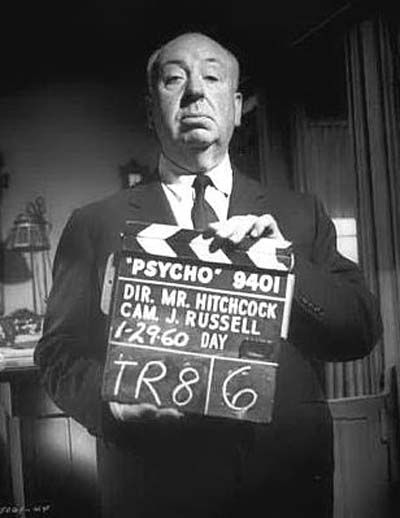
No one could argue with Pat that "anything Hitchcock" is scary. Pat liked The Birds while Diane Fanning cited Rear Window as a favorite. Fanning also mentioned "An Unlocked Window," from the TV series "Alfred Hitchcock Presents." That episode is about a killer on the loose, a man who slips into the cellar window of a medical ward and poses as a female nurse. "That still gives me shivers," Diane said. The chill factor might have been spiked by the set, which was the same house used in Psycho. The Master of Suspense enjoyed tapping into the collective unconscious; he understood the timelessness of terror. Tina Dirmann rents Psycho every year.

Scariest of Them All

But the "scariest movie ever," according to Tina, is The Exorcist. I agreed, as did Connie Park and Cynthia Hunt. The film was based on the William Peter Blatty novel of the same title. Blatty wrote the book and Oscar-winning screenplay, drawing inspiration from actual exorcisms he'd studied, especially the documented exorcism of a 14-year-old boy in 1949. Actress Linda Blair was cast at the same age. (She is probably still in therapy from that childhood role from Hell.) Because of death threats after the film's release, the young actress had to hire bodyguards.

What made The Exorcist, so scary? Perhaps surprisingly for a "supernatural movie"—its realism, thus the threats against the life of an actress whose lines came from a script, not from possession.

"Nothing is scarier," said Cynthia, "than the reality that there is a demonic spirit world that exists alongside us and that the enemy, Satan, is constantly trying to defeat, infect, and destroy everything that is good."


Fear Factor

A modernized battle between Good and Evil can be found in the 1991 remake of the '60s Gregory Peck classic Cape Fear, which was Katherine Scardino's favorite. It's no mystery our defense attorney found this film scary, since the movie depicts a realistic nightmare of every criminal advocate: A vengeful client who blames his lawyer for a stiff sentence. In Cape Fear, an attorney breaches professional ethics by purposely offering a less-than-zealous defense to a vicious rapist, who, upon his release from prison, stalks the lawyer and his family, targeting the attorney's teenage daughter. . . . Equally afraid of a predator's release would be the D.A. who put him away, so it's no surprise that Cape Fear was also a top pick of our sex-crimes prosecutor, Robin Sax. The 1991 version of Cape Fear was a popular choice among several contributors, including Kathryn Casey. (Other thriller picks: Jagged Edge from Robin Sax, and Andrea Campbell recommends Fallen.)

A number of us found favorites in movie adaptations of novels by Stephen KingCarrie, Misery, and Michele McPhee's favorite, The Shining. Who can forget Jack Nicholson as a madman driving an ax through a bathroom door, announcing "Heeeeerz Johnny!"

An earlier Jack Nicholson scene our resident psychiatrist would rather forget: When Nicholson's character is lobotomized in One Flew Over the Cuckoo's Nest. "I can't watch that part," said Lucy Puryear.

Another hard-to-watch lobotomy is found in Hannibal, the sequel to The Silence of the Lambs. The FBI agent played by Ray Liotta is lobotomized by cannibal psychiatrist Dr. Hannibal Lecter.

The Power of Silence

The majority of our contributors ranked The Silence of the Lambs as their favorite scary movie. Based on Thomas Harris's novel of the same title, the film, like the book, is more thriller than horror flick. While this film is one of my all-time favorite thrillers, I would not classify it as a "scary movie."

That said, out of all the horror films I can conjure, the climax to The Silence of the Lambs contains one of the most frightening scenes ever to flicker across the big screen. You remember the scene, when FBI Agent Clarice Starling faces off with serial killer "Buffalo Bill" in his dungeon-like basement.

Sidebar: Buffalo Bill was based on a real serial killer, Edward Gein, a quiet Wisconsin farmer who dressed his victims like deer—using their skins and bones for furnishings (like lamp shades and cereal bowls from skull caps) rather than for actual dresses, or female "body suits," as in Thomas Harris's story.

For both Buffalo Bill and Hannibal Lecter, Harris borrows traits from Gein (pictured above). Like Gein, "Hannibal the Cannibal" ate his victims' body parts. Edward Gein also reportedly served as Hitchcock's inspiration for Psychofilmed a couple of years after Gein's crimes were discovered—as well as "Leatherface" in The Texas Chainsaw Massacre, which chilled our cold-case detective, Connie Park.

But back to the scene from The Silence of the Lambs. You would be hard-pressed to find an actor who has captured the emotion of fear better than Jodie Foster did as Clarice, when her face is framed in the grainy green light from the killer's night-vision goggles. Again, it's what we can't see that makes the heart pound. Don't take our word for it. Watch for yourselves. (Warning: This scene contains language and violence unsuitable for younger viewers.)

Our True Crime Favorites

While The Silence of the Lambs is loosely based on a real villain, there are a number of other films directly adapted from true stories and true-crime books. Since a number of us write fact-based books, this post would not be complete without mentioning our favorite scary movies based on real stories. Here they are, with contributor nominators in parentheses: The Amityville Horror (Tina Dirmann, Vanessa Leggett, Connie Park, Donna Pendergast); In Cold Blood (Jenna Jackson, Vanessa); Helter Skelter (Tina); The Honeymoon Killers (Susan Murphy-Milano); and The Onion Field (Diane Dimond).

So find yourself a scary movie and enjoy the holiday weekend. Now that you know our favorites, we hope you'll share yours with us. A safe and happy Halloween to everyone.

For best-reviewed scary movies, check Rotten Tomatoes, the definitive movie review site: http://www.rottentomatoes.com/


Monday, October 6, 2008

Road to Perfection - Broadway Gives Its Regards to Paul Newman

by Vanessa Leggett

New York — October 3, 2008. That's the night that the lights went out on Broadway. Last Friday, marquees in the theater district dimmed to honor the passing of a star who lit up stages there for half a century.

The haunting yet beautiful visual moment of silence reminded me of a scene from Paul Newman's final role on the big screen.

In 2002, Newman portrayed fictional godfather John Rooney in Road to Perdition, a film based on a graphic crime novel set in Depression-era Chicago. Newman's co-star was Tom Hanks, who played Michael Sullivan, Irish crime boss Rooney's "Angel of Death"—a hit man who also did jobs for Al Capone.

Witness to Murder

To set the stage for that late scene in the film, I must say a word about the conflict that sets the story in motion. The hit man's son, Michael Sullivan, Jr., 12, witnesses one of his father's business associates commit murder during a rough up at a warehouse. The boy was spotted by the executioner, Connor Rooney, the Mafia boss's loose-cannon son, played by Daniel Craig.

"Did you see everything?" Michael Sullivan asks his boy, who nods.

Conner asks Sullivan, "Can he keep a secret?"

"He's my son," says Sullivan.

That's not good enough for Connor, who takes it upon himself to eliminate Sullivan and the boy. But when Connor arrives at the Sullivan residence to take care of business, neither target is home. A frustrated Connor guns down Sullivan's wife and the couple's other son.

Michael Sullivan sets out to exact revenge. This leaves the avenger and Newman's character in direct conflict, each facing impossible choices:

Sullivan knows that his surviving child's life will remain in jeopardy if he does not execute the man who meant to kill them—even if that man happens to be the son of his boss.

And John Rooney's son expects him to eliminate Sullivan, who will surely kill Connor for shooting his wife and child. "You gotta take him now," Connor pleads to his father.

Choosing between the life of a valued hit man or his son may not seem like much of a conflict for John Rooney. But Sullivan, who never had a father of his own, has been more like a son to Rooney than Connor, who is as much of an albatross to his father as Sullivan is a prize.

Connor showed bitterness and jealousy toward Sullivan long before he or Michael Jr. posed any problem for the family. That resentment was stoked just prior to the warehouse execution, when John Rooney ordered his son to "take Michael" along, presumably to avoid unnecessary violence. Sullivan was a judicious hit man. So when Sullivan's son was an eye-witness to Rooney's son committing murder, Connor could not resist the opportunity to take out his only rival for his father's affection.

In the Name of the Father

For Sullivan, getting rid of Connor meant he would also have to kill his father. The crime boss had his son under protection, watched by armed men 24/7. As long as John Rooney was alive, his son could not be killed. The catch was this: No one in Rooney's family wanted Connor to succeed his father. With the crime boss dead, those men would turn the other way for an outsider to take out a childish tyrant waiting to fill his father's shoes. Thus the film's tagline: "Every son holds the future for his father." (Newman's character at right, reacting to his son's news that Sullivan's wife and child had been hit.)

Michael Sullivan first tried to gain access to Connor through his father. When John Rooney said that was something he could never do, Sullivan knew he would have to execute the head of the Rooney crime family, a man heavily guarded. And so the stage is set for the godfather's death.

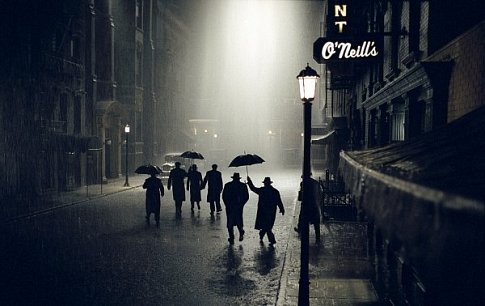
The dimming of the lights on Broadway to mark Newman's death reminded me of the muting of gunfire in the death scene of Newman's character in his final feature film. Befitting an exit of a star like Newman, the scene is, in my opinion, one of the most elegant portrayals of mass violence in the history of American cinema. Never has an assassination in a hail of gunfire taken on such an operatic quality—largely because until the scene's climax, gunfire is never heard.

A Beautiful Death Scene

The surreal street scene is muted by rain and populated with black-silhouetted mobsters carrying umbrellas à la Magritte. From the soundtrack we are entranced by a gorgeous score from classical composer Thomas Newman. (No relation to Paul Newman—but from a rich pool of musical talent—Thomas Newman is also known for the moving soundtracks to The Shawshank Redemption, American Beauty and Six Feet Under's opening credit sequence.)

As the wing-tipped mobsters take their places on the rain-slicked street, the scene turns when the crime boss realizes his driver is not standing with umbrella at an open car door. In the driver's seat, Rooney sees his chauffeur, who appears to be sleeping until Rooney tries the door, and the driver slumps to the steering wheel.

Umbrellas twirl as mobsters pivot, searching for the source. In short order, men collapse around the crime boss, unable to see where the fusillade is coming from. As the ballistics ballet plays out, piano keys echo the tinkling rain as one by one, Rooney's men go down in sync with the sound of descending notes. There is no visible bloodshed.

In the distance, we see the lightning flash of the muzzle from an automatic weapon we know is held by Sullivan, who, after killing everyone but Rooney, emerges from the darkness to do what must be done: kill a man who might as well be his father.

At the end of the scene, Rooney turns to face his executioner. Any Mafia crime boss knows the odds on how he'll die. The question he's plagued by his entire life is—Who will do it? . . . The Law? . . . Family? . . . Foe? . . .

Rooney knew who held the submachine gun the moment he saw one of his bodyguards get hit. In his final moments on screen, facing a man who has been like a son, Newman delivers his last line in cinema: "I'm glad it's you."

This gives Sullivan the courage to open fire, shattering the strange tranquility of the silent street massacre with a blast of bullets to ensure swift, painless death—effectively drowning out the conflict Hanks' character is feeling. The wordless interval between Newman's last line and his assassin's gunfire holds the scene's most poignant moment. In the audience's mind, and no doubt Sullivan's, was Rooney's recent observation: "This is the life we chose—the life we lead—and there is only one guarantee: None of us will see Heaven."

Final Curtain

It's no secret that Paul Newman did not want to be remembered for his acting roles. But his role as Godfather in Road to Perdition—his last appearance on the silver screen—is one I'll never forget.

When Newman's many roles in life ended on September 26, the world lost a star of a human being. But because of the life he chose to lead, the heavens are now one star brighter. He will always be remembered through those whose lives Mr. Newman improved. And thanks to the magic of cinema, Paul Newman lives on—even when the lights go out.


Monday, March 10, 2008

The Bank Job - How the Public Was Robbed

by Vanessa Leggett


The British crime thriller The Bank Job scored big at the box office over opening weekend. The movie is based on a 1971 bank burglary in London. At the time, the size of the take—$1.2 million—was second only to the Great Train Robbery, another infamous U.K. heist from the era. That the bank burglary failed to rivet the public in the same way says nothing about the sex appeal of the story.

The Bank Job weaves a rich tapestry of corruption and intrigue. According to the film, the reason the story has not survived in memory or secured crime-ballad status has nothing to do with the crime, but everything to do with the cover up. The heist that came to be called the "walkie-talkie bank job" walked off the pages of history, saying very little in passing.

Within four days of the bank burglary, the government gagged the press, citing “national security.” The Lloyds Bank in the Marylebone section of London had not been targeted for the vault's cash and jewels as the public and all but one of the looters had been led to believe. The film proposes the operation was set in motion over some nude photographs of Princess Margaret in a ménage à trios in the Caribbean.

The photos were contained in a safe-deposit box that belonged to Caribbean native “Michael X” (Michael de Freitas), a murderous thug, drug kingpin, and extortionist who fancied himself a revolutionary during the Black Power movement of the 1960s.

By threatening to release the photos of the princess at her royal worst, Michael X was able to engage in international trafficking and brutal extortion schemes without fear of arrest. The film also suggests that other looted safe-deposit boxes contained blackmail material from another organized crime figure, a Soho pornographer, who'd stashed photos of British authorities in compromising positions at brothels as well as records of bribes paid to Scotland Yard. The princess’s porn pics and the ledgers of police payoffs meant that organized crime had the British monarchy by its crown jewels.

After surveillance showed that Michael X kept a safe-deposit box in the Lloyds Bank at 185 Baker Street, British authorities decided to act. But they could not storm the bank with a warrant, drill open the box, and seize its contents. That would have made the matter public.

"Until we get our hands on these snaps,” observed an official, referring to the photos, “the police can’t move, the public prosecutor won’t move, the home office doesn’t want to know. There can be no connection to us."

So instead of sending in a team of law enforcement, the film has MI5 (Britain’s FBI) sending in a team of small-time crooks.

"They do things coppers can’t,” one agent explained.

The bank raiders were recruited by a street-smart seductress who was working with the government in exchange for clearing her own record. The ex-model approaches a group of petty thieves she knew from school, tells them she’s dating a man connected to the bank’s security detail, and that the alarm would would be disengaged for a week while the bank serviced the vault.


That weekend, when the bank was closed and the alarm—purportedly—disarmed, the looters tunneled their way into the vault. The “no alarm” device might have been an embellishment to make the story more believable—how else could they have worked in the vault for so many hours without anyone responding?

According to the New York Times piece that ran the day after the burglary, the alarm was working at the time of the heist. The actual window of opportunity given to the crooks was not the lack of an alarm, but the lack of response from law enforcement. The newspaper reported this from Scotland Yard: "33 hours and 40 minutes after the alarm—bank officials found the strong room ransacked and the 15-inch-wide hole in the floor" (New York Times, Sept. 13, 1971).

Police had checked the bank’s strong-room door eighteen hours prior to finding the looted vault. But because they saw no sign of forced entry—the thieves had tunneled into the vault—investigators assumed that the bank had not been raided. In fact, the crooks inside the vault that Sunday afternoon could hear authorities on the other side.

"Everything’s fine,” a policeman said. “No intruders whatsoever."

These and other quotes were preserved on tapes made by a ham radio operator who happened to overhear the burglars, who were using walkie-talkies to communicate with their rooftop lookout across the street—a plot twist so bizarre, it has to be true. The New York Times published excerpts the day after the heist in a piece that carried the headline "A Radio Ham Tunes in London Police To Tape of $1.2-Million Bank Robbery":

"My eyes are like organ stops, mate. I’m not going to be any good tomorrow. I can hardly see now."

"But you can go to sleep tonight. . . . Listen, it’s not a bad rate of pay, is it?"

As the thieves loot the safe-deposit boxes, the woman, whose voice is heard in the background on the recordings, finds the blackmail pictures and ledgers. But as she’s examining the nude photos, the lead thief catches on, realizing he's been set up to get her into the vault so that she could access safe-deposit box 118, while he and the other unwitting thieves paid attention to the jewels and cash in the other boxes. Still, he agrees to help the woman, a lifetime friend and former lover, fearing that MI5 will kill her once they have their photos.

While negotiating with those who have an interest in the photographs and ledgers, the band of burglars tries to gather its own intelligence, searching newspapers for coverage of the heist. But MI5 had already issued a D-Notice to muffle the press, citing a threat to national security.

"If the news could disappear,” the woman says, riffling a newspaper, “so could we.'

In the end, the raiders managed to get away with the crime. And if the filmmakers’ account is true, the government managed to get away with robbing the public of a story that should have been fully covered by the press.

"Scotland Yard ordered an ‘internal inquiry’ into ‘disturbing aspects’ of police handling of the case,” read the last line of the only contemporary New York Times report. Any findings from the "inquiry" have remained internal.

Most of the principals in the story have died. Actress Saffron Burrows, who plays the femme fatale, told the Los Angeles Times that a photo of people connected to the crime exists, but not much else. No jewelry or cash was ever recovered.

"We believe some were convicted and some got away,” she said. “Because of the gag order it’s been very hard to unearth the truth." Putting a lid on the press has a way of doing that.

Burrows also revealed that one of the bank raiders is still living and was consulted for the film. Small chance the public will ever know that man's real name.

Nor will we know the names of any of the players. The 1971 New York Times piece identified “Bob” and “Steve” as names on the taped communications. But neither of those names was used in the film, which, in closing credits, acknowledged the names in the film were fictitious, in order to “protect the guilty."

Just who is guilty and of what must be left to conjecture. Filmmakers cannot be faulted for playing fast and loose with what little facts they had. In its review, the New Yorker characterized the movie as “jauntily mixed” fact and fiction with “what sounds like the party gossip of many decades."

With the release of The Bank Job more than three decades after the heist, the public is finally seeing a return on what most of us did not know was our interest in the crime. Specifically, how the highest levels of British intelligence might have covered crimes of its own.

Since any hard, cold facts have proved as fleeting as the cash, the irony is that this loosely-based-on-truth film—made thirty-six years after the heist—will likely go down as the definitive account of the crime. That much, you can take to the bank.