Showing posts with label Eyewitness Identification. Show all posts

Monday, October 10, 2011

The Limits of Eyewitness Testimony

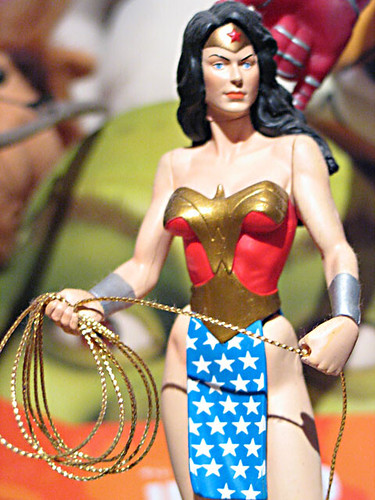
Wonder Womanby Gina Simmons, Ph.D.

A few years ago I attended a concert with my husband and our two teen-aged boys. After the concert, as we filed passed the aisles toward the exit, a drunk heavy-set man shoved my smaller son out of his way so he could pass in front of us. The shove was violent enough that my son was knocked into me.

Most mothers find, at some point in their lives, that a ferocious beast resides inside of you. This bear of a beast only appears when someone threatens or hurts your child. In my mind, the man was fat, out of shape, just a little taller than me. I could take him down! "Keep your hands off my son!" I growled. My husband and larger son made a path for us to get away from the drunk man. After we arrived safely at our car, the four of us talked about the incident. My two boys and husband described the man as approximately 6-feet-2 inches, muscular, with a pot belly. I saw him as about 5-feet-7 and, in that moment of confrontation, I truly believed I could Wonder-Woman him to the ground. Fueled by adrenalin and an instinct to protect my child, I would have made a lousy witness in this case.

According to the Innocence Project, eyewitness testimony is responsible for 75 percent of wrongful convictions overturned by DNA evidence. Many eyewitnesses to more serious criminal offenses find themselves in a similar state of nervous system arousal. Adrenalin pumping, heart racing, pupils dilating, your whole system mobilizes to defend or escape. Some people report experiencing the traumatic event as if it were happening in slow motion. You replay it over and over again, in an effort to make sense of it all. Sometimes, in that replay, we fill in the blank spots of the story with false information in order to make the story connect.

For example, imagine you've stopped at a convenience store. In front of you at the check-out line is a person wearing a dark sweatshirt with a hood. You're looking around the store, wondering if you need to get anything else, when you hear a loud boom. You look back and the person in the hoody is reaching over the counter and pulling money out of a cash register. You look around for a place to hide. Other customers are screaming and shouting different things. "He's getting away! The clerk's been shot." Out of the corner of your eye you see a dark-blue car speed out of the parking lot. Some time later, the police arrive and begin to interview the witnesses. You tell the police that a man pulled a gun, shot the clerk, took money out of the register, and sped away in a dark-blue car.

The clerk gets up from behind the counter and starts to cry. She thought she had been shot. No blood, no bullet, no injury. A witness from outside the store said he saw a large woman in a hooded sweatshirt run out of the store and down a back alley. That witness also saw a black truck speed away in the opposite direction. What did you actually see? The back of a person, could be male or female, in a hooded sweatshirt, took money out of the register, and a dark-colored vehicle sped away. The gender, age, and race of the thief, the source of the loud boom, and the method of get-away are still unknown.

Your eyewitness statement was contaminated by the normal human need to connect the dots of a story, to make sense of a situation. You heard another witness say, "He's getting away," so you assumed the perpetrator was a man. The loud boom, and the fact that you could no longer see the clerk, made you assume she had been shot. This story emphasizes the need for law enforcement officers to interview witnesses as soon as possible after an event, and interview them individually. As tiresome as that process feels to the witnesses, it does help prevent the confabulation of memories as people influence one another to fill in the missing pieces of the story.
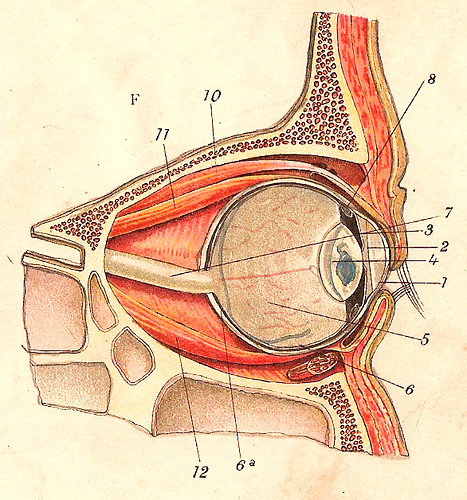
Anatomy of the eye / Anatomia do OlhoWhen we see things out of our peripheral vision, color vision is distorted. The cells in our eyes that perceive color, called cones, fade out in our peripheral vision. If you don't see something head on, you will often mistake the color. As we age, our night vision gets poorer as we lose the more sensitive rod cells. These cells are responsible for motion detection and night vision. The rods are highly sensitive to motion, so you can block something flying toward your head. In the eyewitness example, if you see something out of your peripheral vision you likely will get the color wrong, unless you also see it straight on, in good light, with normal color vision.
Figures of JusticeThe recent execution in Georgia of Troy Davis, convicted of murder based solely on eyewitness testimony, should give us all cause for concern. Seven of the 10 eyewitnesses to the crime either recanted or significantly altered their testimony. Despite the significant holes in the case, Troy Davis was executed on September 21, 2011. The family of murder victim Officer Mark Mac Phail reportedly saw "nothing to rejoice about" in the execution of Troy Davis. Hopefully, they will find some peace and healing.

Officer Mac Phail, jumped to the aid of a homeless man who was being attacked. He was murdered trying to save the life of a stranger. He is survived by a wife and two young children who will never get to know their father. I hope justice, not merely vengeance, prevailed in this case.

Photos courtesy of: Looking glass, CGoulao, and Clearly Ambiguous


Monday, September 26, 2011

Now you see it … The Eyewitness Controversy


It happens in a flash, usually without warning, and certainly for victims and witnesses, without much in the way of preparation. One minute they could be minding their own business; the next they can be in the throes of a crime. Murder, rape, and robbery–you name it–crimes literally happen in the blink of an eye.

Just as quickly, a moment can change the trajectory of a defendant’s life. That moment is the moment they are identified as the one who did it. While courts and prosecutors have long given lip service of the magnitude of this issue, eyewitness misidentification has finally become a real issue that is finally being looked that’s to a historic ruling by New Jersey’s Supreme Court.

As a deputy district attorney in Los Angeles, I handled all kinds of cases with all kinds of evidence. Much of that evidence came from the witnesses and victims to the crime. Witnesses who often swore they could never forget the face of the bad guy. But could they? Really?  

Let's have some perspective here. The most heinous crimes out there–child abuse, sexual assault, rape, domestic violence, elder abuse, and stalking–are crimes that are perpetrated by someone whom the victim knows, and often knew well. These are the cases you hear about in the news. Less discussed are the “stranger” cases, where the victim and perpetrator have no connection, didn’t know each other, and were only brought together through some random (or not so random) senseless act of violence. These are the “ID” cases.

Witnesses are supposed to be considered just like any other type of evidence in a case --blood, sperm, fingerprints-- but they’re not. We all know that the truth is, juries love witnesses. Nothing persuades a jury more than the, (cue the theme music) “Law and Order” moment when a witness takes the stand, looks over, and points to the suspect and says, “There he is. He’s the one who did it.”

In every case, the prosecutor is trying to figure out whether they can make a case. And while we try not to put the pressure on victims to perform the reality, there is a great deal of importance in determining whether the witness can testify credibly, whether their story makes sense, and, more importantly, points to who did it.

The defense attorney, on the other hand, is trying to hold the prosecutor to the burden of proof the Constitution guarantees–that is, the prosecution must prove its case beyond a reasonable doubt. So, as a defense attorney, those words of the witnesses are not about simply making a case; they are about making darn sure you have the right dude.

In my defense work, I pride myself on acknowledging that a crime may, or assuredly did occur. However, I am going to make sure that the prosecutor can prove that the perp is my dude, and not some other dude or SODDI, the known acronym in the legal world for “some other dude did it” defense.

We all know about reliability issues with witnesses. Some have an axe to grind, some have a prior relationship, others have a criminal record or unsavory past, some are drug users, hookers–you name it. But credibility issues are one thing; witness reliability when they are otherwise credible adds a new wrinkle to the equation.

And this is a wrinkle that will really make a dent in criminal prosecutions and finally confirm what defense attorneys have been groaning about for years. And that is that eyewitness identification is inherently flawed. Make no mistake, the New Jersey high court’s ruling could forever change the way police use witnesses to identify bad guys. The US Supreme Court is going to weigh in on the entire issue for the first time since 1971.

Here’s what I’ve witnessed myself over the years: When witnesses say they are 100-percent sure, I’m 1000-percent sure they are not. Why? Our minds and our memories are far from perfect. Sometimes we can’t remember what we had for lunch yesterday. Think about what can happen when a crime is involved. Think about the fear, hate and all kinds of trauma involved here. The chance for unaffected memory is next to zero.

Now, let’s add on the impact of law enforcement. Let’s say you’re a rape victim. The cop who comes in to help you catch the rapist is going to have enormous influence on you. So, if he or she shows you a photo of the bad guy, chances are you will end up agreeing with the choice. I’m not suggesting this is a deliberate act, but it happens all the time. We are only now beginning to understand how a witness experiences and remembers events, faces and time.

The New Jersey Supreme Court Justice, which ruled in the case, said it best: “A vast body of scientific research about human memory has emerged. That body of work casts doubt on some commonly held views relating to memory.” 

Barry Scheck, founder of the Innocence Project and who is famous for using DNA to overturn wrongful convictions, released the following figures from the Project’s files. Of the first 250 wrongful convictions cases overturned by DNA evidence, 190, or 75 percent, involved eyewitnesses who turned out to be flat-out wrong.

Now the courts are finally acknowledging there are issues of eyewitness identification. The question is what is the solution? Prosecutors would like to say defense attorneys could simply argue their cases (but how?), some defense attorneys will argue for exclusion, suppression or limitation of the evidence altogether. Courts allow for experts to appear to testify about the inherent flaws, or even permit jury instructions that address the issues inherent to misidentification by guiding jurors through the process. All of these may be great solutions but they are fixes to a bad identification.

When a person is facing incarceration, loss of liberty and other collateral damages, after-the-fact fixes are just not good enough. We live in a country that forces prosecutors to meet their burden of proof.  Isn’t it time law enforcement be held to the standards that correspond to that heavy burden?

So what am I suggesting? I am suggesting we do something about identification at the critical moment when the initial interview and identification is happening. That is creating a standardized “best practice” system to account for the inherent issues of misidentification, lack of reliability and suggestibility. The simplest and easiest of these can be done right now with only the cost of a tape recorder. If police are required to tape the entire interview with each witness, victim, and suspect then at least everyone can hear verbatim what went down, how the interview was conducted, and how an ID occurred. It is a transparent option that at least will allow attorneys to argue and then jurors to decide for themselves if the identification was good or bunk. There are tons of other ways too, but in a budget-conscious society, one resistant to change, let's start simple with a $15 tape recorder.

If we clean up that part of the investigative chain, we’ll all be able to live with the results as the case makes its way through the system. Memories are flawed. Law enforcement can be too. Let’s remove as much of the human-error part as possible. It’s going to be a better result for justice, which is better for everyone.


Wednesday, August 18, 2010

Eyewitness MISidentification

by Katherine Scardino

My hometown of Houston, Texas, made headlines at the end of July for exonerating two innocent men in one week.

To be honest, I am still angry over the number of years these men spent in prison before being released. I discussed the exoneration of the first man, Mr. Allen Porter, in my last post titled “Free at Last, Free at Last.” The day that post was published on this site, news broke of another Harris County man who was released and exonerated.

Mr. Michael Anthony Green (below right) spent 27 years in prison after being convicted of rape mainly as a result of the testimony of one eyewitness. Other inmates who have been exonerated and later interviewed by the media were quoted as making fairly soft, understanding, Christian-like comments. Mr. Green did no such thing. He was angry. As a matter of fact, on the date the judge acknowledged his innocence of the rape offense, some of his pent up anger burst out at the deputy who insisted on putting him in leg restraints and handcuffs that were too tight for his walk from the County jail to the courthouse -- even though the deputy knew at that moment that Mr. Green was an innocent person. I am afraid that my attitude would be about the same, if not much worse, had I lost 27 years of my life to faulty witness identification and subsequent false testimony. Especially, to top it off -- the icing on the cake -- when an eager officer felt that tight handcuffs were appropriate under the circumstances.

Eyewitness identification is not reliable. From 1990 to 2007, there were 24 wrongful convictions in Texas due to eyewitness identification. The most serious case was that of Timothy Cole, who is not included in the list of 24 exonerated inmates because, unfortunately, he was only officially exonerated posthumously. Timothy Cole (below left) died in a Texas prison in 1999 while serving a 25 year sentence for a rape he did not commit. Nearly a decade later, on April 9, 2009, DNA evidence from the crime posthumously exonerated him and implicated another man as the perpetrator.

In 1985, a young female Texas Tech student was parking her car in a church parking lot across from her dormitory in Lubbock, Texas when an African-American man approached her and asked her to help him start his car. She told him she did not have any cable, and he then reached in through her window and unlocked her door. He then put a knife to her throat and forced her to lie down in her car. The man drove her car to a vacant field where he vaginally raped her. The white female student called the police and during the investigation, she described her attacker.

Timothy Cole was a 26-year-old Army veteran studying business at Texas Tech in 1985. Timothy said he was at home studying the night of the attack. Timothy Cole’s photograph was placed in a photo lineup as a result of a conversation he had at a pizza parlor near the Texas Tech campus with a female detective. Cole was identified by the victim of the rape and was arrested for aggravated sexual assault. The victim of the crime testified at trial and identified Timothy Cole. This identification, along with inaccurate testimony from a forensic examiner, got Timothy Cole convicted of Aggravated Sexual Assault after six hours of jury deliberations. He was sentenced to 25 years in prison.

Now, imagine that you are Timothy Cole. At the time of the rape, he was in college. He had a life, probably a girlfriend or two, and a family -- a past and a future. Until he died in prison in 1999, he had nothing. His appeals were exhausted and nobody could give him any hope that he would ever be released. He was one of those men I have described before. He lived in a box, knowing that he was an innocent person and that no one was doing anything to help find the real perpetrators.

In 1995, one man came forward to accept responsibility for the crime that Mr. Cole was serving time for. Jerry Wayne Johnson wrote to police and prosecutors in Lubbock County stating that he was the guilty party. Keep in mind, however, that this confession came only after the statute of limitations had expired on rape. No one wrote him back. No one did anything. Eventually Mr. Johnson got to the Innocence Project of Texas, where I happily sit on the Board, and told his story. Attorneys at the Innocence Project sought posthumous DNA testing. Cole was cleared by DNA tests in 2008. At a hearing in February 2009, Johnson again confessed his crime before a judge. Mr. Cole was officially pardoned by Gov. Rick Perry on March 1, 2010. Unfortunately, Timothy Cole never knew any of this.

There are many stories like Timothy Cole’s. I will repeat -- eyewitness identification is not reliable. It is the leading cause of wrongful convictions in the United States. Seventy-five percent of the convictions overturned by DNA evidence have involved a mistaken eyewitness.

The Supreme Court of the United States has recognized the uncertainties of eyewitness identification. In United States v. Wade, a 1967 Supreme Court opinion, the court stated: “The vagaries of eyewitness identification are well-known; the annals of criminal law are rife with instances of mistaken identification.”

One of the primary reasons that eyewitnesses to crimes have been shown to make mistakes in their recollection of the attackers is the police procedures used to collect eyewitness evidence. A common eyewitness identification issue arises when a witness or victim is asked to identify a stranger -- either in a line-up, or by viewing a photo spread.

So, how can this problem be solved? It has been recommended that police line-ups be conducted in a double-blind fashion, like any scientific experiment, in order to avoid the possibility that inadvertent cues from the officer who is conducting the line-up may suggest the “correct” answer. That means that neither the witness nor the officer conducting the line-up would know whether the suspect was even in the line-up. Some states have adopted reforms in eyewitness identification procedures. All states should adopt them, but no one wants to admit that they may be wrong. Texas has not adopted any reforms to change much of anything -- including eyewitness identification procedures.