Showing posts with label Vanessa Leggett's posts. Show all posts

Thursday, December 25, 2008

Reviving Ghosts of Christmas Past

by Vanessa Leggett

South Pittsburg, Tenn.—After dark, the hush of Christmas night had fallen over Main Street. Most of the 2,400 citizens were gathered in the warmth of their homes, surrounded by family and the tranquility of the season, not knowing that armed men were squaring off downtown.

At 9:00, shotgun blasts shattered the silent night. Within minutes, several men lay lifeless or bleeding to death on the street. Police never responded. They couldn't. The principal members of city and county law enforcement were dead or wounded that Christmas Day in 1927—shot by each other.

The Christmas Day Massacre story made the New York Times, which headlined a "Street Battle of City and County Police," declaring that "virtually all local law enforcement officers [there were] dead or disabled."

Six of community's finest were killed: the Chief of Police; the Sheriff; a deputy; the City Marshal; the Night Marshal (a former Sheriff); and a special policeman. Several others were injured. According to the Times, none of their service revolvers had been discharged. Each had carried a shotgun.

When I ran across this story, two questions stood out in my mind. The obvious question was: How could this have happened? How could those who are expected to keep the peace and to protect the public violate their sworn duties in such an unthinkable way and on what should be the most peaceful day of the year? Christmas—on a Sunday, no less.

Members of law enforcement consider themselves part of a brotherhood. Yet here was mass fratricide on an incomprehensible scale. In fact, actual brothers in this Cumberland Mountain community had been at war with each other. The Times wrote that "brother was arrayed against brother in the fatal feud":

Thomas Connor, a deputy sheriff and brother of Police Chief [James] Connor, whose account furnished the only known coherent story of events leading to the shooting, said that city officers had drawn pistols on him in an encounter earlier in the evening and that the fight began when Sheriff Wash Coppinger and several deputies later sought to arrest members of the opposing group for displaying their weapons threateningly.
Why had the city officers menaced the county deputy with guns? The conflict was not born that night. This was not a Southern Christmas brawl that developed out of a lethal mix of Jack Daniels and testosterone. The tragic event was the culmination of an industrial strike that had been brewing tension in the town for a year. A local stove manufacturing plant that employed 75% of South Pittsburg's population was attempting to dissolve its unions.

As happens in disputes that polarize communities, law enforcement became involved. In this case, the two major agencies took opposing sides. The Marion County Sheriff and his men supported the union strikers, while the South Pittsburg City Marshals and his deputies backed the stove company and attempted to break up the strike. The County union sympathizers believed their efforts were being undermined by City lawmen. The Sheriff's men accused them of helping special policemen who had been assigned to guard locations.

News accounts reported that the officers involved in the shooting were accompanied by civilians—from both factions of the strike—bringing the total number in gun battle to around twenty.

After some cursory research, I was never able to fully answer that first question: How could peace officers have resorted to murder, the most violent crime of all? Which brings me to the second question, which is less obvious but, to me at least, more bothersome: Why wasn't there more information?

And what ever happened to law and order in South Pittsburg? The only resolution I could glean was that the National Guard had been summoned to restore order. And the slain Sheriff's son assumed the top lawman's post, but not without resistance. The City Administration was set on ousting the Sheriff's family from county authority. The City unsuccessfully supported one of the few surviving officers of the South Pittsburg Police Force. The Attorney General was supposed to investigate, but I could not find any follow-up to this announcement in the New York Times: "An investigation has been started by Attorney General Tom Stewart, who said today that a hearing probably would be called soon to fix responsibility for the fray."

Among the four New York Times pieces I located, one story acknowledged that details of the shooting were "meager." That was reported two days after the police massacre. Eighty-one years later, information is still scant. The South Pittsburg Historic Preservation Society has archived one local story. Usually local papers have the most in-depth information. But aside from a basic summary of events, all the South Pittsburg Hustler had to report 10 days following the shooting was that "no investigation has been made of the horrible tragedy."

A story appeared in the Nashville Banner and likely other papers as well, but none of the stories I read revealed any meaningful details. I could not find a single quote from a witness, and there were survivors and bystanders, according to the Times, which noted that "[s]pectators held back for fear the firing might be resumed." (The shootout took place next to a hotel, whose guests might have been roused by the gunfire.)

Any substantive fact-gathering efforts or accounts of the incident have been recent. Perhaps the most comprehensive account is a scholarly article in the Tennessee Historical Quarterly co-authored by two professors from Middle Tennessee State University in 2004. Researchers at MTSU have been trying to recreate events surrounding the shooting. According to a news story highlighting their work, they consider the Christmas Day Massacre "an important milestone in what happened to unions in the south." (See the video clip below for a documentary encapsulating their research.) In 2005, the South Pittsburg Historic Preservation Society sponsored a presentation on the "Infamous South Pittsburg Shootout," which was attended by the fallen Sheriff's granddaughter and other descendants of those who lost their lives in the gunfight. The co-authors of the scholarly article, professors who spoke at the event, are still looking for information, as is the Society.

Why was there so little contemporary reporting? I believe one factor might be the shroud of secrecy that surrounds investigations into members of law enforcement. There's a reason it's called Internal Affairs. But in a case of such historical import, I don't believe officers' affairs should be kept internal. The public deserves to know exactly what led to the fatal feud that claimed so many lives. The survivors should have that knowledge available.

I don't blame the police. The fault lies with the press. Even if a collective perhaps subconsciously selective amnesia gripped South Pittsburg in the days after the shootout, reporters should have stayed with the story, continued to dig, and to update the public.

Journalists and authors delve into the minds of killers, dissecting their psyches and revealing their personal histories. Why does there seem to be a reluctance to examine that backgrounds of killers who happen to carry badges? Especially, as in this case, those who murder their own?

These ghosts of Christmas past deserve to have their stories told. If you have information on the Christmas Day Massacre of 1927, please contact the South Pittsburg Historic Preservation Society at information@historicsouthpittsburgtn.org


Tuesday, December 2, 2008

What Ever Happened to Jane?

by Vanessa Leggett

Last fall, I wrote about a writer friend of mine who'd found herself in a moral quandary. The subject of her first true-crime book was on trial for murder. Again. My friend's publisher wanted her to attend the second murder trial for an updated version of her book. That was all well and good—until my friend learned she would not be able to cover the proceedings. She had been named as a witness.

So that we're all on the same page, we'll revisit my first story, "Jane's Affliction," and then I'll fill you in on what happened with my friend:

Meet Jane

I have this friend. We'll call her Jane. She's a journalist and true-crime author. For reasons that will shortly become evident, Jane would prefer to remain anonymous. Actually, she'd rather be forgotten altogether, and by one person in particular: a prosecutor who recently tagged her.

See Jane Subpoenaed

I learned of Jane's predicament by e-mail. In my Inbox was a message with the subject line "Whoa! What does this mean?":

I just got my mail out of the box and found a big package from the [redacted] DA's Office. In it was the transcript of my interview with [the Defendant] and a note that said here are copies of your reports and transcripts of your involvement in the [redacted] case. . . . What does this mean? Is this a hint that I'm going to be called to testify?

It was more than a hint, she soon discovered, when the subpoena arrived. Prosecutors wanted Jane to testify in a capital murder trial in California.

During Jane's research ten years ago, she'd interviewed the man who would go on trial for his life a second time—not for the murder Jane wrote about, but for another killing. In the 2007 capital murder trial, the prosecution wanted Jane's testimony to show a consistent modus operandi in the separate slayings.

Problem was, this writer did not want to testify. The issue was not over a breach of journalism ethics; Jane never promised this particular source confidentiality. In fact, what she learned during her interview had already been published in Jane's book.

For Jane, the sticking point was that the prosecution stated its intent to seek the death penalty. Jane is against capital punishment.

See Jane on the Fence

Jane sought my advice because she remembered a subpoena I received in a murder case. I was practically in tears when I discussed my situation with her. So when Jane e-mailed me, she expected I would empathize. And I did, to a degree.

But my dilemma had been different from Jane's. My concern was with protecting my sources. Jane is bound to protect a core belief. And she is tormented by the thought of violating it:

The more I think about it the more uncomfortable I am. They're going for the death penalty. And I'm just not sure I can help put someone to death, even if he is a murderer. . . .

See Jane Suffer Subpoena Syndrome

Something about reading an official document that "commands" you to do something you consider fundamentally wrong messes with your mind. Reason tends to leave as abruptly as the subpoena arrives.

I suspected that Jane, a best-selling author with many years on me in the business, was suffering from something that afflicted me early in my writing career: subpoena syndrome.

I tried to break things down into terms she could live with. I reminded Jane that this type of proceeding, a capital case, contains two trials: In the first, called the "guilt/innocence phase," a defendant's culpability is determined, and if found guilty, the accused is convicted. In the second stage, known as the "punishment phase," a penalty is assessed.

Jane was told she would testify as part of the case in chief, not during the stage in which the death penalty is considered. This meant that Jane's testimony should have no bearing on whatever penalty was decided. Even if she were to testify during the punishment phase, the decision as to whether the man will live or die would not be left to Jane.

In my reply, I tried to ease Jane's conscience: "You need to put the death penalty out of your mind. Prosecutors may seek it, but it's up to the jury to choose death as a punishment."

The way I saw it, the decision would be out of her hands. But Jane could see nothing but blood on her hands if she testified.

See Jane Take a Stand(?)

Taking the stand at any stage of a trial where execution is an option, Jane reasoned, amounts to helping the prosecution put a man to death:

[I]n my heart, mind, in every limb of my body and soul, I think the death penalty is wrong, utterly wrong. So how can I grease the wheels to it? . . . Beyond my moral and ethical beliefs, I also disagree with their death penalty decision because it gives [the Defendant] what he wants. And it seems to me that to [him] the greater punishment, the more horrible punishment, would be life in prison since that's the very thing he did not want.

Jane never expressed doubt about the man's guilt. What she's uncertain of is her ability to testify, if doing so might result in the state taking a man's life. But if she refused, Jane could wind up in a jail cell for contempt of court.

See Jane ______________

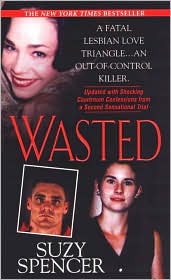
So what did Jane do? . . . It's not a secret anymore, nor is the identity of my friend, Suzy Spencer. Today, her publisher re-released her first book, WASTED, and you can read all about the capital murder trial that Suzy was caught up in.

An Austin Chronicle reviewer called the book "everything a true crime book should be: lean, fierce, and unsparing." The story is riveting. From the back cover:

In 1995, Austin, Texas was rocked by the brutal murder of a lesbian princess named Regina Hartwell. Even though Regina's body was burned beyond recognition, within days police had two suspects. One was the beautiful ex-cheerleader who was the object of Regina's desire. The other was a man who would take the fall for murder. . . . In this new edition of her bestselling book "Wasted", true crime master Suzy Spencer chronicles a fatal love triangle—and lives driven out of control by sexual desire, drugs, and shocking childhood demons. Four years after Regina Hartwell's murder, a new charge was brought against one of her suspected killers. Now, Suzy Spencer adds a new chapter to "Wasted"—detailing a killer gone wild, a nerve wracking legal standoff, the shocking twists that would take place in a second, explosive trial. . . .

Long story short, Suzy did not dodge the trial. She flew to California, not in compliance with the prosecution's subpoena, but at the request of the defense. Her presence meant she would have been available for questioning by either side, though she might have refused to answer for the State. She did not end up testifying at all. Court was canceled that day—in part, Suzy explained, because Justin didn't want any witnesses testifying on his behalf for fear it would ruin his chance of receiving the death penalty.

In the end, Justin Thomas was convicted and sentenced to death. Without putting Suzy on the stand, the State opted to use a portion of the transcript from her taped interview, which was introduced in the punishment phase. As it turned out, Justin's own words netted him a death sentence.

After Suzy's legal battles with this book and with BREAKING POINT, on the Andrea Yates case, she considers the 10th anniversary edition of WASTED her "good-bye" to true crime. Her entry into true crime—hitting the New York Times best-seller list with her first book—was as unconventional as her exit. The "true crime master" has converted to sex book mistress, working on a memoir of sex in America for Berkley. Few would blame her for trading Draconian courtrooms for Hedonism resorts.

As for Justin Thomas, he is now #G11032 at San Quentin State Prison, home of Scott Peterson and Richard Ramirez. Like most prisoners of California's Death Row, Justin will probably die waiting to be executed (assuming the current moratorium is lifted). If so, his "death sentence" will have been converted into what he feared more: the rest of his life in prison, with little hope of his suffering cut short.

That statistics indicate Justin Thomas will not be executed at all should bring Suzy some measure of relief. But not enough to stay in true crime.


Friday, October 31, 2008

Halloween Movie Picks from Women in Crime Ink

by Vanessa Leggett

It's that time of year. For kids, Halloween night means dressing up and venturing out for candy. For party-pooped adults, it means dressing down, staying in, and watching a scary movie.

If you don't like scary movies, you're not alone. Neither does our Texas prosecutor, Kelly Siegler, who put it more bluntly: "I hate scary shows."

And it's little wonder. Like other criminal justice professionals who write for WCI, Kelly might be one of those who look to movies for escape from the real-life horror she encounters day in and day out. Right now, watching a scary movie would be last on Kelly's to-do list. Our "prosecutor for hire" is in the middle of a capital murder trial, where a film of a game warden's shooting death is wearing like the Zapruder reel.

Sounds Like Halloween

If, like Kelly, you don't spend your free time watching scary movies, but your significant other does . . . don't count on shutting your eyes to keep from jumping out of your skin. Usually it's what we can't see that's more frightening—the closed closet door . . . the lengthening shadow of something around the corner . . . the creaking floorboard. . . . Sounds, in fact, can be more frightening than anything seen or suggested on-screen. It only takes two notes from an oboe in JAWS to send chills along the spine . . . or shower sounds and a few strains from the violins of Psycho . . . or a phone's shrill ring, as in When a Stranger Calls and on the other end of the line the killer breathes "Have you checked the children? . . . "

Most of us here at Women in Crime Ink enjoy scary movies, and we like to watch with our eyes open. For Halloween, we polled our contributors for their favorites.

Our Favorite Classics

Every Halloween, Donna Weaver looks forward to her annual dose of Arsenic and Old Lace. Two of Diane Dimond's favorite classics: What Ever Happened to Baby Jane? and Rosemary's Baby. Scary-movie lover Tina Dirmann highlighted Wait Until Dark among several others. And Stacy Dittrich gave Burnt Offerings as her favorite scary movie, while Pat Brown picked The Haunting of Hill House.

"I always thought Shirley Jackson wrote the creepiest stories—more mentally creepy than physically," said profiler Pat, who recalled "the part in The Haunting where the walls are going 'boom, boom' and one woman tells the other to hold her hand until it stops and then, when the noise ceases, she opens her eyes and realizes the other woman is sleeping in a bed all the way across the room . . . eeowww."

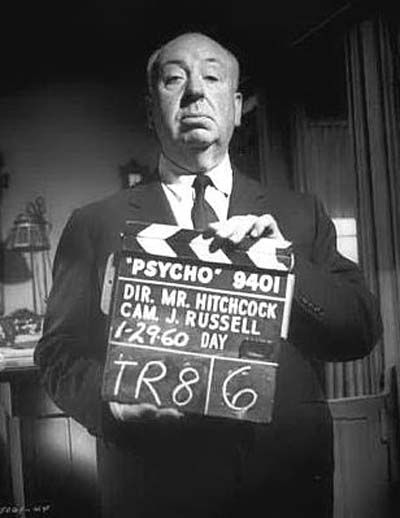
No one could argue with Pat that "anything Hitchcock" is scary. Pat liked The Birds while Diane Fanning cited Rear Window as a favorite. Fanning also mentioned "An Unlocked Window," from the TV series "Alfred Hitchcock Presents." That episode is about a killer on the loose, a man who slips into the cellar window of a medical ward and poses as a female nurse. "That still gives me shivers," Diane said. The chill factor might have been spiked by the set, which was the same house used in Psycho. The Master of Suspense enjoyed tapping into the collective unconscious; he understood the timelessness of terror. Tina Dirmann rents Psycho every year.

Scariest of Them All

But the "scariest movie ever," according to Tina, is The Exorcist. I agreed, as did Connie Park and Cynthia Hunt. The film was based on the William Peter Blatty novel of the same title. Blatty wrote the book and Oscar-winning screenplay, drawing inspiration from actual exorcisms he'd studied, especially the documented exorcism of a 14-year-old boy in 1949. Actress Linda Blair was cast at the same age. (She is probably still in therapy from that childhood role from Hell.) Because of death threats after the film's release, the young actress had to hire bodyguards.

What made The Exorcist, so scary? Perhaps surprisingly for a "supernatural movie"—its realism, thus the threats against the life of an actress whose lines came from a script, not from possession.

"Nothing is scarier," said Cynthia, "than the reality that there is a demonic spirit world that exists alongside us and that the enemy, Satan, is constantly trying to defeat, infect, and destroy everything that is good."


Fear Factor

A modernized battle between Good and Evil can be found in the 1991 remake of the '60s Gregory Peck classic Cape Fear, which was Katherine Scardino's favorite. It's no mystery our defense attorney found this film scary, since the movie depicts a realistic nightmare of every criminal advocate: A vengeful client who blames his lawyer for a stiff sentence. In Cape Fear, an attorney breaches professional ethics by purposely offering a less-than-zealous defense to a vicious rapist, who, upon his release from prison, stalks the lawyer and his family, targeting the attorney's teenage daughter. . . . Equally afraid of a predator's release would be the D.A. who put him away, so it's no surprise that Cape Fear was also a top pick of our sex-crimes prosecutor, Robin Sax. The 1991 version of Cape Fear was a popular choice among several contributors, including Kathryn Casey. (Other thriller picks: Jagged Edge from Robin Sax, and Andrea Campbell recommends Fallen.)

A number of us found favorites in movie adaptations of novels by Stephen KingCarrie, Misery, and Michele McPhee's favorite, The Shining. Who can forget Jack Nicholson as a madman driving an ax through a bathroom door, announcing "Heeeeerz Johnny!"

An earlier Jack Nicholson scene our resident psychiatrist would rather forget: When Nicholson's character is lobotomized in One Flew Over the Cuckoo's Nest. "I can't watch that part," said Lucy Puryear.

Another hard-to-watch lobotomy is found in Hannibal, the sequel to The Silence of the Lambs. The FBI agent played by Ray Liotta is lobotomized by cannibal psychiatrist Dr. Hannibal Lecter.

The Power of Silence

The majority of our contributors ranked The Silence of the Lambs as their favorite scary movie. Based on Thomas Harris's novel of the same title, the film, like the book, is more thriller than horror flick. While this film is one of my all-time favorite thrillers, I would not classify it as a "scary movie."

That said, out of all the horror films I can conjure, the climax to The Silence of the Lambs contains one of the most frightening scenes ever to flicker across the big screen. You remember the scene, when FBI Agent Clarice Starling faces off with serial killer "Buffalo Bill" in his dungeon-like basement.

Sidebar: Buffalo Bill was based on a real serial killer, Edward Gein, a quiet Wisconsin farmer who dressed his victims like deer—using their skins and bones for furnishings (like lamp shades and cereal bowls from skull caps) rather than for actual dresses, or female "body suits," as in Thomas Harris's story.

For both Buffalo Bill and Hannibal Lecter, Harris borrows traits from Gein (pictured above). Like Gein, "Hannibal the Cannibal" ate his victims' body parts. Edward Gein also reportedly served as Hitchcock's inspiration for Psychofilmed a couple of years after Gein's crimes were discovered—as well as "Leatherface" in The Texas Chainsaw Massacre, which chilled our cold-case detective, Connie Park.

But back to the scene from The Silence of the Lambs. You would be hard-pressed to find an actor who has captured the emotion of fear better than Jodie Foster did as Clarice, when her face is framed in the grainy green light from the killer's night-vision goggles. Again, it's what we can't see that makes the heart pound. Don't take our word for it. Watch for yourselves. (Warning: This scene contains language and violence unsuitable for younger viewers.)

Our True Crime Favorites

While The Silence of the Lambs is loosely based on a real villain, there are a number of other films directly adapted from true stories and true-crime books. Since a number of us write fact-based books, this post would not be complete without mentioning our favorite scary movies based on real stories. Here they are, with contributor nominators in parentheses: The Amityville Horror (Tina Dirmann, Vanessa Leggett, Connie Park, Donna Pendergast); In Cold Blood (Jenna Jackson, Vanessa); Helter Skelter (Tina); The Honeymoon Killers (Susan Murphy-Milano); and The Onion Field (Diane Dimond).

So find yourself a scary movie and enjoy the holiday weekend. Now that you know our favorites, we hope you'll share yours with us. A safe and happy Halloween to everyone.

For best-reviewed scary movies, check Rotten Tomatoes, the definitive movie review site: http://www.rottentomatoes.com/


Monday, October 6, 2008

Road to Perfection - Broadway Gives Its Regards to Paul Newman

by Vanessa Leggett

New York — October 3, 2008. That's the night that the lights went out on Broadway. Last Friday, marquees in the theater district dimmed to honor the passing of a star who lit up stages there for half a century.

The haunting yet beautiful visual moment of silence reminded me of a scene from Paul Newman's final role on the big screen.

In 2002, Newman portrayed fictional godfather John Rooney in Road to Perdition, a film based on a graphic crime novel set in Depression-era Chicago. Newman's co-star was Tom Hanks, who played Michael Sullivan, Irish crime boss Rooney's "Angel of Death"—a hit man who also did jobs for Al Capone.

Witness to Murder

To set the stage for that late scene in the film, I must say a word about the conflict that sets the story in motion. The hit man's son, Michael Sullivan, Jr., 12, witnesses one of his father's business associates commit murder during a rough up at a warehouse. The boy was spotted by the executioner, Connor Rooney, the Mafia boss's loose-cannon son, played by Daniel Craig.

"Did you see everything?" Michael Sullivan asks his boy, who nods.

Conner asks Sullivan, "Can he keep a secret?"

"He's my son," says Sullivan.

That's not good enough for Connor, who takes it upon himself to eliminate Sullivan and the boy. But when Connor arrives at the Sullivan residence to take care of business, neither target is home. A frustrated Connor guns down Sullivan's wife and the couple's other son.

Michael Sullivan sets out to exact revenge. This leaves the avenger and Newman's character in direct conflict, each facing impossible choices:

Sullivan knows that his surviving child's life will remain in jeopardy if he does not execute the man who meant to kill them—even if that man happens to be the son of his boss.

And John Rooney's son expects him to eliminate Sullivan, who will surely kill Connor for shooting his wife and child. "You gotta take him now," Connor pleads to his father.

Choosing between the life of a valued hit man or his son may not seem like much of a conflict for John Rooney. But Sullivan, who never had a father of his own, has been more like a son to Rooney than Connor, who is as much of an albatross to his father as Sullivan is a prize.

Connor showed bitterness and jealousy toward Sullivan long before he or Michael Jr. posed any problem for the family. That resentment was stoked just prior to the warehouse execution, when John Rooney ordered his son to "take Michael" along, presumably to avoid unnecessary violence. Sullivan was a judicious hit man. So when Sullivan's son was an eye-witness to Rooney's son committing murder, Connor could not resist the opportunity to take out his only rival for his father's affection.

In the Name of the Father

For Sullivan, getting rid of Connor meant he would also have to kill his father. The crime boss had his son under protection, watched by armed men 24/7. As long as John Rooney was alive, his son could not be killed. The catch was this: No one in Rooney's family wanted Connor to succeed his father. With the crime boss dead, those men would turn the other way for an outsider to take out a childish tyrant waiting to fill his father's shoes. Thus the film's tagline: "Every son holds the future for his father." (Newman's character at right, reacting to his son's news that Sullivan's wife and child had been hit.)

Michael Sullivan first tried to gain access to Connor through his father. When John Rooney said that was something he could never do, Sullivan knew he would have to execute the head of the Rooney crime family, a man heavily guarded. And so the stage is set for the godfather's death.

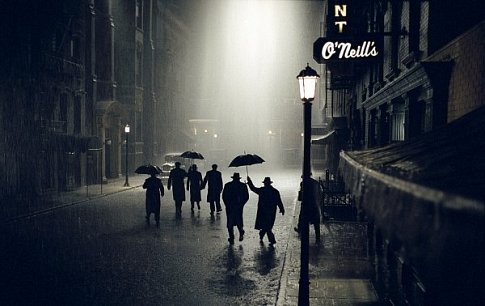
The dimming of the lights on Broadway to mark Newman's death reminded me of the muting of gunfire in the death scene of Newman's character in his final feature film. Befitting an exit of a star like Newman, the scene is, in my opinion, one of the most elegant portrayals of mass violence in the history of American cinema. Never has an assassination in a hail of gunfire taken on such an operatic quality—largely because until the scene's climax, gunfire is never heard.

A Beautiful Death Scene

The surreal street scene is muted by rain and populated with black-silhouetted mobsters carrying umbrellas à la Magritte. From the soundtrack we are entranced by a gorgeous score from classical composer Thomas Newman. (No relation to Paul Newman—but from a rich pool of musical talent—Thomas Newman is also known for the moving soundtracks to The Shawshank Redemption, American Beauty and Six Feet Under's opening credit sequence.)

As the wing-tipped mobsters take their places on the rain-slicked street, the scene turns when the crime boss realizes his driver is not standing with umbrella at an open car door. In the driver's seat, Rooney sees his chauffeur, who appears to be sleeping until Rooney tries the door, and the driver slumps to the steering wheel.

Umbrellas twirl as mobsters pivot, searching for the source. In short order, men collapse around the crime boss, unable to see where the fusillade is coming from. As the ballistics ballet plays out, piano keys echo the tinkling rain as one by one, Rooney's men go down in sync with the sound of descending notes. There is no visible bloodshed.

In the distance, we see the lightning flash of the muzzle from an automatic weapon we know is held by Sullivan, who, after killing everyone but Rooney, emerges from the darkness to do what must be done: kill a man who might as well be his father.

At the end of the scene, Rooney turns to face his executioner. Any Mafia crime boss knows the odds on how he'll die. The question he's plagued by his entire life is—Who will do it? . . . The Law? . . . Family? . . . Foe? . . .

Rooney knew who held the submachine gun the moment he saw one of his bodyguards get hit. In his final moments on screen, facing a man who has been like a son, Newman delivers his last line in cinema: "I'm glad it's you."

This gives Sullivan the courage to open fire, shattering the strange tranquility of the silent street massacre with a blast of bullets to ensure swift, painless death—effectively drowning out the conflict Hanks' character is feeling. The wordless interval between Newman's last line and his assassin's gunfire holds the scene's most poignant moment. In the audience's mind, and no doubt Sullivan's, was Rooney's recent observation: "This is the life we chose—the life we lead—and there is only one guarantee: None of us will see Heaven."

Final Curtain

It's no secret that Paul Newman did not want to be remembered for his acting roles. But his role as Godfather in Road to Perdition—his last appearance on the silver screen—is one I'll never forget.

When Newman's many roles in life ended on September 26, the world lost a star of a human being. But because of the life he chose to lead, the heavens are now one star brighter. He will always be remembered through those whose lives Mr. Newman improved. And thanks to the magic of cinema, Paul Newman lives on—even when the lights go out.


Thursday, September 11, 2008

Freedom Behind Bars

by Vanessa Leggett

We all remember where we were on 9/11. I’ve often wished I could forget. I was in jail—Day 53 of an open-ended incarceration. That summer, a federal judge had found me in contempt of court for my refusal to give a grand jury confidential source material gathered for a book. Surrendering my research would have meant burning sources. I could not do it. And so the judge ordered me jailed for as long as the grand jury was in session. That turned into a 168-day stay at the Federal Detention Center in downtown Houston. When I rejoined society a few months after September eleventh, we were a nation at war and the world I had known was not the same place.

The morning the world changed, I was in my cell, nursing a cold and reading Omerta by Mario Puzo. It was my third day back in general population after a night in solitary. I had made the mistake of questioning the enforceability of a jail policy. Guards made sure I understood what enforcement was all about. The Bureau of Prisons calls segregation blocks the Special Housing Unit, or "SHU" (pronounced shew), fedspeak for what inmates know as "The Hole."

The day I emerged from The Hole was the freest I’d felt during my incarceration. A night in solitary showed me that I'd taken for granted simple freedoms allowed the general population in jail.

For example, outside of SHU, I was free to roam the common area during designated hours. From the dayroom and library, I had several windows with views to the streets below. I considered this privilege a kind of glass-partition visitation with the outside world.

Every day until 9/11, I had watched Houstonians talk on their cell phones, check their watches and PDAs, and sip coffee from Starbucks. (I could spot the cardboard-sleeved cups from blocks away.) By day's end on 9/11, there was little sign of life in downtown Houston, the fourth largest city in the nation.

Another window to the world unavailable to those in solitary was the television. The morning of 9/11, a fellow inmate summoned me to the lower recreation room minutes before the second jet hit the World Trade Center. The north tower was smoking from the impact of the first aircraft. We watched in stunned silence.

Later, I held hands with a group of women in a circle as a chaplain led us in prayer. I remember the inmate to my right squeezing my hand and not letting go immediately. Her home was in another country.

I did not need to speak her language to understand. Each of us wanted to connect with family, with those we loved, and with the people who loved us, to make sure they were safe, and to tell them we were okay. But visitation would be out of the question. For security, the entire detention center went into lockdown mode. My world shrunk to the size of my cell.

I've often thought of how my day on 9/11 would have been no different from my day on the tenth had I remained in solitary confinement. I would not have had access to television. Guards who checked on me would have had no obligation to tell me America was under attack. For my own safety, jail staff might have been ordered not to inform segregated inmates of the national disaster; it didn't take much to lose it in solitary.

Though I was in jail, separated from the world, at least I had been released from The Hole, and was able to see, however horrific, history unfold in real time. My only conduit to the outside world that day was the TV screen, which gave me a sense of connection to other Americans.

That connection was broken once the detention center went into lockdown. All I knew of what was going on in the world was what I had seen through the celluloid window that day: The World Trade Center, our twin trophies of commerce, had disintegrated. Our seat of military might, the Pentagon, had been hit. And another aircraft appeared to have been headed for the Capitol. When I saw members of Congress join hands and sing "God Bless America,” I must admit I feared the end was near.

It wasn't. My incarceration felt like it would never come to an end . . . but it did, eventually, when the grand jury disbanded in early January. For months I'd lived under fluorescent lights, without a single trip outside. As I emerged from the jail, the transition felt as disorienting as walking out of a matinée.

Over the next few weeks, I saw evidence of how the world had changed: metal detectors and pat-downs, building barricades, Middle Eastern cabbies whose well-worn taxis sported crisp, new American flags. Fear was everywhere.

It did not take long for me to realize I was about as free as I had been when I rejoined general population from solitary. Though I was part of the free world again, among my fellow Americans, none of us was truly free. Not like we used to be.


Monday, September 1, 2008

It's Official: Gustav Looters GO DIRECTLY TO JAIL (Not to Angola Prison)

by Vanessa Leggett

Most of us know better than to believe everything we see on TV. But when an official makes an emergency announcement during a press conference televised worldwide, we pay attention, as we should. And we tend to accept such statements as fact.
As Hurricane Gustav churned toward the Gulf Coast over the weekend, I caught a press conference on CNN.

New Orleans Mayor C. Ray Nagin had important announcements to make. This was the third time in as many years that Mayor Nagin found himself addressing a panicked public trying to recover from or prepare for cataclysmic hurricanes: first Katrina (looter pictured above), then Rita, and now Gustav. “This is the Storm of the Century,” the mayor proclaimed on Saturday.
"The Storm of the Century"

Big storms call for big words. And Mayor Nagin was full of them. A
mandatory evacuation had been ordered in anticipation of a Category 4 hurricane. The mayor had a warning for anyone who did not follow orders to evacuate: Watch out for flying mobile homes. Trailers would become “projectiles,” he said, and would “start to fly around the city.”
He also had a warning for crooks planning to take advantage of the city-wide evacuation. "Anybody who is caught looting in New Orleans will be brought directly to Angola,” he said, repeating himself: "Directly to Angola."
This statement hit me harder than the one about trailers hurtling through the city, which Nagin said to expect as "a matter of fact," though it sounded more like the movie Twister than reality. I remembered the devastation Katrina brought, however, so I was prepared to believe in flying trailers.

I was not ready to accept that the Constitution would be thrown to the wind as well—that police would pluck looters from the streets of New Orleans and haul the accused to Louisiana's Death Row. If cows could fly in Twister, BS could fly in a press conference. Nothing unrealistic about that. In fact, City Hall seemed as fitting a venue as any. But the mayor's message was broadcast worldwide.

“You will not have a temporary stay in the city," Mayor Nagin continued. "You’ll go directly to the Big House, in general population. You will go directly to Angola Prison. And God bless you when you go there."

Given New Orleans’ experience during the storms of 2005, cautioning would-be looters was called for—especially after Hurricane Katrina, when pilfering was so widespread that even uniformed members of law enforcement were
filmed helping themselves to goods from a Wal-Mart.

I remember how stunned I had been to see
police captured on tape, stealing in the storm-torn town they were sworn to protect. But I found Nagin's message even more shocking. Here was the Mayor of New Orleans making an official announcement, threatening thieves picking over others' belongings with a direct ticket to "general population" in the nation's largest maximum-security prison, the "Alcatraz of the South." It was unbelievable.
Maybe my personal background is what kept me from buying the threat. I'd taught corrections at a university and later did time in a maximum-security federal facility. You could say I know a thing or two about the prison system. My knowledge of how things are run on both sides of the bars did not square with Nagin's threat.
C.J. 101: Arrestees are detained in jails, not prisons. Penitentiaries house those who have been convicted of a crime, felons who have been sentenced to a term of imprisonment.
The Mayor Has No Clothes
Traditionally, the responsibility of bringing such errors to public attention falls on the media. (Though it doesn’t always happen that way and results can be disastrous. Just ask former ambassador Joe Wilson.) Of course, the mainstream media might not be motivated to correct this type of inaccuracy, since it seemed to me at least that Nagin was using a scare tactic to force law and order. I'm guessing journalists with more practiced noses than mine at "smell test" reporting shared my initial reservation in bringing the error to the public's attention: Why let the thugs think otherwise? And there was a less honorable reason the press did not point a finger at Nagin to say there was not a thread of truth to the mayor's statement: some reporters never let the facts get in the way of a good story.

But after watching credible journalists like
Wolf Blitzer perpetuate Nagin’s claim that looters would be sent directly to Angola, I started to wonder . . . Could it be true? Yet another report made me reconsider my initial impression. A New Orleans-based broadcast journalist interviewed by CNN echoed the cable network's reports that looters would be sent directly to the Big House. "They’re serious," he said, seeming, well, serious.

When in Louisiana . . .
OK. If a local reporter was backing up Nagin's claim, maybe these Louisianans were serious after all. The law in Louisiana is different from any other state in the country—and I’m not referring to the way it’s enforced, or that it’s sometimes not enforced. Louisiana operates under the Napoleonic Code.

I decided to check
the statute, which I was not surprised to see had been revised since the storms of 2005:

"Whoever commits the crime of looting during the existence of a state of emergency . . . shall be imprisoned at hard labor for not less than three years nor more than fifteen years without benefit of probation, parole, or suspension of sentence."
The punishment seemed a bit harsh. For a property crime that could be as small as stealing a loaf of bread to keep from starving, sending someone to prison for a minimum 1,095 days approached the fiction of Les MisÄ—rables. In New Orleans a few years ago, those who rode out Katrina truly were without survival essentials. In the looting footage cited above, the reporter at Wal-Mart asked one man if he was stealing from the store.
"We have no means of washed clothes or food, sure," he said, continuing shopping.
If Nagin's straight-to-prison threat became reality, what would happen to a victim who was without food, or a merchant to sell it to him? And what if an evacuating homeowner returned to pick up something left behind? What if, for example, a New Orleans P.D. officer didn't believe he really lived there? Should an innocent man go straight to prison? Would a teenager having fun in all the chaos by stealing a plastic pink flamingo from a neighbor's yard find himself in general pop at Angola?
Where in all this mess is a little thing called due process? As the Louisiana looting statute stands, at least three years prison would be mandatory for anyone found guilty of looting during an emergency. In addition to imprisonment, a fine would be subject to a judge's discretion. How could a monetary punishment be left up to a judge in a courtroom, but a man's life and liberty rest solely in the hands of an officer on the street?
As preposterous as the whole thing seemed to me, one phrase in the statute gave me pause. Looters would be “imprisoned at hard labor.” Angola, a.k.a. "The Farm," is perhaps the country’s most recognized hard labor prison. The acronym for Louisiana State Penitentiary stands for something else to the prison population, which knows L.S.P. as the “Last Slave Plantation.”

I did a quick fact tally. During a state of emergency, the law mandates "hard labor" as punishment for all looters. And Angola Prison is the state symbol for chain-gang labor. Maybe the mayor wasn’t off his rocker. Two years ago,
Katrina looters had been dealt double-digit prison sentences for stealing booze from a store, to "send a message."

Louisiana does do things differently. And exigencies can similarly affect how laws are applied in any state. The Constitution makes due process exceptions during times of war or in cases arising out of "public danger." Insurance policies contain clauses addressing force majeure, or “acts of God,” which can change the rules.
More than a century ago, The New York Times ran a story days after the Great Storm of 1900, a Category 4 hurricane, which claimed more than 6,000 lives in another Gulf Coast community: Galveston, Texas. In the aftermath of that disaster, an insurance company spokesman was quoted as saying "The letter of the law will not be adhered to."
In 2005, one New Orleans cop looting the Wal-Mart had the same spirit. In that footage, a reporter asked an officer what was going on in the closed superstore. "Doing my job," the cop said, walking away from a basket of stolen goods. "Looking for looters."
Lessons from History
According to storm lore, on September 9, 1900, the day after the Great Storm made landfall on Galveston Island, literally thousands of corpses began rapidly decomposing in the Gulf Coast's relentless heat and humidity. On the small island, the stench of human remains and livestock carcases littering the landscape was unbearable. Survivors quickly decided to dump bodies at sea. Looters complicated efforts to ID the dead. Police caught one man whose pockets were stuffed with a couple of dozen gold rings, the owners’ fingers still attached. Ears and other body parts were severed for jewelry. More than thirty looters were dealt with Texas-style: the majority were shot to death, some on the spot.

Contra-flow of Information
Like Texas, Louisiana is a renegade state, but I still doubted Mayor Nagin's sincerity. I had to do a little independent investigation. I checked for official press releases restating the mayor's Angola warning, but found nothing.
Visiting the Louisiana State Penitentiary Web site, I did discover a public notice concerning the state prison system's "Preparation for Tropical Storm Gustav." The press release simply notified the public that visitation would be suspended. The L.S.P. posted the bulletin to inform and "assure the public that the prison is secure and public safety will be maintained through this emergency crisis." Nothing about Angola.
I e-mailed a request for more specific information regarding Mayor Nagin's comments. Here was the official response:
Post-evacuation and post-storm arrestees will be housed at Elayn Hunt Correctional Center in St. Gabriel, not Louisiana State Penitentiary. . . .We are in the process of establishing court functions at EHCC for later in the week. More than likely, a judge will be appointed to hear cases from all parishes making arrests, instead of having a judge from each parish coming in and handling only that parish. We're still working out the details on that, but we did have some court hearings at EHCC after Hurricane Katrina so this is not unchartered territory.

Pam Laborde, the Communications Director for the Louisiana Department of Public Safety and Corrections, ended the statement with the typical courtesy: "Please let me know if you have any further questions."
I did. Perhaps I asked too many. Though she'd just confirmed, in so many words, that the mayor's claim had no clothes, I knew I had to press, specifically about Angola. And while Ms. Laborde's responses were helpful . . . it wasn't until I bore down on Angola, that I received the information I needed:
"Angola has nothing to do with this story," she wrote, "other than the fact that the mayor apparently gave incorrect information as to where arrestees would be taken."
The Mayor is Full of Hot Air ("Apparently")

I do understand that leaders have to make choices for the greater good of those they serve. And this would not be the first time or the last that a man in charge delivered deliberate misinformation for what he believed was in the better interest of his community.
Maybe Nagin's prevarication served its purpose. The mayor gave his "Mother of All Storms" warning Saturday night as mass evacuations were under way. As of Sunday morning, the New Orleans Police Department reported no arrests for looting. Then again, those reports came during the calm before the storm.
But should it ever be acceptable for an elected official to deliberately mislead his constituency? Does talk of projectile mobile homes and prison without due process (if spoken to secure the public's personal safety and property) rise to the level of yelling "Fire!" in a crowded movie theater? I'm not sure.
But I have a problem with even the appearance that a person's Fifth Amendment rights can be gutted, even if the threat is ultimately empty. If that's what Mayor Nagin did, he abused the First Amendment.
On the other hand, I would support a citizen's right to push the free speech envelope. I appreciated this comment to an online news story restating the mayor's whopper. This reader had an even stronger notion of how looters could be deterred:
"Unless they drop [the property] immediately, shoot them. Tag them with signs saying, this was a looter."
Lesser of Two Disasters
Perhaps Nagin's greater good was served. But what will the repercussions be, considering his message was broadcast around the world? Might other countries wonder: Is that how America now deals with petty thieves? Hard-core prison without benefit of trial or so much as a hearing before a magistrate?
Early this morning, as the world waited for Gustav to make landfall, I was thankful to see CNN storm trooper Anderson Cooper wisely revising history. He seemed to fumble for words that wouldn’t take the wind out of the mayor’s threat, but would make the report closer to the truth.
“You will be taken directly to a local jail,” he said.
Anderson’s trademark squint seemed especially blinky. Perhaps it was the wind whipping his face. More likely, I think, is that Anderson realized what he’d just said on live television:
Looters will be confined in a jail within the city that Gustav is barreling toward, the "ghost town" that everyone else has evacuated.