Showing posts with label Mafia. Show all posts

Monday, April 11, 2011

Is Sin City Mayoral Candidate Goodman More Than a 'Mouthpiece?'


Word on the street is that the campaign headquarters of Carolyn Goodman at last Tuesday's election night in Sin City was peppered with mobsters. Old-time mobsters.

"At least 10 were there," the source said.

It's not surprising, considering Carolyn's husband is Oscar Goodman, the self-proclaimed "Mouthpiece for the Mob" who, as a criminal defense attorney, represented the likes of Chicago mobster Anthony "Tony the Ant" Spilotro, once suspected of more than 20 killings, and Philadelphia mob underboss Philip Leonetti. Oscar, currently the mayor of Las Vegas whose three-term sting is expiring, has been vocal about his hopes for his wife succeeding him as mayor.

Back in June of 1999, Oscar Goodman was elected mayor of this gambling mecca. At the time, he said he was proud of his past: "I'm not ashamed of anything." During Goodman's tenure as mayor, he changed his popular "mouthpiece" moniker to "America's Happiest Mayor."
On Tuesday, his wife won 37 percent of the vote, with Chris Giunchigliani coming in second, inching closer to her husband's aspirations for her.

Whisperings, however, at the Goodmans' election-night party, according to the source, were that Carolyn might have been able to pull off an early first in the primary based on name recognition, but when it comes to winning in the run off, it might not be as simple.

That's because Giunchigliani, currently a Clark County commissioner, is known as a politician for the people who runs grassroots campaigns. The personable Carolyn Goodman, on the other hand, is new to politics other than as first lady of Las Vegas for the last 12 years. Mrs. Goodman is more recognized as the founder of a private school, known as a top college prep academy where people with money send their kids

"I am running against a name, let’s put it that way," Giunchigliani recently told The Washington Post. "But I think the public recognizes that the time for that type of leadership style has passed."

Now it's up to the voters. Chris, 57, and Carolyn, 72, will face each other again on June 7 in a run-off election. 

Photos courtesy of the candidates' campaign websites and philly.com.


Thursday, July 8, 2010

System Failures: Part II

by Robin Sax

Yesterday I told you about the case of Baby Vanessa, who is about to be torn away from the only mother she's ever known and shipped halfway across the nation to be raised by a biological family she's never met, one that includes a violent bio-dad with a record. Today, I'd like to recount my second infuriating July 2010 case, that of an admitted hit-man. Just thinking about this case makes my blood pressure climb. Amazingly, self-confessed former mafia hit-man James “Jimmy” Hughes walked out of the Riverside Superior Court in Indio, CA, a free man last Thursday, after the case against him was dismissed at the prosecutors' request.

To explain what happened, let's back up. Hughes was arrested in September 2009 for the 1981 triple homicide known as the “Octopus Murders,” the shooting deaths of former Cabazon Band of Mission Indians tribal leader Fred Alvarez; his girlfriend, Patricia Castro; and friend Ralph Boger. All three were found dead on July 1, 1981 in Rancho Mirage; each had been shot execution style in the back of the head. The case got its unusual name because some believe the killings are connected to tribal dealings and government agencies.

Now let's talk about 1984, three years after the murders. That's when James “Jimmy” Hughes told authorities and reporters that he was the bag-man who delivered the money for the hit, and that Cabazon Indian tribe administrator John Phillip Nichols contracted the hit. After confessing, Hughes left the United States before he could testify and built a new life in Latin America where he lived for 28 years. In California, the triple homicide case lingered until Detective John Powers of the Riverside County Sheriff’s Department took control of the cold case file on November 27, 2007.

Who kept the case alive all those years? One of the victims, Ralph Boger, has a daughter who was instrumental in pushing the case. Frustrated by a lack of action, Begley investigated her father's death, so well that investigators have credited her with uncovering important evidence. Thirteen at the time of her father's murder, Begley says she wants justice for the victims and that she has come too far to give up. “How many people must die or suffer at the hands of James Hughes before he is brought to justice?” Begley asked in a statement delivered in court. “He is literally getting away with murder.”

Deputy Attorney General Mike Murphy - the prosecutor - notified Rachel Begley on June 24th that he planned to drop charges against Hughes on July 1 (the 29th anniversary of the triple homicide). Interestingly, she was informed weeks, possibly months after the defendant and his whole family were told.

So the case is being closed again - despite the fact that Jimmy Hughes has been in custody with special circumstances for nine months and the self-confessed hit-man publicly admitted he was the perpetrator.

How and why does a case with so much potentially incriminating evidence get dropped? I find this baffling! This is the stuff of TV and movie dramas – not the American justice system, an institution our soldiers are dying overseas to protect. Is the mafia still involved with Hughes? Are the prosecutors being threatened? What's happening here?

These are all widely speculative questions, but it appears obvious that something isn't right. Why wouldn’t we have a trial? If Hughes is innocent, the case would be examined and properly closed. But to let him loose with no trial is a disgusting outcome. I commend Rachel for her bravery and tenacity, taking on this task of trying to prosecute her father’s murderer. But our system should be doing what Rachel is doing: seeking justice.

Sometimes justice is swift and executed fairly and our system makes me proud. At other times, in those cases like this one and the Baby Vanessa case, I see egregious miscarriages of justice.

We all have a right to be angry about these cases, and we have an obligation to make are voices heard. These two cases, a child being taken away from the only mother she has known to possibly go to an abusive man, and a daughter having to sit by and wonder if the man who murdered her father is walking free, shouldn't be happening in America.

Click here to see the motion that let Hughes walk. For more details on his case, visit: A Hit Man with a New Mission, From CIA operative and mafia hit-man to evangelical pastor, Murderer of five thousand dollars.


Thursday, February 25, 2010

Smoke and Mirrors: The Truth About Las Vegas

Watching Las Vegas Mayor Oscar Goodman’s indignation over recent advice by President Barack Obama to a New Hampshire audience to not waste cash in Las Vegas was reminiscent of a similarly indignant Goodman a decade earlier. 


Goodman, a former criminal defense attorney and self-described “mouthpiece for the mob,” spent 35 years defending the nation’s most notorious underworld figures. His clients included mobsters Meyer Lansky, Anthony "Tony The Ant" Spilotro and Frank "Lefty" Rosenthal, the latter two portrayed in the film Casino by actors Joe Pesci and Robert DeNiro. Goodman, also in the film, played himself–a lawyer for the mob. 


So it came as a surprise in 1999 when Goodman tried to deny the mob’s existence in Las Vegas. It was during Goodman’s mayoral run, when he issued a statement in the midst of a colorful Las Vegas trial of two reputed Mafiosi charged in connection with the 1997 execution-style murder of another gangster, Herbert “Fat Herbie” Blitzstein. The trial spotlighted the very kind of mob activity that officials, other than Goodman, had insisted, year after year, no longer existed in Las Vegas.


It started in the early 1990s, when the Nevada Gaming Commission released the first of several statements assuring the public that the FBI had forced the last of the mob out of Las Vegas in the 1980s. That was not true, of course. Goodman himself had represented Spilotro in a mob trial in the mid-1980s, shortly before Spilotro was buried alive and left for dead in an Indiana cornfield. Blitzstein was a co-defendant with Spilotro in that trial. After Spilotro’s murder, Blitzstein pleaded guilty and went to prison. He was released in the early 1990s and returned to Las Vegas, picking up where he had left off.


The 62-year-old Blitzstein ran a downtown auto-repair shop that fronted for his rackets. Authorities said he ran loan-shark and insurance-fraud racketeering operations out of the shop. 


In January 1997, Blitzstein was gunned down in his town house. Federal prosecutors later contended that mob families in Los Angeles and Buffalo, N.Y., had ordered Blitzstein’s hit so they could take control of his business. 


Then, in May 1999, Goodman, as a mayoral candidate, issued a press release declaring the streets of the city free of traditional organized crime.


"For the last 15 years," Goodman said, "there hasn't been a mob presence here." 


Coincidentally or not, Goodman issued that statement from his law office, which was around the corner from the U.S. District courthouse where the Blitzstein murder-related trial was well underway. Testimony in that case, which was heavily covered by the media, related to the life-and-death saga of Herbert Blitzstein–who had been Spilotro's right-hand man–provided new details about Las Vegas street rackets. For example, the 12-count racketeering indictment handed down in the case named 10 defendants charged with offenses ranging from Mafia-related murder-for-hire to racketeering. 


The trial surrounding Blitzstein’s murder, which ended with most of the defendants pleading out to lesser crimes, was the last Mafia-related trial in Las Vegas. 


Blitzstein’s murder also marked the last mob hit in Sin City. But don't tell Oscar Goodman. We'll just keep it between us.


Friday, November 20, 2009

Murder of 'Mob Princess' Susan Berman Remains A Mystery

The following is an excerpt from Cathy Scott's latest book, The Rough Guide to True Crime, released by Penguin Books in August. Susan Berman is the subject of an earlier book by Scott titled Murder of a Mafia Daughter: The Life and Tragic Death of Susan Berman (Barricade Books), due out in a second edition early next year.

by Cathy Scott

The life of a journalist and author who spent her adult years writing about her mob roots ended dramatically, like a character in one of her books. Susan Berman, 55, was murdered in her
Beverly Hills, California, home. She was shot execution-style by an unknown assailant just as New York state police were scheduling an interview about a decades-old unsolved missing-person's case.

Berman’s body was found on December 24, 2000, inside her rundown rented house in the woodsy
Benedict Canyon neighborhood, where she lived with her three dogs. The front door had been left wide open – there were no signs of a forced entry or struggle, no signs of a sexual assault, and no items had been stolen from the house.

Susan had lived what she once described as a perfect childhood, despite being the daughter of a Jewish mobster. In the 1930s and '40s, her father,
Davie Berman, was part of the same crime syndicate as Benjamin “Bugsy” Siegel and mob kingpin Meyer Lansky. Working with Lansky, considered one of the shrewdest gangsters to ever walk the streets of 20th-century New York, gave Davie the opportunity to learn from the mob's top echelon. After all, Lansky was known as Lucky Luciano’s right-hand man and the mob’s financial mastermind.

As a trio, Berman, Siegel and Lansky pioneered the development of Las Vegas from a sleepy desert cow town to a thriving gambling Mecca. Nevertheless, the gangsters soon found themselves in an uneasy alliance with the Italian Mafia, who moved in on the Jewish mob’s territory. Davie, who co-owned the famous Flamingo Hotel and Casino with Siegel and Lansky, ran the place after Siegel was murdered in 1947 (in the Beverly Hills home of his mistress, Virginia Hill). Only in 1951, after the highly publicized and televised Kefauver Committee hearings of the US Senate’s investigation into organized crime, did the public become aware of the extent of Jewish involvement in the underworld.

Susan was unaware of her father’s underworld dealings until she became an adult, but her Las Vegas childhood was not exactly normal. Her father had slot machines installed in Flamingo Hotel rooms so his daughter could pass the time gambling and ordering room service. Susan enjoyed the life of a spoiled, indulged child. She wanted for nothing. Elvis Presley, Frank Sinatra and Liberace performed at her birthday parties. Davie drove fancy new Cadillacs. To his Susie, he was the world. What Susan did not know then was that when mob families were feuding, her family was in danger. During times of mob unrest, Davie piloted Susan away to Los Angeles, flying out of McCarran Field to the Los Angeles airport, and then to the Beverly Wilshire Hotel for two or three days. He told Susan they were short vacations. Bodyguard Lou Raskin, a mountain of a man, lived with the Bermans so he could watch over Davie’s precious daughter. Susie remembered the trips as wonderful outings. She fell in love with Los Angeles.

The high-society lifestyle of the “Mafia Princess”, as the media called her, came to an abrupt end in 1957, when she was twelve. That year her father died during intestinal surgery. Only a few months later her mother Gladys committed suicide by taking a barbiturate overdose. Her Nevada childhood would haunt Susan for the rest of her life. In the ensuing years, what Berman wanted most was for her father to be remembered for his contributions to the development of Las Vegas. She wrote about Davie in two memoirs, 1981’s critically acclaimed Easy Street and 1996’s Lady Las Vegas. There was speculation after Susan's death that perhaps digging into Davie’s mob past was what got Susan killed. When police, responding to reports of dogs running loose, found Susan’s lifeless body on the floor of her rented house, they also noticed a 1920s Chicago Police “WANTED” poster for her father. Combined with the cause of death – a single gunshot wound to the back of the head – it was not surprising that detectives wondered if Susan had been whacked by the Mafia. That notion was soon debunked when they realized the mobsters of her father’s era would be between 90 and 100 years old. Moreover, nothing Susan was working on was anything she would be killed over.

One person of interest to the police was Berman’s
University of California classmate Bobby Durst. She regularly referred to him as her brother and her best friend. They had much in common. Durst was a multimillionaire and the eldest son of a rich New York real-estate tycoon family. Like Berman, Durst’s mother committed suicide when he was a child, falling from the roof of the family mansion while her son watched.

Durst’s wife,
Kathleen McCormack, went missing in 1982; he was questioned about the disappearance but never charged with any crime. In 1999, Kathleen’s parents went to court and had their daughter declared dead, even though no body was ever found. It cleared the way for them to settle her estate. But it also cleared the path for Durst to remarry, which he did.

Questioned about Susan’s killing, Durst told investigators he’d spent the holidays in the Hamptons with his second wife at the time Berman was gunned down. But Durst’s wife, Debra Lee Charatan, did not corroborate her husband’s claim. Durst’s celebrity lawyer, Dick DeGuerin, offered up a different alibi: Durst, he said, was on a plane Christmas Eve day – headed from San Francisco, where Durst owned a home, to New York - when Berman’s body was discovered. About the same time police were arriving at Berman’s home, DeGuerin said, Durst was on a plane. The problem with that alibi was that police said Berman had been dead for two days when her body was discovered, which meant Durst was not off the hook. Instead of providing an alibi for his client, DeGuerin unwittingly placed Durst in California at the time of Berman’s murder, just up the coast from the crime scene. Durst, 57 at the time of Susan’s death, was not charged in connection with her murder.


Three years later he was, however, tried for killing
Morris Black, an elderly neighbor of his in Galveston, Texas. Durst had moved to that state for fear of being indicted in New York by the Westchester County district attorney, who had reopened the investigation into Durst's first wife’s disappearance. He lived in disguise, masquerading as a mute woman and renting a $300-a-month apartment. Morris Black, 71, a bad-tempered former seaman, lived across the hall.


Black’s body was butchered and stuffed into garbage bags that were found floating in
Galveston Bay. Durst was arrested and charged with murder. He posted a $300,000 bond and then jumped bail, leaving the state and thus becoming a fugitive. He was found six weeks later in Pennsylvania, when – despite having $500 in his pocket – he was caught shoplifting a chicken sandwich, a Band-Aid and a newspaper. At trial, Durst admitted the killing, but claimed self defense.

In a shock verdict, the jury acquitted him.

If Durst had admitted to killing Morris Black, then what about Susan Berman, her friends asked. Could he have killed Susan … and his first wife, Kathleen, too? Medical student Kathleen, 29, was last seen on Jan. 31, 1982. Durst told police he’d put her on a Manhattan-bound train at a Katonah, N.Y., station so she could return to classes in the city the next day. He remained at their cottage near South Salem, Westchester County. Five days later, he reported his wife missing.

At the time, Susan Berman acted as Durst’s unofficial spokeswoman, fielding telephone calls from the media so Bobby did not have to deal with them. The dean of Kathleen Durst’s college told investigators that a woman identifying herself as Kathleen called in sick to school around the time of her disappearance. Friends and family believe Susan in fact made that call; they believe Susan knew too much about Kathleen Durst’s disappearance – and that’s what got her killed. Susan, so her confidants said, could be pushy. Perhaps, they surmised, Susan had pushed too far. After all, she’d contacted Bobby and asked for a loan so she could buy a used SUV. Instead, Bobby Durst sent her two separate checks for $25,000, telling her in a note that they were gifts, not loans. Still, the investigation of Durst by Los Angeles police detectives went cold. Authorities named a second man, Nyle Brenner, Susan’s manager, as a person of interest in the case. That probe too went nowhere.

No eyewitnesses to Susan’s murder ever came forward. Susan’s killer simply escaped into the night. At the scene, investigators found the casing of a spent bullet used in a 9mm handgun. It was the best evidence they had. After Durst was arrested in the Black case and police found a 9mm handgun in the trunk of his car, LAPD investigators traveled to Texas and did ballistics tests on the gun to see if it matched the casing found at Berman’s house. The tests were inconclusive.

According to the lead detective, Paul Coulter, he would have done things differently had homicide investigators been called in to handle the case from the start. His office, however, was not given the case until a few days after a news release was issued – eleven long days after the murder. As a result, reporters across the globe began calling the LAPD for information. That was when higher-ups handed off the case to the Robbery-Homicide unit.

“It’s very difficult, because we weren’t there from the get-go,” Detective Coulter said in a telephone interview. Jerry Stephens, Coulter’s partner on the case, retired in mid-2003. Another detective, Jesse Linn, replaced Stephens and paired up with Coulter in the investigation. Later, however, no one seemed to be investigating the murder. There were no new clues or leads.

The Berman investigation, Case No. 000825485, is now a cold one at Parker Center on North Los Angeles Street, where the LAPD's Robbery–Homicide Division is housed. Berman’s murder was one of 548 committed within LAPD’s jurisdiction in 2000.

When she came of age, Susan was given a trust of $5.25 million – which, over the years, she squandered on overspending and bad investments. She purchased three homes and lost them all to foreclosure. Still, for years she kept up a facade and wanted to be treated as if she had money. She was a wealthy Mafia daughter and a respected writer – but she ended up struggling and penniless, living in squalor while she waited for a big movie deal, until she was shot to death in the back of the head, her murderer never apprehended.

Photos courtesy of CourtTV.


Friday, March 6, 2009

Wiseguy Protection Program—Your Tax Dollars at Work

by Michele McPhee

You want to know the secret ways in which untold amounts of our federal tax dollars are squandered? Recently, I was asked whether I thought Joseph Milano—the owner of a Florida pizzeria named Goomba’s—was really a Mafia hitman named Joey “Crazy Joe” Calco I wrote about in my first book, Mob Over Miami.

I did and it was.

Calco (pictured above) is a confessed killer who was part of the notorious Bonanno crime family’s Bath Avenue Crew. He served six years in prison for murdering two of his pals. He promised federal Judge Edward Korman that if given another chance he “won’t let this court down and I won’t let you down.”

With that, Calco became one of the many in the absurdly expensive federal Witness Protection Program and was relocated to Florida with a girlfriend and his parents.

On January 23rd, two customers came into Goomba’s to complain about a calzone they had purchased. Milano (at right) pulled out a Luger 9mm handgun, jumped over the counter, and pistol-whipped the men. The attack was captured on surveillance tape (below). After the incident, Milano was arrested at his parents’ home and charged with aggravated assault with a deadly weapon.

Two weeks later, once police caught on, Joseph Milano, a.k.a. “Joey Calco,” was rearrested as a felon in possession of a firearm.

In the years since Calco became a maggot in Florida, he has been accused of sexually harassing a teenage girl who worked in the pizzeria and he has logged a battery arrest for slapping another teen employee.

Richie Capie, 35, one of the men Calco attacked, said he has heard the news that he was brutalized by a Mob hitman helped by the government.

“Now that’s in the back of my mind—the guy’s a killer," Capie said.

Calco is not the only wiseguy to get in trouble again after making a deal. Who could forget Sammy “the Bull” Gravano, the Gambino crime family hitman? I guess their contributions help stimulate the economy with police overtime?


Monday, October 6, 2008

Road to Perfection - Broadway Gives Its Regards to Paul Newman

by Vanessa Leggett

New York — October 3, 2008. That's the night that the lights went out on Broadway. Last Friday, marquees in the theater district dimmed to honor the passing of a star who lit up stages there for half a century.

The haunting yet beautiful visual moment of silence reminded me of a scene from Paul Newman's final role on the big screen.

In 2002, Newman portrayed fictional godfather John Rooney in Road to Perdition, a film based on a graphic crime novel set in Depression-era Chicago. Newman's co-star was Tom Hanks, who played Michael Sullivan, Irish crime boss Rooney's "Angel of Death"—a hit man who also did jobs for Al Capone.

Witness to Murder

To set the stage for that late scene in the film, I must say a word about the conflict that sets the story in motion. The hit man's son, Michael Sullivan, Jr., 12, witnesses one of his father's business associates commit murder during a rough up at a warehouse. The boy was spotted by the executioner, Connor Rooney, the Mafia boss's loose-cannon son, played by Daniel Craig.

"Did you see everything?" Michael Sullivan asks his boy, who nods.

Conner asks Sullivan, "Can he keep a secret?"

"He's my son," says Sullivan.

That's not good enough for Connor, who takes it upon himself to eliminate Sullivan and the boy. But when Connor arrives at the Sullivan residence to take care of business, neither target is home. A frustrated Connor guns down Sullivan's wife and the couple's other son.

Michael Sullivan sets out to exact revenge. This leaves the avenger and Newman's character in direct conflict, each facing impossible choices:

Sullivan knows that his surviving child's life will remain in jeopardy if he does not execute the man who meant to kill them—even if that man happens to be the son of his boss.

And John Rooney's son expects him to eliminate Sullivan, who will surely kill Connor for shooting his wife and child. "You gotta take him now," Connor pleads to his father.

Choosing between the life of a valued hit man or his son may not seem like much of a conflict for John Rooney. But Sullivan, who never had a father of his own, has been more like a son to Rooney than Connor, who is as much of an albatross to his father as Sullivan is a prize.

Connor showed bitterness and jealousy toward Sullivan long before he or Michael Jr. posed any problem for the family. That resentment was stoked just prior to the warehouse execution, when John Rooney ordered his son to "take Michael" along, presumably to avoid unnecessary violence. Sullivan was a judicious hit man. So when Sullivan's son was an eye-witness to Rooney's son committing murder, Connor could not resist the opportunity to take out his only rival for his father's affection.

In the Name of the Father

For Sullivan, getting rid of Connor meant he would also have to kill his father. The crime boss had his son under protection, watched by armed men 24/7. As long as John Rooney was alive, his son could not be killed. The catch was this: No one in Rooney's family wanted Connor to succeed his father. With the crime boss dead, those men would turn the other way for an outsider to take out a childish tyrant waiting to fill his father's shoes. Thus the film's tagline: "Every son holds the future for his father." (Newman's character at right, reacting to his son's news that Sullivan's wife and child had been hit.)

Michael Sullivan first tried to gain access to Connor through his father. When John Rooney said that was something he could never do, Sullivan knew he would have to execute the head of the Rooney crime family, a man heavily guarded. And so the stage is set for the godfather's death.

The dimming of the lights on Broadway to mark Newman's death reminded me of the muting of gunfire in the death scene of Newman's character in his final feature film. Befitting an exit of a star like Newman, the scene is, in my opinion, one of the most elegant portrayals of mass violence in the history of American cinema. Never has an assassination in a hail of gunfire taken on such an operatic quality—largely because until the scene's climax, gunfire is never heard.

A Beautiful Death Scene
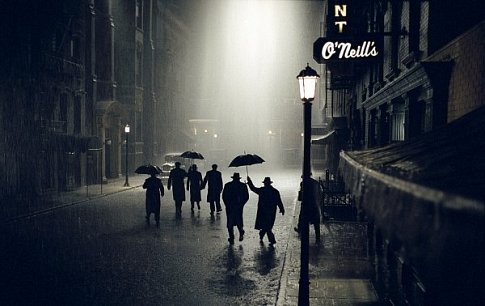
The surreal street scene is muted by rain and populated with black-silhouetted mobsters carrying umbrellas à la Magritte. From the soundtrack we are entranced by a gorgeous score from classical composer Thomas Newman. (No relation to Paul Newman—but from a rich pool of musical talent—Thomas Newman is also known for the moving soundtracks to The Shawshank Redemption, American Beauty and Six Feet Under's opening credit sequence.)

As the wing-tipped mobsters take their places on the rain-slicked street, the scene turns when the crime boss realizes his driver is not standing with umbrella at an open car door. In the driver's seat, Rooney sees his chauffeur, who appears to be sleeping until Rooney tries the door, and the driver slumps to the steering wheel.

Umbrellas twirl as mobsters pivot, searching for the source. In short order, men collapse around the crime boss, unable to see where the fusillade is coming from. As the ballistics ballet plays out, piano keys echo the tinkling rain as one by one, Rooney's men go down in sync with the sound of descending notes. There is no visible bloodshed.

In the distance, we see the lightning flash of the muzzle from an automatic weapon we know is held by Sullivan, who, after killing everyone but Rooney, emerges from the darkness to do what must be done: kill a man who might as well be his father.

At the end of the scene, Rooney turns to face his executioner. Any Mafia crime boss knows the odds on how he'll die. The question he's plagued by his entire life is—Who will do it? . . . The Law? . . . Family? . . . Foe? . . .

Rooney knew who held the submachine gun the moment he saw one of his bodyguards get hit. In his final moments on screen, facing a man who has been like a son, Newman delivers his last line in cinema: "I'm glad it's you."

This gives Sullivan the courage to open fire, shattering the strange tranquility of the silent street massacre with a blast of bullets to ensure swift, painless death—effectively drowning out the conflict Hanks' character is feeling. The wordless interval between Newman's last line and his assassin's gunfire holds the scene's most poignant moment. In the audience's mind, and no doubt Sullivan's, was Rooney's recent observation: "This is the life we chose—the life we lead—and there is only one guarantee: None of us will see Heaven."

Final Curtain

It's no secret that Paul Newman did not want to be remembered for his acting roles. But his role as Godfather in Road to Perdition—his last appearance on the silver screen—is one I'll never forget.

When Newman's many roles in life ended on September 26, the world lost a star of a human being. But because of the life he chose to lead, the heavens are now one star brighter. He will always be remembered through those whose lives Mr. Newman improved. And thanks to the magic of cinema, Paul Newman lives on—even when the lights go out.


Tuesday, May 20, 2008

NOT-SO-WISE WISEGUYS

by Michele McPhee

It’s official. The New England Mafia sleeps with the fishes. This week, the man whom federal prosecutors call the underboss for the Boston underworld–Carmen “The Cheese Man” DiNunzio–begged a judge to grant him access to a bigger toilet after he was locked up for trying to bribe Big Dig officials into giving him a lucrative contract to sell the highway department dirt.

For those of you unfamiliar with the $15 billion boondoggle that was Boston’s Big Dig, that was the most expensive roadway project in the history of the United States paid for with your tax dollars. In 1982, Massachusetts politicians swore the Big Dig would only cost us $3 billion and take a few years to complete. Well, it’s 2008, the job has swelled to the $15 billion-range and reputed wiseguys are still trying to get a piece of the massive swindle. That tells you roughly all you need to know.

Anyway, why the bigger toilet for the New England Mafia underboss? DiNunzio, 50, who earned his nickname from the cheese shop he owns in Boston’s Little Italy, the North End, weighs 400 pounds and can only relieve himself on a super-sized toilet. At least that’s what his lawyer argued in front of a federal judge this week.

Out loud. In public.

What is the underworld coming to when its bosses complain that their toilets are too small and continue to bloviate about themselves within earshot of wiretaps like DiNunzio did when he declared to an undercover informant posing as a dirty Massachusetts highway official: “I’m the Cheeseman."

The undercover replied: “You’re the Cheeseman?"

To which DiNunzio replied, “Ask anyone about me."

Oh boy.

But there is no one in law enforcement under the illusion that the Mafia anywhere in this country is intact. In New York City, Joseph Massino of the Bonanno crime family was the only Mafia boss not in prison. Shortly after I wrote a front page New York Daily News story dubbing him "The Last Don," Massino was arrested. He quickly rolled and became a government informant, ratting out his underlings.

Before Massino “went bad,” as underworld associates refer to government witnesses, Vincent “Vinny Ocean” Palermo, the boss of the New Jersey crime family the hit TV series The Sopranos was based on, rolled on his family. Since then, dozens of made guys have joined the witness protection program rather than serve time.

Now the feds are scraping the bottom of the barrel to sweep up wiseguys to garner those headline-grabbing arrests. In New Jersey this month, twenty-one Gambino associates were arrested in a sweep.

So as Boston’s underboss undertakes his battle for a bigger throne in prison, Brooklyn crime boss John “Jackie the Nose” D’Amico is arguing that he should be allowed to leave jail to resume his $700-a-week no-show job at a water-bottling plant. Only problem with that is that Jackie the Nose was caught bragging that he paid the company $700 a week to put his name on the payroll books to evade investigators. A judge is taking his request under consideration.

Covering the Mafia used to be so much fun. There was the crime family that plotted to kill Rudolph Giuliani and the Gotti son that wanted to kill the founder of the Guardian Angels Curtis Sliwa. Then there was Vincent “The Chin” Gigante and his famous wanderings through Greenwich Village, Manhattan in a bathrobe to shake the cops. It worked . . . for a while. What about Joey Gallo, the gangster who was shot dead in Umbertos, dying in a plate of pasta or Carmine Galante, who died with a lit stogie in his mouth.

My first book, Mob Over Miami, covered La Cosa Nostra in its glory years and exposed how South Beach, Miami was revitalized in the 1990s by gangsters' money. St. Martin’s Press announced this week it will republish the 2002 title in anticipation of a feature film, UnMade Man, based on my book.

Now, the mobsters in my book were wiseguys. This generation being chased around by the government is earning the reputation that they are the not-so-wise guys.