Showing posts with label media ethics. Show all posts

Monday, December 21, 2009

Fuhrman's Persuasive Polemic

By Laura James

There is much wrong with the portrayal of criminal justice in the media today. Even those who work for the crime media will tell you that the way it's done today, it's cheap, profitable, and wrong. In a scathing new book, FOX analyst Mark Fuhrman details his criticisms of "The Murder Business." "All the claims they make on these shows about justice and crime-stopping," he writes, "are a mockery of the English language." The book is The Murder Business: How the Media Turns Crime Into Entertainment and Subverts Justice.

He backs up his sturm und drang with compelling examples. Once I overcame the tinnitus caused by reading incendiary analysis by an insider who admits he played a "notorious role in the OJ Simpson trial," I found myself agreeing with many of his points.

Per Fuhrman, crime TV commits these sins. Do any of his criticisms ring true (or false) to you?

1. "They don't actually investigate... Facts have mostly been replaced with opinion, conversation, debate, and argument... Investigative journalists don't do much investigating. They stand in a pack outside Drew Peterson's house shouting, 'Did you kill Kathleen Savio?' I mean honestly, what did they expect him to say?"

2. They deliberately drag out stories, misrepresenting the facts if it helps to do so. It was obvious immediately that Caylee Anthony was dead, Fuhrman writes; but she was "missing" according to the press. "They want a big, loose time-line filled with "leads" and "possible suspects" and "persons of interest"... They didn't want a grim and depressing Search for Caylee Anthony's Body, but a suspenseful, heart-rending Search for Caylee Anthony. A story they could drag out for months, long after it was clear to me, the police, and every realistic observer or participant, that the child was dead."

3. They shell out huge sums for interviews and/or photos.

4. "They manufacture questions, but never try to answer them."

5. They relentlessly focus on attractive, middle class females as either culprit or victim. Haleigh Cummings' case fell from the TV screen because of the class of her family, which turned the story into "a white-trash nightmare, too much of a freak show."

Fuhrman goes on to analyze several recent cases of prominence.

Fuhrman on Drew Peterson: "He's got personality disorders they don't have a name for yet."

Fuhrman on Scott Peterson: "The media played along [with him]. They made his relationship with Amber Frey the centerpiece of the story, rather than the overwhelming evidence against him, mounting each day."

Fuhrman on his experiences as a true crime reporter in the Martha Moxley case: "I have never in my life been treated more shabbily than I was in Greenwich, CT. And that includes the Simpson trial."

Fuhrman on Nancy Grace: "She all but convicted the Duke University lacrosse players... and didn't apologize later when the accusations proved bogus... Grace flat-out declared suspect Richard Ricci guilty [of the abduction of Elizabeth Smart] several times on air... Grace didn't apologize for that one either... [Her interview of Melinda Duckett would] establish a new low, even by the standards of crime TV... Nancy Grace fired blindly. All she did was work herself into a lather and make Duckett clam up. The next day, Duckett was dead, and the investigation effectively died with her."

Fuhrman on the future of crime reporting: "Crime as entertainment has become so intoxicating, it's very difficult to go back. But all it takes is one person -- one journalist willing to step outside the circle and investigate the facts. One Woodward or one Bernstein could change the entire industry, remind reporters of their responsibility tot he public, and balance out the soap opera on the air."


Wednesday, November 25, 2009

Our Hysterical Media


By Laura James

I have three theories on why the mass media hypes certain types of true crime stories. First, certain kinds of cases hit our buttons and drive up viewership. Second, exaggerating a case to "historic" proportions makes the journalist feel more important, since it strokes the ego to think one is reporting on a history-shattering event. Third, whatever drives up ratings is likely to have a divisive political angle worth exploring for ratings the next day.

Every media outlet in the country is guilty of these sins. I can prove that. Outrageous sensationalism is most often associated with mass murders, especially those committed with a "semi-automatic weapon" (news flash: most guns are "semi-automatic"). Another kind of case that attracts a lot of hype, over-analysis and speculation is the family annihilator.

There are dozens of workplace shootings every year. We'll hear about one and only one, I'd guess, this year. Sadly, that recent massacre took place in a city that had experienced just such a madman's rampage decades ago. Very few news outlets bothered to mention that earlier incident. Why? They prefer to think of every story they cover as unprecedented and unique. Precedents spoil hype.

Here is more proof. The most respected media outlets in the United States sensationalize true crime stories to the point of making blatantly false statements for the sake of a great opening sentence.

The mass shooting at Virginia Tech was not even close to being the worst massacre in US history, or even the worst school massacre in US history. But it was hyped exactly as such by none other than these outlets. (I noted the exact quote in case the links expired, and many did.)

On the Virginia Tech massacre, every single statement a false one:

MSNBC - "the worst school massacre in US history"
ABC - George Stephanopoulos: "The worst campus massacre before Virginia Tech was back in the University of Texas in 1966."
Newsweek - "worst massacre in U.S. history"
Time - "the worst massacre in US history"
Baltimore Sun - "the worst school massacre in US history"
Los Angeles Times - "the worst school massacre in history"
Court TV Crime Library "the worst mass murder in American history," indeed! This is a particularly egregious and unforgivable error on a website that purports to offer encyclopedic treatment of historic crimes, including articles on the Bath massacre and Mountain Meadows.
New Jersey Star-Ledger - "America's worst campus massacre"
Atlanta Journal-Constitution - "worst campus massacre in US history"
New York Daily News - "the worst campus massacre in American history"
Troy Record - "the nation's worst massacre"
WorldNetDaily - "America's worst school massacre"
Campus Times - "worst school massacre in United States history"
Shreveport Times - "worst massacre in American history"
Asheville Citizen-Times "The worst massacre in U.S. history"
Janesville Gazette - "the worst massacre in US history"
Roanoke Times - "worst school massacre in US history"
Daily Titan - "worst massacre in US history"
Bakersfield Californian - "the worst massacre in the country's history."

You'd think the press would've remembered having to correct their reporting when they erroneously fluffed the Columbine massacre as the "worst ever." Oops - I assume too much - did they correct themselves?

For the record, the worst school massacre in U.S. history took place in Michigan. The worst massacre ever is more difficult to discern because of all of the horrific examples. There was never a need to exaggerate any of them.


* * *

Once a newspaper touches a story, the facts are lost forever, even to the protagonists.

--Norman Mailer


Wednesday, April 22, 2009

On a lighter note... Can Madonna Sue?

by Laura James

The women who contribute thoughtful essays to this crime and justice site are serious professionals who grapple with profound and controversial legal questions. Hopefully they'll indulge me for considering a relatively frivolous legal issue today.

Some are
honestly wondering about the legal ramifications of Madonna's recent fall from a horse, which her publicist blamed on an aggressive paparazzo. Her injuries, thank goodness, don't seem serious. But the incident offers a chance for a bit of exposition and education on the laws of personal injury. Can she sue? Would she win? Could she collect? The answers are sure, maybe, and probably not.

Can she sue?

Anyone with a hundred-dollar bill can file a lawsuit. The Material Girl didn't earn that moniker for nothing, so this one is a gimme.

Would she win?

Assuming that what her publicist says is true -- a photographer jumped from some bushes and scared her steed -- she'd have a pretty good case. If it came down to a he-said-she-said debate, she could get to a jury with it, and the jury would decide who is telling the truth.

Everyone, everywhere, at all times, has a "duty" under the law to act as a reasonable person would act in the same situation. That legal standard is vague, and it's usually up to a jury, and not a judge, to decide whether someone's actions were reasonable under the circumstances. I don't think it requires anything more than common sense to know that startling a horse can cause injury to its rider.

The department that rendered aid to her is releasing its
own opinion on the matter. I found their statements rather curious. If Madonna said nothing to them about the photographer, that is neither here nor there. In the usual trip-and-fall, there's no reason for a responder to deeply delve. "How did this happen?" "I fell from my horse." That's as much of a conversation as I'd expect to see reflected in a police report.

Could she collect?

Assuming the jury believed Madonna's version of the dustup and gave her, say, a small verdict to compensate for a few hundred dollars in medical bills and a day or two of mild pain and suffering, collecting would probably be a challenge.

The press says he was a freelancer. Since he had no regular employer that could also be held accountable for his actions, there would be no insured corporate deep pocket to shake down. As a private person, he might own a home and might have homeowner's insurance. But it probably isn't much, and it might not cover such a claim since it arose from his line of business. Most homeowner's policies have limits or exclusions when you're sued because of the work that you do.

Believe it or not, as a rule lawyers do not like to pursue the personal assets of tort defendants (unless they've done something particularly egregious, and even then, I don't know many lawyers who would push to collect personally from an uninsured or underinsured person). If the jury did slam the fellow with a large verdict, he would have the option of filing for bankruptcy and blowing out the judgment there.

So even if Madonna did win a lawsuit against the fellow, she'd probably have a devil of a time getting any money from him. That's not to say I wouldn't take the case. If she needs a lawyer to handle the claim, gosh, I'm available!

Bottom line: While Madonna has credibility problems in general and a lifestyle that most people disdain, the paparazzi aren't doing much better these days in the court of public opinion. Given all the times when some jerk of a photographer sued a star for some stupid dustup, it might be fun to see the shoe on the other foot.


Monday, March 30, 2009

When Is It Too Early to Publish a Book?

by Laura James

Long gone are the days when a true-crime author—like William Roughead, or Truman Capote more recently—waited until after the verdict to write the whole story (or, in Capote's case, after the hangings). In the instant era, books speed to release, and the publishers are becoming even quicker about releasing true-crime titles in particular.

Readers seem to be of two minds when it comes to quick releases.

Many say they won't read a book that comes out before the trial even starts. Others hold that a book can be quickly written and still be well done. But if put out early, the timing of the release will dominate all reviews forever.

Some readers are really unhappy.

On a book about Laci and Scott Peterson: "This was obviously written BEFORE the trial and has no pertinent information at all about what happened after Scott's arrest. Hardly the 'whole story' advertised."

On Robert Graysmith's book about Bob Crane: "We learn nothing about Carpenter's trial (an integral part of this entire story) because Graysmith and the publisher couldn't seem to wait until the trial was over, to send this book to the press."

On another true-crime title: "I also don't understand why this book was written before the trial."

The booksellers who specialize in true crime consistently tell me that many true-crime fans buy not the first book about any given case but the fourth or the twelfth or the twentieth. Many of us who study human depravity for a pastime or a career find a case that especially intrigues us, and we read everything we can about it. Some cases that have inspired such intense study are Lizzie Borden, Bruno Hauptmann, Jack the Ripper, and so on. So the first book a reader buys may well not be the last, particularly if the first isn't entirely satisfying.

Readers are fickle and inconsistent, simultaneously lamenting early books while snapping them up. . . .
One writer recently picked up an early book out about Austria's Fritzl case and reports: "If you want to read Monster, I'm afraid I bought the last copy at Borders. But just wait a month or so, and I'm sure there'll be more comprehensive alternatives. It's perverse, I know. But I can't wait."

Though quickly produced true-crime titles will always have their critics, in the end it is the quality of the publication and not its release date that matters the most, don't you agree? Is there a line to be drawn? After the verdict? After sentencing?

Readers, writers, and publishers can't seem to make up their minds, but one thing is certain: more of these quickly produced books will be on the shelves in the future (and Kindles, and cell phones. . . .)


Thursday, March 5, 2009

Why Crime History Matters

by Laura James

Unfortunately, the media often errs badly in its crime reporting because some reporters don't know a thing about the history of crime. And I guess they're too lazy to look it up before speaking on the subject.

For some reason, the natural tendency is to make it up—and get it wrong.

And that's too bad, because many times, some historical perspective might inform any given situation.

One example everyone knows: the press has erred badly in its coverage of the JonBenét Ramsey case on one small but perhaps important detail.

"Sex murderers never leave ransom notes." That's what the experts told us in the JonBenét Ramsey case. For years, in fact, that "fact" has been repeated.

It's always dangerous to talk in absolutes when the subject is human behavior, but there you have it.

And it wasn't true. One has to wonder just how much this error colored early perceptions of the case.

William Heirens was a sex killer. He left a ransom note. He kidnapped a little girl from the bedroom of her family home in the middle of the night, and later raped and killed her. Then he went on to kill again.

His name should sound familiar. No other inmate alive in a U.S. prison today has served longer than William Heirens, who went to prison in 1946. That's sixty-two years, and counting, behind bars.

While the press often get their precedents messed up, another type of error is more common: the tendency of some reporters to grossly exaggerate the historical significance of an event that is already, in and of itself, a very shocking crime that requires no exaggeration.

Reporters covering the terrible shooting massacre at Virginia Tech in 2007 called it "the worst massacre in U.S. history." That's a verbatim quote from Newsweek and from Time and from many, many others. No adjectives were omitted. And it was just flat-out a misstatement of fact.

Was it hysteria that caused so many journalists to overstate the matter as they did? Really, "the worst massacre in U.S. history"?

Thirty-two people died at Virginia Tech (Wiki).

That is far less than the Oklahoma City bombing (168 victims), Wounded Knee (300 victims), Mountain Meadows Massacre (100+ victims), or 9/11 (2,998 victims).

Alas, the terrible shootings at Virginia Tech could not even be called the "worst school massacre in U.S. history," though dozens of media outlets in fact did call it that.

It wasn't. A sad record still stands. The worst school massacre in U.S. history remains the Bath School Massacre, which claimed 45 lives in 1927. Not everyone has forgotten them.


Thursday, December 11, 2008

Freedom of the Press vs. Sense of Decency

by Kelly Siegler

A sentence of death was recently imposed by a Wharton County jury against defendant James Garrett Freeman for the capital murder of Texas Game Warden Justin Hurst.

Jury selection began on September 8, testimony on October 20, and Freeman was sentenced on November 7, 2008. The most compelling and gripping evidence included the in-car video footage of the defendant getting out of his pick-up immediately after an hour and a half chase down the back roads of Wharton County.

The video showed him emptying 11 rounds of his Glock semi-automatic weapon and then retrieving his AK-47 and firing both at six different police cars. The clip ends when Freeman shoots out the camera in a deputy's car.

Because so many law enforcement officers were involved in the chase and gunfight, there were seven separate in-car videos from different vantage points offered before the jury. One of those videos is the one described above. Another video depicts the tragic death of Warden Hurst when he was shot by the defendant with his AK-47.

The point of discussion has to do with the fact that the video depicting James Garrett Freeman (pictured right) firing his weapons was posted on YouTube within a week or so after the trial concluded. I learned of this when I got a phone call from Freeman's lead defense attorney, a well-respected attorney from here in Texas, Stanley Schneider. I do not know how the posting of the video on YouTube came to Stanley's attention. I do know that we made a point of notifying Justin's family and his fellow Texas Parks and Wildlife "family" of its posting immediately.

They were upset. They were angry. Do you blame them?

But were they surprised? For the most part, not really.

And THAT surprised me. Maybe because I'm still proud of myself for being able to e-mail in this tech-savvy day and age. Maybe because I have looked at something on YouTube a grand total of two times with this being one of them. Admittedly, I am way "behind the times."

All of that is beside the point. As is asking ourselves the question regarding how a piece of evidence in a public trial could get posted on YouTube so quickly. The link is http://www.liveleak.com/view?i=7f4_1226297782. Doesn't really matter and we'll never know for sure.

The question that SHOULD be asked is . . . How will it make Justin's loved ones and friends feel when they see such a clip on the World Wide Web?

To you the "post-er": Did you think about that? Did it ever cross your mind? Did you contemplate the idea that Justin's wife and mother and father would have to deal with seeing that clip for years? That his now infant son would also be faced with the same tragic situation years from now?

From Stanley Schneider's point of view and that of Freeman and his family: Did you appreciate the effect of the posting from an appellate perspective?

In this media-hungry world, in this day of non-stop 24-hour "breaking" news, should we be surprised? Probably not.

Might we still hope that there exists some remnant of integrity and sense of decency when it comes to writing or posting whatever piques our interest? We can only wish.

I wouldn't hold my breath.


Tuesday, December 2, 2008

What Ever Happened to Jane?

by Vanessa Leggett

Last fall, I wrote about a writer friend of mine who'd found herself in a moral quandary. The subject of her first true-crime book was on trial for murder. Again. My friend's publisher wanted her to attend the second murder trial for an updated version of her book. That was all well and good—until my friend learned she would not be able to cover the proceedings. She had been named as a witness.

So that we're all on the same page, we'll revisit my first story, "Jane's Affliction," and then I'll fill you in on what happened with my friend:

Meet Jane

I have this friend. We'll call her Jane. She's a journalist and true-crime author. For reasons that will shortly become evident, Jane would prefer to remain anonymous. Actually, she'd rather be forgotten altogether, and by one person in particular: a prosecutor who recently tagged her.

See Jane Subpoenaed

I learned of Jane's predicament by e-mail. In my Inbox was a message with the subject line "Whoa! What does this mean?":

I just got my mail out of the box and found a big package from the [redacted] DA's Office. In it was the transcript of my interview with [the Defendant] and a note that said here are copies of your reports and transcripts of your involvement in the [redacted] case. . . . What does this mean? Is this a hint that I'm going to be called to testify?

It was more than a hint, she soon discovered, when the subpoena arrived. Prosecutors wanted Jane to testify in a capital murder trial in California.

During Jane's research ten years ago, she'd interviewed the man who would go on trial for his life a second time—not for the murder Jane wrote about, but for another killing. In the 2007 capital murder trial, the prosecution wanted Jane's testimony to show a consistent modus operandi in the separate slayings.

Problem was, this writer did not want to testify. The issue was not over a breach of journalism ethics; Jane never promised this particular source confidentiality. In fact, what she learned during her interview had already been published in Jane's book.

For Jane, the sticking point was that the prosecution stated its intent to seek the death penalty. Jane is against capital punishment.

See Jane on the Fence

Jane sought my advice because she remembered a subpoena I received in a murder case. I was practically in tears when I discussed my situation with her. So when Jane e-mailed me, she expected I would empathize. And I did, to a degree.

But my dilemma had been different from Jane's. My concern was with protecting my sources. Jane is bound to protect a core belief. And she is tormented by the thought of violating it:

The more I think about it the more uncomfortable I am. They're going for the death penalty. And I'm just not sure I can help put someone to death, even if he is a murderer. . . .

See Jane Suffer Subpoena Syndrome

Something about reading an official document that "commands" you to do something you consider fundamentally wrong messes with your mind. Reason tends to leave as abruptly as the subpoena arrives.

I suspected that Jane, a best-selling author with many years on me in the business, was suffering from something that afflicted me early in my writing career: subpoena syndrome.

I tried to break things down into terms she could live with. I reminded Jane that this type of proceeding, a capital case, contains two trials: In the first, called the "guilt/innocence phase," a defendant's culpability is determined, and if found guilty, the accused is convicted. In the second stage, known as the "punishment phase," a penalty is assessed.

Jane was told she would testify as part of the case in chief, not during the stage in which the death penalty is considered. This meant that Jane's testimony should have no bearing on whatever penalty was decided. Even if she were to testify during the punishment phase, the decision as to whether the man will live or die would not be left to Jane.

In my reply, I tried to ease Jane's conscience: "You need to put the death penalty out of your mind. Prosecutors may seek it, but it's up to the jury to choose death as a punishment."

The way I saw it, the decision would be out of her hands. But Jane could see nothing but blood on her hands if she testified.

See Jane Take a Stand(?)

Taking the stand at any stage of a trial where execution is an option, Jane reasoned, amounts to helping the prosecution put a man to death:

[I]n my heart, mind, in every limb of my body and soul, I think the death penalty is wrong, utterly wrong. So how can I grease the wheels to it? . . . Beyond my moral and ethical beliefs, I also disagree with their death penalty decision because it gives [the Defendant] what he wants. And it seems to me that to [him] the greater punishment, the more horrible punishment, would be life in prison since that's the very thing he did not want.

Jane never expressed doubt about the man's guilt. What she's uncertain of is her ability to testify, if doing so might result in the state taking a man's life. But if she refused, Jane could wind up in a jail cell for contempt of court.

See Jane ______________

So what did Jane do? . . . It's not a secret anymore, nor is the identity of my friend, Suzy Spencer. Today, her publisher re-released her first book, WASTED, and you can read all about the capital murder trial that Suzy was caught up in.

An Austin Chronicle reviewer called the book "everything a true crime book should be: lean, fierce, and unsparing." The story is riveting. From the back cover:
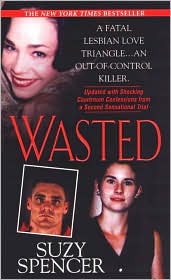
In 1995, Austin, Texas was rocked by the brutal murder of a lesbian princess named Regina Hartwell. Even though Regina's body was burned beyond recognition, within days police had two suspects. One was the beautiful ex-cheerleader who was the object of Regina's desire. The other was a man who would take the fall for murder. . . . In this new edition of her bestselling book "Wasted", true crime master Suzy Spencer chronicles a fatal love triangle—and lives driven out of control by sexual desire, drugs, and shocking childhood demons. Four years after Regina Hartwell's murder, a new charge was brought against one of her suspected killers. Now, Suzy Spencer adds a new chapter to "Wasted"—detailing a killer gone wild, a nerve wracking legal standoff, the shocking twists that would take place in a second, explosive trial. . . .

Long story short, Suzy did not dodge the trial. She flew to California, not in compliance with the prosecution's subpoena, but at the request of the defense. Her presence meant she would have been available for questioning by either side, though she might have refused to answer for the State. She did not end up testifying at all. Court was canceled that day—in part, Suzy explained, because Justin didn't want any witnesses testifying on his behalf for fear it would ruin his chance of receiving the death penalty.

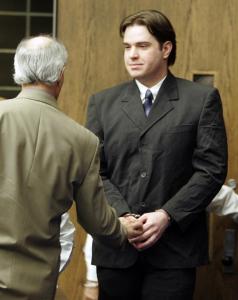
In the end, Justin Thomas was convicted and sentenced to death. Without putting Suzy on the stand, the State opted to use a portion of the transcript from her taped interview, which was introduced in the punishment phase. As it turned out, Justin's own words netted him a death sentence.

After Suzy's legal battles with this book and with BREAKING POINT, on the Andrea Yates case, she considers the 10th anniversary edition of WASTED her "good-bye" to true crime. Her entry into true crime—hitting the New York Times best-seller list with her first book—was as unconventional as her exit. The "true crime master" has converted to sex book mistress, working on a memoir of sex in America for Berkley. Few would blame her for trading Draconian courtrooms for Hedonism resorts.

As for Justin Thomas, he is now #G11032 at San Quentin State Prison, home of Scott Peterson and Richard Ramirez. Like most prisoners of California's Death Row, Justin will probably die waiting to be executed (assuming the current moratorium is lifted). If so, his "death sentence" will have been converted into what he feared more: the rest of his life in prison, with little hope of his suffering cut short.

That statistics indicate Justin Thomas will not be executed at all should bring Suzy some measure of relief. But not enough to stay in true crime.


Thursday, September 11, 2008

Freedom Behind Bars

by Vanessa Leggett

We all remember where we were on 9/11. I’ve often wished I could forget. I was in jail—Day 53 of an open-ended incarceration. That summer, a federal judge had found me in contempt of court for my refusal to give a grand jury confidential source material gathered for a book. Surrendering my research would have meant burning sources. I could not do it. And so the judge ordered me jailed for as long as the grand jury was in session. That turned into a 168-day stay at the Federal Detention Center in downtown Houston. When I rejoined society a few months after September eleventh, we were a nation at war and the world I had known was not the same place.

The morning the world changed, I was in my cell, nursing a cold and reading Omerta by Mario Puzo. It was my third day back in general population after a night in solitary. I had made the mistake of questioning the enforceability of a jail policy. Guards made sure I understood what enforcement was all about. The Bureau of Prisons calls segregation blocks the Special Housing Unit, or "SHU" (pronounced shew), fedspeak for what inmates know as "The Hole."

The day I emerged from The Hole was the freest I’d felt during my incarceration. A night in solitary showed me that I'd taken for granted simple freedoms allowed the general population in jail.

For example, outside of SHU, I was free to roam the common area during designated hours. From the dayroom and library, I had several windows with views to the streets below. I considered this privilege a kind of glass-partition visitation with the outside world.

Every day until 9/11, I had watched Houstonians talk on their cell phones, check their watches and PDAs, and sip coffee from Starbucks. (I could spot the cardboard-sleeved cups from blocks away.) By day's end on 9/11, there was little sign of life in downtown Houston, the fourth largest city in the nation.

Another window to the world unavailable to those in solitary was the television. The morning of 9/11, a fellow inmate summoned me to the lower recreation room minutes before the second jet hit the World Trade Center. The north tower was smoking from the impact of the first aircraft. We watched in stunned silence.

Later, I held hands with a group of women in a circle as a chaplain led us in prayer. I remember the inmate to my right squeezing my hand and not letting go immediately. Her home was in another country.

I did not need to speak her language to understand. Each of us wanted to connect with family, with those we loved, and with the people who loved us, to make sure they were safe, and to tell them we were okay. But visitation would be out of the question. For security, the entire detention center went into lockdown mode. My world shrunk to the size of my cell.

I've often thought of how my day on 9/11 would have been no different from my day on the tenth had I remained in solitary confinement. I would not have had access to television. Guards who checked on me would have had no obligation to tell me America was under attack. For my own safety, jail staff might have been ordered not to inform segregated inmates of the national disaster; it didn't take much to lose it in solitary.

Though I was in jail, separated from the world, at least I had been released from The Hole, and was able to see, however horrific, history unfold in real time. My only conduit to the outside world that day was the TV screen, which gave me a sense of connection to other Americans.

That connection was broken once the detention center went into lockdown. All I knew of what was going on in the world was what I had seen through the celluloid window that day: The World Trade Center, our twin trophies of commerce, had disintegrated. Our seat of military might, the Pentagon, had been hit. And another aircraft appeared to have been headed for the Capitol. When I saw members of Congress join hands and sing "God Bless America,” I must admit I feared the end was near.

It wasn't. My incarceration felt like it would never come to an end . . . but it did, eventually, when the grand jury disbanded in early January. For months I'd lived under fluorescent lights, without a single trip outside. As I emerged from the jail, the transition felt as disorienting as walking out of a matinée.

Over the next few weeks, I saw evidence of how the world had changed: metal detectors and pat-downs, building barricades, Middle Eastern cabbies whose well-worn taxis sported crisp, new American flags. Fear was everywhere.

It did not take long for me to realize I was about as free as I had been when I rejoined general population from solitary. Though I was part of the free world again, among my fellow Americans, none of us was truly free. Not like we used to be.


Wednesday, September 10, 2008

Okay, now I'm seriously ticked. . . .

by Kathryn Casey


Okay, like the headline says, now I'm seriously ticked. I was about ready to go to bed Tuesday night, already worried about that darn Hadron Collider in Europe destroying the world, when I decided to check the Internet one last time before turning off the computer. There it was, the headline I half expected but could barely believe:

Casey Anthony offered more than $1 million to tell her story.

Has the world gone mad?

Let's back up. I have a newspaper editor friend who reminds me that I should recap cases, to make sure readers have the nuts and bolts. So, in case you haven't watched television, read a newspaper, perused the grocery store tabloids or checked the net since July 17th, Casey is the mother of Caylee Anthony, an absolutely darling 3-year-old. Little Caylee was first reported missing by her grandmother, Cindy Anthony, in mid July. At the time, mom Casey said the little girl had been taken by her nanny. Now we seriously question the existence of the nanny, plus we know Caylee's DNA was found in Mommy Dearest's trunk along with signs of human decomposition. So, the buzz on the street is that it appears that this cute little girl with the big brown eyes is dead. And all the while, Casey Anthony, concerned mom that she is, has refused to help police. Guess cooperating with police attempting to find your missing daughter isn't as much fun as hitting the clubs and partying just days after your little girl disappears?

(You can tell I'm fuming about this, can't you? Sorry. I try, but sometimes I just can't help myself.)

Anyway, what set me off tonight is that, according to the
article on the WESH website, an Orlando television station, Casey, who may or may not have murdered her daughter but at the very least is in line for a "Monster Mother of the Year" designation, is being offered big money for interviews, starting at $350,000 and up to $500,00 per sit down with a reporter. The article doesn't say who's offering the cash, just that it's on the table.

"We've had an offer come in from an overseas company that specializes in pay-per-view, and those offers can exceed $1 million," Jose Baez law firm (Casey's attorneys) spokesman Todd Black told WESH.

Does anyone else feel like vomiting?

What has happened to this world that we're willing to pay a woman who may have killed her little girl big bucks to get on camera and tell us what she won't tell police? The very idea that anyone would consider this is.... I'm so disgusted, I'm sorry, I can't even think of a word harsh enough.

Geesh. Let's face it: the only thing Casey Anthony had that was worth that kind of money was little Caylee, and she was priceless.

After reading the WESH article, I thought back to my
blog from last week, the one where in the comment section, on rumors this might happen, I suggested we join together to boycott anyone who paid the Anthonys money for interviews. You know, I thought, that could be a really good idea. Why the heck not?

So, here's my plan: I propose that we start a worldwide Internet campaign against any outlet that pays Casey Anthony anything, even a single dollar, for an interview. We do this by monitoring the news to find out who the offenders are and then sending out e-mails to all our friends, asking them to tell all their friends, and so on, so on, warning everyone of this disgusting behavior, urging them not to watch whatever television program Anthony appears on. If there's money involved, turn the TV off! Maybe keep it off that channel/program even after the interview airs, just for good measure. Let these lowlifes know we mean business.

If it's true, this is checkbook journalism at its absolute worst. I don't know who is vying for the interviews, but it has to be someone without conscience much less ethics. How can anyone pay a mother suspected of being involved in her little girl's death? Sure, we don't know what happened with Caylee yet, maybe we never will, but there are certainly grounds for suspicion.

Are you with me?


Monday, September 1, 2008

It's Official: Gustav Looters GO DIRECTLY TO JAIL (Not to Angola Prison)

by Vanessa Leggett

Most of us know better than to believe everything we see on TV. But when an official makes an emergency announcement during a press conference televised worldwide, we pay attention, as we should. And we tend to accept such statements as fact.
As Hurricane Gustav churned toward the Gulf Coast over the weekend, I caught a press conference on CNN.

New Orleans Mayor C. Ray Nagin had important announcements to make. This was the third time in as many years that Mayor Nagin found himself addressing a panicked public trying to recover from or prepare for cataclysmic hurricanes: first Katrina (looter pictured above), then Rita, and now Gustav. “This is the Storm of the Century,” the mayor proclaimed on Saturday.
"The Storm of the Century"

Big storms call for big words. And Mayor Nagin was full of them. A
mandatory evacuation had been ordered in anticipation of a Category 4 hurricane. The mayor had a warning for anyone who did not follow orders to evacuate: Watch out for flying mobile homes. Trailers would become “projectiles,” he said, and would “start to fly around the city.”
He also had a warning for crooks planning to take advantage of the city-wide evacuation. "Anybody who is caught looting in New Orleans will be brought directly to Angola,” he said, repeating himself: "Directly to Angola."
This statement hit me harder than the one about trailers hurtling through the city, which Nagin said to expect as "a matter of fact," though it sounded more like the movie Twister than reality. I remembered the devastation Katrina brought, however, so I was prepared to believe in flying trailers.

I was not ready to accept that the Constitution would be thrown to the wind as well—that police would pluck looters from the streets of New Orleans and haul the accused to Louisiana's Death Row. If cows could fly in Twister, BS could fly in a press conference. Nothing unrealistic about that. In fact, City Hall seemed as fitting a venue as any. But the mayor's message was broadcast worldwide.

“You will not have a temporary stay in the city," Mayor Nagin continued. "You’ll go directly to the Big House, in general population. You will go directly to Angola Prison. And God bless you when you go there."

Given New Orleans’ experience during the storms of 2005, cautioning would-be looters was called for—especially after Hurricane Katrina, when pilfering was so widespread that even uniformed members of law enforcement were
filmed helping themselves to goods from a Wal-Mart.

I remember how stunned I had been to see
police captured on tape, stealing in the storm-torn town they were sworn to protect. But I found Nagin's message even more shocking. Here was the Mayor of New Orleans making an official announcement, threatening thieves picking over others' belongings with a direct ticket to "general population" in the nation's largest maximum-security prison, the "Alcatraz of the South." It was unbelievable.
Maybe my personal background is what kept me from buying the threat. I'd taught corrections at a university and later did time in a maximum-security federal facility. You could say I know a thing or two about the prison system. My knowledge of how things are run on both sides of the bars did not square with Nagin's threat.
C.J. 101: Arrestees are detained in jails, not prisons. Penitentiaries house those who have been convicted of a crime, felons who have been sentenced to a term of imprisonment.
The Mayor Has No Clothes
Traditionally, the responsibility of bringing such errors to public attention falls on the media. (Though it doesn’t always happen that way and results can be disastrous. Just ask former ambassador Joe Wilson.) Of course, the mainstream media might not be motivated to correct this type of inaccuracy, since it seemed to me at least that Nagin was using a scare tactic to force law and order. I'm guessing journalists with more practiced noses than mine at "smell test" reporting shared my initial reservation in bringing the error to the public's attention: Why let the thugs think otherwise? And there was a less honorable reason the press did not point a finger at Nagin to say there was not a thread of truth to the mayor's statement: some reporters never let the facts get in the way of a good story.

But after watching credible journalists like
Wolf Blitzer perpetuate Nagin’s claim that looters would be sent directly to Angola, I started to wonder . . . Could it be true? Yet another report made me reconsider my initial impression. A New Orleans-based broadcast journalist interviewed by CNN echoed the cable network's reports that looters would be sent directly to the Big House. "They’re serious," he said, seeming, well, serious.

When in Louisiana . . .
OK. If a local reporter was backing up Nagin's claim, maybe these Louisianans were serious after all. The law in Louisiana is different from any other state in the country—and I’m not referring to the way it’s enforced, or that it’s sometimes not enforced. Louisiana operates under the Napoleonic Code.

I decided to check
the statute, which I was not surprised to see had been revised since the storms of 2005:

"Whoever commits the crime of looting during the existence of a state of emergency . . . shall be imprisoned at hard labor for not less than three years nor more than fifteen years without benefit of probation, parole, or suspension of sentence."
The punishment seemed a bit harsh. For a property crime that could be as small as stealing a loaf of bread to keep from starving, sending someone to prison for a minimum 1,095 days approached the fiction of Les MisÄ—rables. In New Orleans a few years ago, those who rode out Katrina truly were without survival essentials. In the looting footage cited above, the reporter at Wal-Mart asked one man if he was stealing from the store.
"We have no means of washed clothes or food, sure," he said, continuing shopping.
If Nagin's straight-to-prison threat became reality, what would happen to a victim who was without food, or a merchant to sell it to him? And what if an evacuating homeowner returned to pick up something left behind? What if, for example, a New Orleans P.D. officer didn't believe he really lived there? Should an innocent man go straight to prison? Would a teenager having fun in all the chaos by stealing a plastic pink flamingo from a neighbor's yard find himself in general pop at Angola?
Where in all this mess is a little thing called due process? As the Louisiana looting statute stands, at least three years prison would be mandatory for anyone found guilty of looting during an emergency. In addition to imprisonment, a fine would be subject to a judge's discretion. How could a monetary punishment be left up to a judge in a courtroom, but a man's life and liberty rest solely in the hands of an officer on the street?
As preposterous as the whole thing seemed to me, one phrase in the statute gave me pause. Looters would be “imprisoned at hard labor.” Angola, a.k.a. "The Farm," is perhaps the country’s most recognized hard labor prison. The acronym for Louisiana State Penitentiary stands for something else to the prison population, which knows L.S.P. as the “Last Slave Plantation.”

I did a quick fact tally. During a state of emergency, the law mandates "hard labor" as punishment for all looters. And Angola Prison is the state symbol for chain-gang labor. Maybe the mayor wasn’t off his rocker. Two years ago,
Katrina looters had been dealt double-digit prison sentences for stealing booze from a store, to "send a message."

Louisiana does do things differently. And exigencies can similarly affect how laws are applied in any state. The Constitution makes due process exceptions during times of war or in cases arising out of "public danger." Insurance policies contain clauses addressing force majeure, or “acts of God,” which can change the rules.
More than a century ago, The New York Times ran a story days after the Great Storm of 1900, a Category 4 hurricane, which claimed more than 6,000 lives in another Gulf Coast community: Galveston, Texas. In the aftermath of that disaster, an insurance company spokesman was quoted as saying "The letter of the law will not be adhered to."
In 2005, one New Orleans cop looting the Wal-Mart had the same spirit. In that footage, a reporter asked an officer what was going on in the closed superstore. "Doing my job," the cop said, walking away from a basket of stolen goods. "Looking for looters."
Lessons from History
According to storm lore, on September 9, 1900, the day after the Great Storm made landfall on Galveston Island, literally thousands of corpses began rapidly decomposing in the Gulf Coast's relentless heat and humidity. On the small island, the stench of human remains and livestock carcases littering the landscape was unbearable. Survivors quickly decided to dump bodies at sea. Looters complicated efforts to ID the dead. Police caught one man whose pockets were stuffed with a couple of dozen gold rings, the owners’ fingers still attached. Ears and other body parts were severed for jewelry. More than thirty looters were dealt with Texas-style: the majority were shot to death, some on the spot.

Contra-flow of Information
Like Texas, Louisiana is a renegade state, but I still doubted Mayor Nagin's sincerity. I had to do a little independent investigation. I checked for official press releases restating the mayor's Angola warning, but found nothing.
Visiting the Louisiana State Penitentiary Web site, I did discover a public notice concerning the state prison system's "Preparation for Tropical Storm Gustav." The press release simply notified the public that visitation would be suspended. The L.S.P. posted the bulletin to inform and "assure the public that the prison is secure and public safety will be maintained through this emergency crisis." Nothing about Angola.
I e-mailed a request for more specific information regarding Mayor Nagin's comments. Here was the official response:
Post-evacuation and post-storm arrestees will be housed at Elayn Hunt Correctional Center in St. Gabriel, not Louisiana State Penitentiary. . . .We are in the process of establishing court functions at EHCC for later in the week. More than likely, a judge will be appointed to hear cases from all parishes making arrests, instead of having a judge from each parish coming in and handling only that parish. We're still working out the details on that, but we did have some court hearings at EHCC after Hurricane Katrina so this is not unchartered territory.

Pam Laborde, the Communications Director for the Louisiana Department of Public Safety and Corrections, ended the statement with the typical courtesy: "Please let me know if you have any further questions."
I did. Perhaps I asked too many. Though she'd just confirmed, in so many words, that the mayor's claim had no clothes, I knew I had to press, specifically about Angola. And while Ms. Laborde's responses were helpful . . . it wasn't until I bore down on Angola, that I received the information I needed:
"Angola has nothing to do with this story," she wrote, "other than the fact that the mayor apparently gave incorrect information as to where arrestees would be taken."
The Mayor is Full of Hot Air ("Apparently")

I do understand that leaders have to make choices for the greater good of those they serve. And this would not be the first time or the last that a man in charge delivered deliberate misinformation for what he believed was in the better interest of his community.
Maybe Nagin's prevarication served its purpose. The mayor gave his "Mother of All Storms" warning Saturday night as mass evacuations were under way. As of Sunday morning, the New Orleans Police Department reported no arrests for looting. Then again, those reports came during the calm before the storm.
But should it ever be acceptable for an elected official to deliberately mislead his constituency? Does talk of projectile mobile homes and prison without due process (if spoken to secure the public's personal safety and property) rise to the level of yelling "Fire!" in a crowded movie theater? I'm not sure.
But I have a problem with even the appearance that a person's Fifth Amendment rights can be gutted, even if the threat is ultimately empty. If that's what Mayor Nagin did, he abused the First Amendment.
On the other hand, I would support a citizen's right to push the free speech envelope. I appreciated this comment to an online news story restating the mayor's whopper. This reader had an even stronger notion of how looters could be deterred:
"Unless they drop [the property] immediately, shoot them. Tag them with signs saying, this was a looter."
Lesser of Two Disasters
Perhaps Nagin's greater good was served. But what will the repercussions be, considering his message was broadcast around the world? Might other countries wonder: Is that how America now deals with petty thieves? Hard-core prison without benefit of trial or so much as a hearing before a magistrate?
Early this morning, as the world waited for Gustav to make landfall, I was thankful to see CNN storm trooper Anderson Cooper wisely revising history. He seemed to fumble for words that wouldn’t take the wind out of the mayor’s threat, but would make the report closer to the truth.
“You will be taken directly to a local jail,” he said.
Anderson’s trademark squint seemed especially blinky. Perhaps it was the wind whipping his face. More likely, I think, is that Anderson realized what he’d just said on live television:
Looters will be confined in a jail within the city that Gustav is barreling toward, the "ghost town" that everyone else has evacuated.


Tuesday, June 3, 2008

Reporters on Trial - Why I Won't Testify in the Murder Trial of Neil Entwistle

by Michele McPhee

Martha's Vineyard is gorgeous this time of year. In fact, despite the real estate slump, the average hotel room on the island can still fetch upwards of $600 to $700 a night.

No wonder Neil Entwistle's attorneys want to move his trial to Edgartown Superior Court, a cozy, picturesque courtroom that serves Cape Cod and the islands of Nantucket and Martha's Vineyard. Entwistle is the Englishman charged with pumping a bullet into his 9-month-old daughter's belly, and his wife's head, on a cold winter's night in 2006.

After the killings, Entwistle (pictured below with wife and child) fled the country, according to prosecutors, who say he even left traces of gunshot residue on a kitchen knife, bolstering investigators' theory that the plan was murder-suicide. Only Entwistle didn't have the guts to commit suicide.

Why the change of venue? Well, Weinstein argued that my new book, Heartless, the True Story of Neil Entwistle and the Brutal Murder of His Wife and Child, released today, will make it impossible for him to defend his client from a prejudiced jury. And what better place to find a fair jury than a gorgeous seaside island at the height of the summer crush? After all, lodging for the accused British killer and his legal team would be picked up by the Massachusetts taxpayers – not by his attorneys, Elliot Weinstein and Stephanie Page.

The selection of the jury who will decide Neil Entwistle's fate began yesterday and will continue this week. On Friday, Weinstein asked the Honorable Diane Kottmyer to consider a motion to change venue, to move the Woburn-based trial to the Cape, arguing that the book and the publicity surrounding the case will make it impossible for Entwistle (attorney and client pictured right) to get a fair trial. (With the British invasion of reporters from the United Kingdom flooding into Massachusetts right now, he hasn't seen publicity yet. I remember all too well the trial of the English au pair Louise Woodward who was convicted of shaking a baby to death that was in her care. The British press corps resemble European soccer fans, crushing and often over-zealous.) After seeing the strip mall that the Entwistle trial will unfold in, I can see why Weinstein would rather spend the summer on Cape Cod than in Woburn.

But I believe that the judge recognizes the court would be hard pressed to find a reasonable alternate location where a jury has not heard at least some of the details of this gruesome murder. And I think she also realizes that Rachel Souza's devastated mother, her brother, and her step-father have every right to attend the trail – without having to endure the additional hardship of a ferry ride, expensive lodging, and a crowded courtroom. That's why Kottmyer denied Weinstein's request.

Still, the lawyer is expected to ask again this week – armed with a copy of my book. Earlier this month, he hit me with a subpoena with a plan to compel me to reveal a confidential source regarding a suicide note his client had penned him from the slammer. That case was found to be moot after prosecutors said the suicide note would not be used in the Entwistle trial.

So the case that will unfold this week is not just a horrible allegation of domestic violence. It's a case for First Amendment lawyers to watch closely so we can finally bring a reporter's shield law to Massachusetts. Thirty-two other states have laws protecting reporters from being forced – under the threat of jail or financial penalties – from revealing their sources. It's a critical First Amendment issue and one that could continue to unfold as the Entwistle trial gets underway.

Why? Because Weinstein has told other reporters that he could hit me with another subpoena about the sourcing in the book. And, again, I will answer with the same refrain I have used as a crime reporter for two decades:

I have never revealed a source, and I never will.