
Showing posts with label Innocence Project. Show all posts

Monday, October 10, 2011

The Limits of Eyewitness Testimony

Wonder Womanby Gina Simmons, Ph.D.

A few years ago I attended a concert with my husband and our two teen-aged boys. After the concert, as we filed passed the aisles toward the exit, a drunk heavy-set man shoved my smaller son out of his way so he could pass in front of us. The shove was violent enough that my son was knocked into me.

Most mothers find, at some point in their lives, that a ferocious beast resides inside of you. This bear of a beast only appears when someone threatens or hurts your child. In my mind, the man was fat, out of shape, just a little taller than me. I could take him down! "Keep your hands off my son!" I growled. My husband and larger son made a path for us to get away from the drunk man. After we arrived safely at our car, the four of us talked about the incident. My two boys and husband described the man as approximately 6-feet-2 inches, muscular, with a pot belly. I saw him as about 5-feet-7 and, in that moment of confrontation, I truly believed I could Wonder-Woman him to the ground. Fueled by adrenalin and an instinct to protect my child, I would have made a lousy witness in this case.

According to the Innocence Project, eyewitness testimony is responsible for 75 percent of wrongful convictions overturned by DNA evidence. Many eyewitnesses to more serious criminal offenses find themselves in a similar state of nervous system arousal. Adrenalin pumping, heart racing, pupils dilating, your whole system mobilizes to defend or escape. Some people report experiencing the traumatic event as if it were happening in slow motion. You replay it over and over again, in an effort to make sense of it all. Sometimes, in that replay, we fill in the blank spots of the story with false information in order to make the story connect.

For example, imagine you've stopped at a convenience store. In front of you at the check-out line is a person wearing a dark sweatshirt with a hood. You're looking around the store, wondering if you need to get anything else, when you hear a loud boom. You look back and the person in the hoody is reaching over the counter and pulling money out of a cash register. You look around for a place to hide. Other customers are screaming and shouting different things. "He's getting away! The clerk's been shot." Out of the corner of your eye you see a dark-blue car speed out of the parking lot. Some time later, the police arrive and begin to interview the witnesses. You tell the police that a man pulled a gun, shot the clerk, took money out of the register, and sped away in a dark-blue car.

The clerk gets up from behind the counter and starts to cry. She thought she had been shot. No blood, no bullet, no injury. A witness from outside the store said he saw a large woman in a hooded sweatshirt run out of the store and down a back alley. That witness also saw a black truck speed away in the opposite direction. What did you actually see? The back of a person, could be male or female, in a hooded sweatshirt, took money out of the register, and a dark-colored vehicle sped away. The gender, age, and race of the thief, the source of the loud boom, and the method of get-away are still unknown.

Your eyewitness statement was contaminated by the normal human need to connect the dots of a story, to make sense of a situation. You heard another witness say, "He's getting away," so you assumed the perpetrator was a man. The loud boom, and the fact that you could no longer see the clerk, made you assume she had been shot. This story emphasizes the need for law enforcement officers to interview witnesses as soon as possible after an event, and interview them individually. As tiresome as that process feels to the witnesses, it does help prevent the confabulation of memories as people influence one another to fill in the missing pieces of the story.
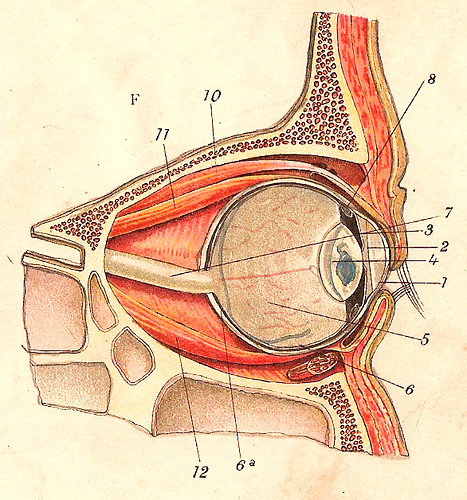
Anatomy of the eye / Anatomia do OlhoWhen we see things out of our peripheral vision, color vision is distorted. The cells in our eyes that perceive color, called cones, fade out in our peripheral vision. If you don't see something head on, you will often mistake the color. As we age, our night vision gets poorer as we lose the more sensitive rod cells. These cells are responsible for motion detection and night vision. The rods are highly sensitive to motion, so you can block something flying toward your head. In the eyewitness example, if you see something out of your peripheral vision you likely will get the color wrong, unless you also see it straight on, in good light, with normal color vision.
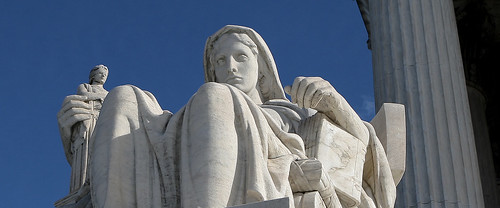
Figures of JusticeThe recent execution in Georgia of Troy Davis, convicted of murder based solely on eyewitness testimony, should give us all cause for concern. Seven of the 10 eyewitnesses to the crime either recanted or significantly altered their testimony. Despite the significant holes in the case, Troy Davis was executed on September 21, 2011. The family of murder victim Officer Mark Mac Phail reportedly saw "nothing to rejoice about" in the execution of Troy Davis. Hopefully, they will find some peace and healing.

Officer Mac Phail, jumped to the aid of a homeless man who was being attacked. He was murdered trying to save the life of a stranger. He is survived by a wife and two young children who will never get to know their father. I hope justice, not merely vengeance, prevailed in this case.

Photos courtesy of: Looking glass, CGoulao, and Clearly Ambiguous


Monday, September 26, 2011

Now you see it … The Eyewitness Controversy


It happens in a flash, usually without warning, and certainly for victims and witnesses, without much in the way of preparation. One minute they could be minding their own business; the next they can be in the throes of a crime. Murder, rape, and robbery–you name it–crimes literally happen in the blink of an eye.

Just as quickly, a moment can change the trajectory of a defendant’s life. That moment is the moment they are identified as the one who did it. While courts and prosecutors have long given lip service of the magnitude of this issue, eyewitness misidentification has finally become a real issue that is finally being looked that’s to a historic ruling by New Jersey’s Supreme Court.

As a deputy district attorney in Los Angeles, I handled all kinds of cases with all kinds of evidence. Much of that evidence came from the witnesses and victims to the crime. Witnesses who often swore they could never forget the face of the bad guy. But could they? Really?  

Let's have some perspective here. The most heinous crimes out there–child abuse, sexual assault, rape, domestic violence, elder abuse, and stalking–are crimes that are perpetrated by someone whom the victim knows, and often knew well. These are the cases you hear about in the news. Less discussed are the “stranger” cases, where the victim and perpetrator have no connection, didn’t know each other, and were only brought together through some random (or not so random) senseless act of violence. These are the “ID” cases.

Witnesses are supposed to be considered just like any other type of evidence in a case --blood, sperm, fingerprints-- but they’re not. We all know that the truth is, juries love witnesses. Nothing persuades a jury more than the, (cue the theme music) “Law and Order” moment when a witness takes the stand, looks over, and points to the suspect and says, “There he is. He’s the one who did it.”

In every case, the prosecutor is trying to figure out whether they can make a case. And while we try not to put the pressure on victims to perform the reality, there is a great deal of importance in determining whether the witness can testify credibly, whether their story makes sense, and, more importantly, points to who did it.

The defense attorney, on the other hand, is trying to hold the prosecutor to the burden of proof the Constitution guarantees–that is, the prosecution must prove its case beyond a reasonable doubt. So, as a defense attorney, those words of the witnesses are not about simply making a case; they are about making darn sure you have the right dude.

In my defense work, I pride myself on acknowledging that a crime may, or assuredly did occur. However, I am going to make sure that the prosecutor can prove that the perp is my dude, and not some other dude or SODDI, the known acronym in the legal world for “some other dude did it” defense.

We all know about reliability issues with witnesses. Some have an axe to grind, some have a prior relationship, others have a criminal record or unsavory past, some are drug users, hookers–you name it. But credibility issues are one thing; witness reliability when they are otherwise credible adds a new wrinkle to the equation.

And this is a wrinkle that will really make a dent in criminal prosecutions and finally confirm what defense attorneys have been groaning about for years. And that is that eyewitness identification is inherently flawed. Make no mistake, the New Jersey high court’s ruling could forever change the way police use witnesses to identify bad guys. The US Supreme Court is going to weigh in on the entire issue for the first time since 1971.

Here’s what I’ve witnessed myself over the years: When witnesses say they are 100-percent sure, I’m 1000-percent sure they are not. Why? Our minds and our memories are far from perfect. Sometimes we can’t remember what we had for lunch yesterday. Think about what can happen when a crime is involved. Think about the fear, hate and all kinds of trauma involved here. The chance for unaffected memory is next to zero.

Now, let’s add on the impact of law enforcement. Let’s say you’re a rape victim. The cop who comes in to help you catch the rapist is going to have enormous influence on you. So, if he or she shows you a photo of the bad guy, chances are you will end up agreeing with the choice. I’m not suggesting this is a deliberate act, but it happens all the time. We are only now beginning to understand how a witness experiences and remembers events, faces and time.

The New Jersey Supreme Court Justice, which ruled in the case, said it best: “A vast body of scientific research about human memory has emerged. That body of work casts doubt on some commonly held views relating to memory.” 

Barry Scheck, founder of the Innocence Project and who is famous for using DNA to overturn wrongful convictions, released the following figures from the Project’s files. Of the first 250 wrongful convictions cases overturned by DNA evidence, 190, or 75 percent, involved eyewitnesses who turned out to be flat-out wrong.

Now the courts are finally acknowledging there are issues of eyewitness identification. The question is what is the solution? Prosecutors would like to say defense attorneys could simply argue their cases (but how?), some defense attorneys will argue for exclusion, suppression or limitation of the evidence altogether. Courts allow for experts to appear to testify about the inherent flaws, or even permit jury instructions that address the issues inherent to misidentification by guiding jurors through the process. All of these may be great solutions but they are fixes to a bad identification.

When a person is facing incarceration, loss of liberty and other collateral damages, after-the-fact fixes are just not good enough. We live in a country that forces prosecutors to meet their burden of proof.  Isn’t it time law enforcement be held to the standards that correspond to that heavy burden?

So what am I suggesting? I am suggesting we do something about identification at the critical moment when the initial interview and identification is happening. That is creating a standardized “best practice” system to account for the inherent issues of misidentification, lack of reliability and suggestibility. The simplest and easiest of these can be done right now with only the cost of a tape recorder. If police are required to tape the entire interview with each witness, victim, and suspect then at least everyone can hear verbatim what went down, how the interview was conducted, and how an ID occurred. It is a transparent option that at least will allow attorneys to argue and then jurors to decide for themselves if the identification was good or bunk. There are tons of other ways too, but in a budget-conscious society, one resistant to change, let's start simple with a $15 tape recorder.

If we clean up that part of the investigative chain, we’ll all be able to live with the results as the case makes its way through the system. Memories are flawed. Law enforcement can be too. Let’s remove as much of the human-error part as possible. It’s going to be a better result for justice, which is better for everyone.


Thursday, October 8, 2009

A Particularly Unsettling Exoneration

by Laura James

The Court of Appeals said the evidence was "overwhelming." Nathaniel Maurice Hatchett confessed to carjacking and raping a woman. The victim identified him as her attacker. He was caught driving her car three days after the crime.

Yet Hatchett
walked out of a Michigan prison after serving 12 years, because the semen found on the victim did not match him. The current prosecutor remarked: "We went back in and did a full investigation. We could have fought for a new trial, but our job is to seek justice. It was served today."

Now for the unsettling part: the prosecutor, trial judge, and Court of Appeals knew at the time of his trial that the DNA from the semen did not match the defendant, but the 17-year-old was convicted anyway. It now appears that the only "overwhelming" evidence in State v. Hatchett was of prosecutorial abuse and judicial incompetence.

They also knew that when Hatchett was caught with her car, the ignition had been popped out. Curious. The carjacker left the victim on the side of the road and took off - with the keys in the ignition. Why would he break the steering column if he had the keys? They also knew some details from the confession did not match the victim's account. For example, the defendant denied robbing her. The most burning question concerned the DNA result. When weighed against a victim's cross-racial identification, even against a confession elicited after several hours of interrogation of a teenager, isn't DNA evidence from semen, in a rape case, a trump card?

Apparently not. Said the trial judge: "[The DNA can] hardly be found to represent a reasonable doubt considering all of the evidence in the case. The court does not find that the laboratory analysis is a fact which would lead to a verdict of acquittal."

DNA - not exculpatory? I find that logic quite strange. By the way, that trial judge is now a
federal judge - appointed by President William J. Clinton.

But surely there are smarter judges at the Court of Appeals level, right?

The appellate decision is
available online. The bizarre logic applied by the unanimous, three-judge panel that affirmed Hatchett's conviction makes for hair-raising reading. Said the Court of Appeals: "We agree ... that while the DNA test results introduce a slight doubt ... there are several plausible explanations for these results." The Court of Appeals goes on to give two "plausible explanations." Not "several." Two.

One: "The victim told the treating nurse that defendant ejaculated 'on' her, and she told the treating physician that she was only 'fairly certain' that defendant ejaculated at all; therefore, it is altogether possible that defendant's semen would not be found in the victim's vagina or in her underpants."

This is quite curious reasoning. Someone's semen was found on the rape victim. Do these three judges have their heads in the sand? How can the judges choose to question the victim's veracity when she described her attacker's ejaculation while simultaneously refusing to harbor any doubt about her identification of Mr. Hatchett as the rapist? They said her evidence was "overwhelming" - and I guess it was, except for the details.

Two: "The donor might have been the victim's spouse." That is a plausible explanation. So why didn't they obtain a racial profile from the DNA? Or better yet, test the husband? When 25 to 40 years of a man's life are on the line, why was that question posed but not answered?

As it turns out, the husband was in fact tested. He did not match the DNA from the semen. The prosecutor
never brought that fact to the attention of the defense attorney, the trial judge, or the Court of Appeals. He is still a prosecutor today - and he actually denies knowingly putting an innocent kid in prison, all evidence to the contrary notwithstanding.

Unfortunately, nothing will come of it. The prosecutor won't be affected. The trial judge now has a lifetime appointment. None of the appeals court judges will even see their names in the paper, let alone be made to feel like court jesters, as they should. Judges William B. Murphy and Donald S. Owens are still sitting on the Court of Appeals.

Mr. Hatchett is the 216th person freed by DNA, his exoneration coming at the behest of the Thomas M. Cooley Law School's
Innocence Project. What a shame for Nathaniel Hatchett that 12 years had to pass before the DNA evidence that was there all along was brought to the attention of fair-minded men.


Wednesday, August 12, 2009

"I Used To Be Mad..."

by Katherine Scardino

That’s what Ernest Sonnier told the reporter who asked how he felt after spending 23 years in prison for a crime he did not commit. Harris County, Texas, now has the distinction of having convicted six innocent people that we know of. They are the six fortunate individuals who could scream loud enough to get the Texas Innocence Project to look at their cases and demand action. I am on the board of the Texas Innocence Project; I learned last week it has more than a thousand cases to review to determine if there is even one more out there who should be freed. That's in Texas alone. Only a handful of workers are willing to labor that hard for so many hours and so little pay.

Mr. Sonnier spent his 23 years in prison knowing he was innocent. His family knew he was innocent; his mother says she knew because he was at home with her.

How often do prosecutors hear that alibi? Yeah, right, home with mom. The law says that until someone is convicted, he is presumed innocent. Why is that so damn hard for prosecutors and judges to remember and honor? Why have we all become so prejudiced against people accused of committing crimes that we assume they are guilty, no evidence required? Just ask someone accused of sexual abuse of a child whether they felt their jury looked at them fairly.

So, what happened to Mr. Sonnier? He was convicted in 1986 for the 1985 aggravated kidnapping and rape of a woman who lived in Alief, Texas. Two men grabbed her and raped her repeatedly in their car until they stopped at a store, giving her the chance to flee and call police. DNA evidence was handled poorly by the prosecutor and the Houston Police Department Crime Lab. The newspaper article about Mr. Sonnier’s release used the phrase “faulty forensics." Translate that to “HPD Crime Lab technicians lied.” There are only two ways you can get “faulty forensics” - falsifying results and lying in court, or contaminating evidence, knowingly or not.

It was not unusual several years ago for crime lab technicians to assume they worked for the prosecution and that their test results should help prosecutors. Such skewed results meant some innocent people, like Mr. Sonnier, wasted their lives in prison.

I cannot, in my wildest dreams, see how anyone could maintain their sanity and humanity while locked in prison for a crime they did not commit. I can't imagine the thoughts that would course through my mind -- about the hopelessness, helplessness and sheer futility of life, not to mention my seething anger.

The repercussions of losing most of the good years of your life? How about the aging of yourself and your family? Your children, nieces and nephews are all grown after 23 years. Your parents may be dead or in failing health. Your health has most lik ely deteriorated because of poor medical facilities in prison or the aging process we all endur e. But we endure it in freedom, with access to the best medical facilities available. Mr. Sonnier barely had a doctor or medication, let alone access to Texas Medical Center.

The problem is simple: Arrogant power controlled by small minds. The solution is not so simple. It would be a large step forward if our judges and prosecutors really believed in the presumption of innocence.

So, Mr. Sonnier, how do you feel today? Are you angry?

“No”, he says... "I used to be mad...”

Bless your heart, sir. Our best wishes for the rest of your life.


Friday, June 5, 2009

Blocking Access to DNA Testing

by Diane Fanning

In Louisiana, Kenneth Reed sits in prison convicted of rape. He continues to claim his innocence and file appeals. A simple DNA test could confirm his guilt or throw his 1991 conviction into doubt. The prosecutor is blocking that testing as hard as he can even though though the state of Louisiana is one of forty-six states to give that right to inmates.

For the past three years, an Illinois state attorney has been obstructing DNA testing for Johnnie Lee Savory (right), convicted of a double homicide in 1977 when he was 14 years old, insisting that the jury didn't need DNA to convict. A ridiculous statement considering the fact that there have been 175 exonerations by DNA.

State after state, the story continues--prosecutors balking at the tests that could actually confirm the guilt of the inmate or point to possible innocence. Certainly, all claims of innocence are not valid just as DNA testing is not always the whole answer to every case. But even if it doesn't tell the whole story, it is a vital piece of the puzzle.

Hearing all these prosecutors battle against the revelation of all the facts and truth in a case makes you wonder if they understand the meaning of justice, have any concept of their mission, or remember they are representing us in the courtroom, not themselves. Too many of them have prioritized winning over truth and justice, making a mockery of the law they are sworn to uphold.

Fortunately, not all of the people’s representatives in the court of law have lost sight of the meaning behind their calling. One sterling example of a prosecutor with a clear vision of his mission is Craig Watkins (right) in Dallas County, Texas.

Watkins took office in January 2007 inheriting a staff that possessed a win-at-any-costs mentality embedded in the office culture by legendary Dallas County prosecutor Henry Wade. Wade actually bragged about obtaining convictions on innocent people--he said it proved his tremendous skill as a prosecutor.

In July 2007, Watkins established the Conviction Integrity Unit charged with the oversight of four hundred post-conviction reviews where DNA could provide answers. He staffed it with one assistant district attorney, one investigator and one legal assistant who work in conjunction with the Innocence Project of Texas. It is the first division of its kind in the United States.

Since its inception, the unit has called for testing in forty cases of claimed innocence. As a result, nineteen men were determined to be wrongfully convicted and ten innocent men have been set free from Texas prisons. Barry Scheck of the Innocence Project said: "Sometimes district attorneys are reluctant to admit that a mistake was made. What he proved is if the district attorney's office is not afraid to admit that a mistake was made and correct it, then juries will reward them for it. By doing justice, you establish credibility."

It's not all one-sided in Dallas County as a single viewing of Dallas DNA on the Investigation Discovery channel demonstrates. Many men requesting the genetic testing to clear their names are informed that, to the contrary, it confirmed their guilt. I imagine most of those inmates were just gambling that the science would fail and a mistake in the lab would set them free. A few had probably lied so long, they'd forgotten the truth. Either way, the jury verdict was confirmed as just and true.

There are those out there who are not moved by the thought of an innocent person in jail. They tend to think that those people probably committed another crime and just got away with it--so what difference does it make to keep them behind bars. This cynical attitude overlooks one very important problem--a complication that leaves all of us less safe, by exposing us to the predation of more rapists, killers and molesters.

Every time an innocent person is wrongfully convicted, there is a guilty person--perhaps a very violent person--who walks free able to re-offend. Brandon Garrett, a professor at the University of Virginia School of Law, analyzed 225 cases of DNA exoneration. In 98 of those cases, the new information led straight to the actual perpetrator allowing law enforcement to get the guilty man off of the streets.

Conviction at any cost is simply not in our best interests, even if we never end up in a courtroom on either side of the aisle. Self-preservation alone should prod all of us into demanding that prosecutors in our jurisdiction care more about justice than they do about winning. I don't expect perfection from the state's attorneys--they are human, there will be mistakes.

But I do expect prosecutors to care about these errors, to be willing to admit to them and to do everything possible to restore justice to wrongfully convicted inmates.

After all, as citizens, it is in their best interests, too.


Saturday, May 9, 2009

Drew Peterson: From Cathouse to the Big House?

by Pat Brown

I can't think of more than a handful of people (seriously deluded ones) who wouldn't like to see the smirk wiped off of Drew Peterson's face. Surely some folks cheered in front of their television sets when they learned "I'm So Sexy" Peterson lost his opportunity to be a star of "Cathouse," the HBO reality brothel show filmed at the Nevada brothel known as the "Moonlight Bunny Ranch." Cops showed up at near Peterson's home today, stopped his vehicle, and carted Drew off to the much less entertaining venue known as jail.

"Nobody Actually Thinks You're Sexy" Peterson will be cavorting with lifers instead of hookers if the prosecution succeeds in convicting him of murdering his third wife, Kathleen Savio, the wife who was found dead in the bathtub (not the wife who went missing in 2007 . . . or the one who had her car brakes tampered with . . . or the one who says he wasn't really that bad a character when she was married to him).

I hope Drew Peterson gets what's coming to him. I think he is guilty as heck of making Stacy Peterson, Wife Number Four disappear. I think he is likely guilty as heck of the bathtub death of Wife Number Three. But, I also hope he does not get convicted without solid evidence even if I think he deserves a bum deal.

Why am I so concerned about what happens to a creep like Drew Peterson? I will tell you. The law is supposed to be impartial, the jury is supposed to be impartial, and if we allow the courts to convict people simply because the jury (and the community) doesn't like the defendant, then we are allowing our justice system to become a mockery.

Most "wrongful conviction" news in recent years has involved the Innocence Project, a group that is more interested in getting rid of the Death Penalty than getting innocent folk out of jail. This is why they don't bother with lifers. They also focus strictly on DNA evidence and, regardless of an often overwhelming pile of evidence proving guilt of the convicted felon, they work to get the killer freed on some DNA screw-up, technicality or irrelevant point (like the semen belonged to the victim's last date before the killer broke in and murdered her, or the semen belonged his partner-in-crime who was never identified). I don't see them taking up cases where the convicted man got life for being unlikeable.

Michael Skakel was one of those unlucky schmucks. Sure, he did masturbate in trees as a teenager and he was an arrogant member of the Kennedy clan and he had a big mouth he should have kept closed. Maybe he should have shut up, but he shouldn't have been convicted of killing Greenwich, Connecticut teenager Martha Moxley decades ago (1975) on less evidence than connected original suspect Ken Littleton to the crime. Littleton, a pretty creepy character who failed the polygraph test more than once, continued living with the Skakel brothers even though he had to "know" one of them committed the crime. But, no matter—Skakel was a Kennedy and Mark Fuhrman made him the villain, and the jury decided Skakel was creepier than Littleton. Guilty.

And what about Paul Dubois who supposedly gunned down Linda Silva in Cape Cod in 1996? He got convicted because his ex-girlfriend said she once saw a gun of Paul's that could have been the gun used in the murder and she wrote down the serial number on some toilet paper. Dubois may be a shady character that the community won't miss but if he didn't kill Silva, someone else did.

In Tennessee in 2003, James David Johnson got convicted of killing 73-year-old Florence Jean Hall in her garage purely on his confession. It didn't seem to matter to the jury (or maybe the prosecution withheld the information) that not one bit of physical evidence existed in the case. Although Johnson supposedly killed Mrs. Hall late in the afternoon, the woman had gone missing early in the morning, never showed up for any of her appointments and she never came home for lunch as she routinely did. The family apparently didn't feel the need to call and see if Mom was dead in a ditch (or dying on the floor of the garage since morning). Sure, Johnson is no stranger to crime, but if he didn't commit this one, someone else should be sitting in his place.

Which brings me back to Drew Peterson, no nominee for Boy Scout of the Month. In the case of Kathleen Savio, I tend to believe if a jury does convict Peterson without anything more than innuendo and some curious circumstantial evidence, they have the right man. But setting a trend of convicting people for being unlikeable rather than convicting them on sufficient evidence is not a good thing; an innocent (at least of that crime) guy goes to prison and the guilty party remains on the street to kill again.

I am waiting to find out what the probable cause was to arrest Drew Peterson. Something has to link Peterson to the Savio's home that night and to a violent assault on her. I doubt physical evidence exists so we can eliminate that. This leaves witnesses and/or confession.

Just in time to benefit the Will County prosecutors, Illinois amended the hearsay law, which will now allow the "testimony" of a dead person into court. This means the letter Savio left stating Drew might kill her could be allowed into court. I don't have a problem with a statement of any deceased person being brought into court if it is written in her handwriting, tape recorded, or authenticated by enough credible witnesses.

But, I do have a problem with such a statement being proof that Peterson killed her. Just because someone says another person is out to get them doesn't mean that this was the person who showed up and did the deed. It could be a new boyfriend (maybe Savio has bad taste in men), it could be a serial killer, or maybe a burglary gone bad. It could even be possible that Peterson entered Savio's home that evening with a machete in his hand, ready to lop off her head but found, Happy Day, that someone had beat him to the punch.

So, now I am only left with confession. A pastor said that Wife Number Four, Stacy Peterson, confided that Drew admitted killing Kathleen. Is this the telephone game? Is this good enough to convict Peterson without solid supporting evidence? Not in my opinion. To me, the only evidence that should convict Peterson and the only evidence I think would be good enough for probable cause to even arrest this sorry-excuse-for-a-man would be Drew's own words. I hope someone, sometime, somewhere, was wearing a wire and Drew bragged that he killed Kathleen and got away with it. I hope.

Over the next several days, we ought to have a little light shed on what probable cause the police had to bring Peterson in. I am keeping my fingers crossed they have something more than a good theory. A good theory alone may result in a conviction, but if juries keep convicting without evidence (and sometimes oddly refusing to convict in spite of overwhelming evidence), our court system will become nothing more than a popularity contest. This scares me more than Drew Peterson getting away with murder.

While I have never been fond of this saying: "It is better to let ten guilty men go free than one innocent man be wrongly convicted" (doesn't that mean the ten guilty men go on to kill fifty more people and therefore we murdered fifty to save one?), I do object to the concept of allowing the guilty man the freedom to kill yet more people because we put the wrong guy away.

Worse yet, I would hate to see Drew Peterson laughing at us as he walks back out of jail a free man.