|
| Julie and Joel |
If your child were murdered and you were charged with committing that homicide but you knew you were not the perpetrator, how do you cope with knowing that your innocence simply was not enough to pull you out of the vortex of a criminal justice system operating in an alternative reality?
Can you imagine anything worse ever happening to a parent? I can't.
It is what happened to Julie Rea after the murder of her ten-year-old son Joel Kirkpatrick. She described the intruder in her home. She suffered injuries that the emergency room doctor said could not have been self-inflicted. She passed lie detector test. Law enforcement did not believe her.
Represented by an inexperienced, court-appointed attorney, she was convicted and sentenced to 65 years in prison.
Initially, I did not believe her, either. I did not place any credibility in what was said by Julie, her friends, her family or her attorneys. Then, I heard the prosecutor speak. He said that there were no stranger fingerprints in the house; that no stranger would come into the house to kill a child; that the violence of the crime proved the perpetrator was someone very close to the child; and that a person does not come into someone's home without a weapon and pull a knife out of the kitchen drawer and use it to kill.

That's when I knew Julie Rea might not be guilty because I'd been interviewing serial killer Tommy Lynn Sells for my book Through the Window. He did all those things at crime scenes. I didn't suspect him then but thought someone just like him could have committed the crime.
When I wrote to Sells about what the ridiculous things the prosecutor said, without any details of names, places or dates, he wrote back asking if the crime was committed a couple days before his murder of Stephanie Mahaney in Springfield, Missouri--maybe on the 13th. That was how his confession began. Still, I was skeptical until Bill Clutter, investigator for the Downstate Illinois Innocence Project, found corroborating testimony in the town of Lawrenceville, Illinois.
 |
| Julie Rea and Diane Fanning |
From that moment on, I was convinced and was determined to do what I could to help find justice for Julie Rea. The Center for Wrongful Convictions and an extraordinary Chicago defense attorney, Ron Safer, became involved. Julie got a new trial and was acquitted of the crime. Just last month, she received a Certificate of Actual Innocence from the State of Illinois. Julie handed me the Defender of the Innocent Award from the Downstate Illinois Innocence Project--definitely the highlight of my career as a crime writer.
Whenever anyone maligns the True Crime genre or is dismissive of my writing, I will always think of Julie and the role my book played in her tragic story. It is just one example of why I think the genre makes a significant contribution and why I feel compelled to keep writing it.
But still something was missing and that was Justice for Joel. After his murder, if the sheriff's office would have paid any attention to reports of a suspicious stranger in town, maybe deputies could have found Tommy Lynn Sells before he killed again. But, instead, they myopically focused on proving Julie's guilt, hid some evidence from the defense and ignored anything that did not fit their theory of the case.
 Today, even though the state has completely exonerated Julie Rea, the State's Attorney's Office refuses to investigate further--refuses to find Justice for Joel.

This Sunday night, on the Investigation Discovery channel, at 10 pm Eastern, On the Case with Paula Zahn presents A Mother's Nightmare, the story of Julie Rea, her son Joel and the many people including me, who stood up to find Justice for Julie and Joel.
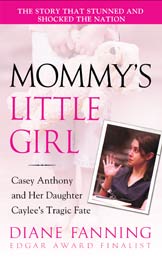
Throughout the trial of Casey Anthony, Diane Fanning, author of Mommy's Little Girl, writes daily about the the pursuit of Justice for Caylee Anthony on her blog, Writing Is a Crime.
Tweet