Showing posts with label Louisiana State Penitentiary at Angola. Show all posts

Tuesday, August 2, 2011

Serving Life

by Lisa R. Cohen

Two weeks ago I traveled to Louisiana's maximum security Angola State Penitentiary. It was almost exactly two years since I'd begun Serving Life, the documentary that aired last Thursday night on OWN, the Oprah Winfrey Network.

Back in July of 2009, months before OWN decided to fund the film, before Academy Award winner Forest Whitaker came on board as Executive Producer, I first went to Angola to check out their inmate hospice program.

There I met the inmate volunteers who staffed the program and I was skeptical - it seemed too good to be true. Murderers - serving life sentences - were caring for their dying fellow inmates. Washing their bed-sore covered bodies, changing their diapers, holding their hands while they took their last breath. It was the other side of death, not the one at the end of a sudden muzzle flash, but the slow and wrenching kind, leaving plenty of time for hard reflection.

It's a volunteer position; the inmates have regular jobs that come first. So there's a lot of burnout, and the hospice coordinator planned to pick a new class of volunteers from among the ranks of the prison's 5,100 inmates. I asked if we could follow along, from the application interviews through the selection through the training, and their first patients. This way, we could watch for ourselves to decide whether it was a con job. The prison said yes.

Two years passed, during which time I was there, off and on, and then on and on, with a skeleton crew of producers and camera men (and one amazing and nimble woman) who flew in from New York. One cameramen was local - an inmate named Sean Vaughn, whose innate talents blossomed over the course of production. He himself is serving life.

They say time passes slowly in prison, but it did pass. We met the incoming class of volunteers on a freezing January day, the record-breaking, coldest day in years. They seemed to be wearing every piece of clothing they owned, and with good reason.

We watched them train in June, and their T-shirts gave us continuity problems. So did the sweat that beaded up on their faces as they concentrated on practicing feeding, bathing and changing the sick, elder inmates in the hospital wards before graduating to actual hospice patients.

Angola is, well, let's just say unique, as prisons go. It's 26 miles of acreage, a huge former plantation bounded on three sides by the Mississippi. Most of the wardens, guards and other staff actually live inside the prison, in a town with its own post office, swimming pool, baseball diamond and 9 hole golf course (called Prison View).

At Angola, they decorate big time for holidays. Life size Uncle Sam cut outs and fireworks (yes, fireworks) on the Fourth of July, turkeys with crepe paper tails at Thanksgiving, and Christmas lights strung from the guard shacks. You can't fail to notice the seasons passing by. We were there for all of the major holidays, except Easter. I imagine there were brightly colored eggs, and the staff's children probably had a hunt.

Our team lived at the prison as well, in a series of small guest houses built to accommodate the endless stream of visitors who pass through Angola. The one we spent weeks in overlooked a small lake, and alligators occasionally skirted the dock, making us more nervous than any of the "trusty" inmates who wandered freely, carrying out their farm duties - raising cattle, fishing the lake.

And we filmed. Hundreds of hours at the hospital, in the inmate dormitories late at night, the cafeterias during meals, the churches and the workshops, the college classrooms and the inmate basketball court. But mostly, we filmed in the hospice, tracking the new volunteers' progress.

There was the ambivalent "Boston" who juggled doubts about his work with anxiety over his nine-year old son's impending visit, a son he'd never met. The convicted murderer Justin, who was serving life for being at the scene even though he hadn't pulled the trigger. The "three-strikes-you're-out" lifer Ratliff, who also helped care for his older brother at the hospital, a Crohns patient. And Shaheed, who very late in the game disclosed the tragedy in his life that had helped him change his way of thinking. They all proved my skepticism wrong.

Two years passed, including 4 plus months of filming, half a dozen deaths, 4 months of edit, and more late nights than I thought there were in a lifetime. The film was finished, and we wanted the inmates to see it. It felt very important. I flew down for the first time in many months and on a very hot July day, hundreds of inmates streamed into the prison's main chapel, along with Warden Burl Cain and many of his assistant wardens, several guards, and other staff.

I was nervous. More so than I'd be the next week in Los Angeles, at a private invitation-only screening filled with, among others, the new Co-presidents of OWN, Forest Whitaker and other media muckety mucks. There I'd have to get up and join Forest in a Q&A afterwards.

But this was harder. We'd followed these men around, shoving a camera in their faces for months, as they cringed, cried and peeled back their layers - something tough guys in prison never do. Then we'd thrown out 99.9% of it, shaped the remaining .1% into a dish of our own making, and now it was going to be projected up on the giant white wall at the back of the sanctuary. Not to mention broadcast nationally the following week.

Luckily I sat in the front row where I couldn't see anyone's face. It was very quiet, but I was thrilled when the audience laughed in all the places I'd hoped they would. It's hard to believe, but we'd worked very hard to include the humor - which there is in every part of life, especially the toughest parts. The AP reporter who covered the screening wrote afterwards that the room was also filled with quiet sobbing - I was too far away to hear for myself.


But afterwards the Warden spoke briefly. "It's incredible," he said, visibly moved and teary himself. "Many of you have a chance to change your lives, and this says you can do it... And
you're worthy of this film. You're worthy of what the public is going to think about you.... My encouragement to you is, you have a legacy. And you can't betray it. You can't betray this hospice program. So you just got to live it... We can't be counterfeit, and if we do, then we desecrate what you just saw. And we can't do that. So it draws out the best in all of us."

A lot of very positive reviews followed, including the Washington Post, New Orleans Times Picayune, and others. But the Warden's comments - those were the most rewarding I've gotten so far.

Serving Life encores this Wednesday night, Aug 3, at 9pm and then again at midnight. See the trailer here, and find out where it's showing in your zip code.


Friday, July 1, 2011

Defining Features

by Lisa R. Cohen

For the last two years, I’ve been in and out of prison. I’m out now, and have something to show for it – a documentary film I directed and produced called “Serving Life” that will premiere on the Oprah Winfrey Network (OWN) on July 28. I’ll be writing about it in my next few blogs. It’s been two years in the making, and I’m mighty proud of our small production team’s heroic efforts. You can watch the promo for it here.

The film, executive produced and narrated by Academy Award winner Forest Whitaker, led us to the infamous Louisiana State Penitentiary, otherwise known as Angola, aka “the Alcatraz of the South.”

I happen to have been to Angola many times in the past, and I know the place better than many. The 26 mile property, contained on three sides by the Mississippi River (except when it floods the levies there as it did last month) is an unearthly world unto itself, a throwback to a long ago time when Angola actually was a plantation, worked by forced emigrés from the African nation it was named for.

My first visit to the maximum security prison was over 15 years ago, and when I arrived this time around, on a sweltering July day, for a week of preliminary shooting, some things had changed. Since the ‘90s, under the current Warden, Angola has had so many outside visitors, they’ve built guest cottages on the premises. So this time we literally moved into the prison. Every morning we’d leave our cozy four bedroom cabin, overlooking a lake filled with with cedar stumps and sinister looking alligators, and head to the prison hospital.

There, tucked away in a corner of a chronic care ward, a group of inmates staffed the prison hospice. Day after day, these volunteers walked the chain length enclosed path from their dorms to the hospital, to wipe a dying man’s fevered brow, change his diaper, and, finally, to hold his hand while he takes his last breath. It’s a burn-out job. In fact it’s not a job at all, it’s all-volunteer. At Angola inmates work every day; the volunteers come to hospice before and afterwards. So it’s no surprise there’s a constant need for fresh recruits.

Our mission was to follow a new crop of inmate volunteers–watch them get picked, get trained, and then find out whether they were up to the task. If a hardened criminal can be taught to perform the ultimate act of compassion, what excuse do the rest of us have?

By last summer we were in full production. That meant weeks on end watching as these men tested themselves. What they learned about themselves, we did too, and the results were both chilling and life-affirming.

The first day at the hospital, I met probably a few dozen inmates. They all looked exactly the same to me, even though at Angola they dress in street clothes, a kind of informal uniform of jeans and colorful t-shirts that advertise the various prison clubs they belong to. But their faces all blurred together, impersonal, hard-lived, and I could only identify them by their charges–murderers mostly, armed robbers, a heroin-lifer, and multiple drug offenders.

As the days passed, though, personalities emerged, and pretty soon these men defined themselves–by their past criminal acts, their current struggle to redefine themselves, and their hopes for the future. (And they all maintain hope, even the ones who are destined to die at Angola, perhaps in a hospice bed.)

I met their children, their sisters, their brothers (some serving time in another part of the prison). I watched them recoil with disgust as they started training, but then come to embrace the most grueling parts of the work. I watched them make each other laugh– and me too–because that’s what you do in real life even in the darkest times.

I spent this week filming on the start of another venture, just the first days of a long, long haul. On Monday I sat in a room in Nashville and listened as a group of women bared their painful pasts. On Monday they all looked the same to me, just like Robert and "Animal" and Stephen did two years ago.

But by yesterday, as I said goodbye and headed for the airport, I’d begun to know their stories of courage and survival. These women were taking shape to me, and their message was that much more powerful. It made me realize, once again, that this is why I do it. And that getting the chance to pass on those stories can make us all a little more human.


Monday, January 25, 2010

A Credible Motive


by Lisa R. Cohen

I missed my slot on this blog in the last cycle because I was away in the slammer. Don't get me wrong -- I was comfortably ensconced in a two bedroom guest cottage with wood burning fireplace and fully stocked frig.

But the cottage was high atop a hill inside Louisiana State Penitentiary at Angola, aka "the Alcatraz of the South." A former plantation worked by slaves imported from the country it's named for, Angola holds some 5,000 maximum security inmates and spans 22 miles - "bigger than all of Manhattan," as the warden likes to say.

There were four of us packed into the two bedrooms, and the southern heating system couldn't compete with record freezing temperatures, but still, the housing was certainly bigger than the cells some Angola inmates inhabit, and much more private than the sweeping double-bunked dorms most of them sleep in at night. I am always cognizant and grateful when I go there that I can drive out whenever I want.

After our first night, I arrived at the Treatment Center, home to the hospice patients whose lives and deaths I'm here to chronicle. I was sad to see the Christmas lights that had twinkled around the guard shack when I visited in December were being packed up. The candy cane and Santa Claus-patterned gift wrap that had papered the infirmary office doors was gone, as the New Year ushered in a return to institutional white.

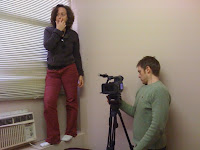
I was there with a film production crew to watch as the prison hospice staff selected a new crop of inmate volunteers. Executive Producer Molly Fowler (who took the photos of our trip); DP Tom Mason; Producer Jeca Taudte, and I were following the inmates for our new documentary-in-progress, ONE LAST SHOT: A Story of Redemption, see more info and trailer here.

One at a time, the applicants sat in the infirmary chapel, facing a security warden, the hospice co-ordinator, two mental health specialists and a classifications officer. One of the men considered each question intently as he sweated so profusely, it beaded up and rolled down his face. One was bowed over with the weight of decades spent at Angola. Several were still young, but they knew they were going to grow old and die there. Many are murderers.

"Why do you want to be a hospice volunteer?" asked Stacye, the hospice co-ordinator with a healthy bullshit detector. "I want to help in time of suffering," said one, in biblical tones. He'd watched his mother die of cancer, he informed the room. He probably had, and he seemed very sincere. Later Stacye told us she'd believe it when she saw it. "You have to prove it to me," she said, in tones that brooked no nonsense.

"I'd like to think someone will be here for me one day, when I need looking after," said another, enlightened self-interest at its most pointed. "I want to learn about life," said a third, a little cryptically, or profoundly, depending on the interpretation. He almost sounded like he was looking for an adventure - which didn't bode well for his chances.

I find all these answers somewhat unsatisfying. Mainly this is because I haven't yet heard one that works for me. "Why the hell would anyone want to volunteer to work in hospice?" is the more apt question I find myself thinking. I just can't fathom it.

Taking a dying stranger into your heart, watching him shrivel and weaken as he strikes out against death -- futilely -- and often against you, holds little appeal. Feeding him, bathing him, holding his hand as he slips away; who would step forward to embrace such a task? And yet scores of these inmates do.

Are they looking for special privileges? A sympathetic ear from the mostly female nursing staff? Some face-time on our air? Or, like Stacye says, will they show better than tell their genuine intent?

We arrived on a Sunday night. Executions in Louisiana have been all but put on hold, as post-conviction appeals wend their way endlessly through the courts. But that Thursday an execution was scheduled, the first in eight years. Gerald Bordelon (seen at right), convicted of raping and murdering his 12-year-old stepdaughter, was to be put to death at sundown that day. He had waived all his appeals; there was no paper trail to slow him down.

So on Monday, before the hospice job interviews, we watched from inside the execution chamber as the prison "strap-down" team held its final rehearsal for the big show. They practiced over and over cinching the buckles for each arm and leg, monitoring the heart rate, taping the IV line securely. Someone positioned a plastic trash can under the end of the drip, to keep the floor free of the saline which dribbled harmlessly out of the plastic tubing instead of feeding into the arm of the assistant warden standing in for Bordelon.

By Wednesday afternoon, the hospice folks had finished making their candidate picks -- eight new recruits made the cut. Wednesday night, my small production crew and I went back to the execution chamber building to talk to Bordelon. He was awaiting his death the next day in a cell just 62 steps away from the lethal injection table.

"What will God think about all this?" I asked him, as I faced him through the horizontal meal slot in the barred door. Our hospice film is about men who seek redemption, and we'd wondered if that's why Bordelon had chosen to waive his chance to hang on to life at least a little longer, possibly for decades.

"I'm not doing it so God will grant me forgiveness," he replied, "or for redemption, but if He's the God I believe in, maybe He will." Bordelon said he wanted to do it sooner rather than later to atone for what he'd done, to bring -- if possible -- some peace to his ex-wife and her family. Like the prison volunteer candidate, he seemed sincere, too.

There were more practical reasons, of course. The appeals process extends your life, but it doesn't extend the square footage of your floor plan, and an 8x6 cell is a rough place to spend years waiting. And Bordelon had been clear about one other thing. If he ever got out, he'd said, he would probably do it again. Better not to take any chances.

The next day it all went off without a hitch, and Gerald Bordelon showed rather than told his good intentions. And in the days that followed we went on with the rest of our shoot, interviewing our new hospice volunteers. Not all of the eight will make it through the next step -- a three-week training course, one week of class and then two tougher weeks on the job before graduating.

The inmates who've been doing this work for years will be putting the new guys through their paces and looking over their shoulders every step of the way. My film crew and I will be looking over theirs, to see who's "gaming" as the old hands call it, and who's got the real, credible motives.

All photos of One Last Shot production by Molly Fowler.