Showing posts with label crime-scene investigation. Show all posts

Wednesday, January 7, 2009

Toolmarks and Bombs

by Andrea Campbell

Almost every crime involves a tool. Shovels move dirt when evidence is buried, crowbars are handy for breaking into door frames and safes, screwdrivers sometimes force open windows, pliers help make bombs, and bolt cutters clip through fence. The tools used in executing crimes make scars, scrapes, dents, chips, and grooves, and these marks can be traced back to
the source just like striation marks on bullets or the ridges found on fingertips.

Police look for objects bearing toolmarks, photograph them, and, if movable, submit it to the lab. It’s not uncommon for investigators to saw off pieces of door frame, turn in small safes and locked drawers, or bring in bits of metal which may have come from the tip of a knife or the claw-side end of a hammer.

Then when a suspect is identified, they get a search warrant for his home or car and try to match up any found tool with its marks, because every tool is unique. N
o matter how well a tool is forged and polished, under microscopic scrutiny, one can see minute defects or marks on its strike- or cutting-surface. Plus, slight chips or faults as the result of hard employment are produced each time the tool is used. In Florida, a firearms examiner with the Metro Dade Crime Lab in Miami identified a knife used to make a stab wound. He compared the striations left by the knife blade on bone and cartilage on the victim’s sternum.

To compare toolmarks, the examiner reproduces test marks in a manner similar to “the unknown” crime-scene marks, and then he compares the characteristics of each, looking for a match. In essence then, the marks are duplicated and carefully compared.

Tools can also be a source of trace evidence, carrying on them tiny bits of hair, fiber, paint, and soil. And for its last evidentiary significance, toolmark examiners are qualified to make fracture matches—evidence that puts together a small broken fragment in a match to its whole.

For example, a series of bank robberies on night-deposit boxes was committed using hammers, crowbars, and screwdrivers. The method of removing the boxes was pretty clear, but that was all detectives had and nothing much happened. One night though, an investigator found a tiny piece of broken metal which police held onto as a clue. Later when several suspects were identified, a search warrant was obtained, and police collected broken screwdrivers among the suspects’ tools. The broken metal tip saved from the crime scene earlier, perfectly matched one of the broken screwdrivers found in their possession, and the toolmark evidence was enough to put that gang away.

Explosives, Bombs, and Fire

Evidence collection after a bombing or fire is chaotic, dangerous and difficult. Sometimes K-9 units may be used to sniff out explosives. Certain retrieval robotic units may be employed where the danger of future detonation is possible. Fire evidence is generally collected and put into clean, unused paint cans. Even the most seemingly insignificant fragments may prove helpful. Investigators look for blast-cap fragments, fuses, detonating wire, duct tape, cotton, steel fragments, samples of unexploded materials, and even fertilizer. An important clue to an airplane crash over Locherbie, Scotland, was a small fragment, no bigger than a fingernail, but it was evidence of a detonating device.

Laboratory findings in bombings can include:

• What type of explosive was used, possibly with the aid of a manufacturer's chemical signature, certain inert but identifiable chemicals in various explosives.

Where the explosion or fire took place.

• Identification of triggering device.

In Utah in 1985, a man killed two people with bombs and a third went off in his own car. After thinking the man might have been a victim, soon the trail of evidence led back to him. A workshop in his house proved to be the location where the bombs were constructed—items were matched to crime scene evidence—and sales people remembered selling him some of the supplies that later became parts for the bombs.

Detailed technical information regarding explosive devices is collected, plugged into the computer, and distributed via national databases. This helps authorities identify serial bombers, the sophistication of the explosive devices being used, and the need for a uniform procedure. The FBI has a Data Bomb Center and the Bureau of Alcohol, Tobacco and Firearms houses an Arson and Explosives National Repository.*


Wednesday, November 12, 2008

Painting the Scene of the Crime

by Andrea Campbell

The FBI has a library of paint samples and the National Automotive Paint File contains more than 40,000 original paint finish samples. This tremendous stock of material enables examiners to identify the year, make and model of any car by comparing the physical characteristics and chemical composition of paint found at a crime scene with that of known specimens. The chemical constituents of paint can be analyzed via releasing gases and using gas chromatography. This technique creates characteristics for each layer and establishes points of comparison. Also the shape of a chip can be matched to an area where the chip is missing.

With x-ray fluorometry, by bombarding the metal elements in the paint with high-energy electrons, an inner orbital electron of the atom hit by the beam is displaced or knocked out. In order to stabilize, an outer orbital electron falls to fill the void. The atom emits an x-ray and the x-ray emitted is specific to the atom (and therefore the element) that it came from. This technique permits examination of the composition of the paint on an atomic level. The elemental composition of the fragment should match that of its place of origin—allowing the fragment to be linked back to the crime scene.

Although a few flakes of paint may not seem like much, in cases with hit-and-run injuries they can make all the difference.


A ten-year-old Los Angeles boy was killed by a hit-and-run driver. Examiners took the boy’s clothes into an airtight scraping room and carefully rubbed paint off with a metal spatula. Tiny paint chips fell off the boy’s pants, which had probably been pressed into the clothes by his blood and fluids. The gold metallic paint identified was used on three model cars by the same manufacturer. The lab quickly notified the Los Angeles police department that the killer would be driving one of these models.

Soon after, police discovered one of the boy’s neighbors drove a gold sports car with a recently replaced hood. The suspect claimed the body work was the result of a different traffic accident. To his dismay, the hood was recovered, and the examiners were not only able to match the paint chips but they also found fibers caught in the metal that matched the boy’s jacket. Faced with this evidence, the owner of the car confessed to the crime.


Basically, paint can provide key information in any crime whenever a car is a component. A bank robber team in San Diego made the mistake of bumping into a parked car in their attempt for a quick getaway. After the smudge was identified, the motor vehicle bureau helped by providing a list of everyone in that area who owned that particular model. The foreign paint found on the parked car led directly to the apprehension of the harried bank robbers.

In addition to the collections of paint samples, the FBI has standards against which to test typewriting samples, watermarks, plastics and polymers, duct tape, gemstones, cosmetics, and even lubricants like eighty-five types of petroleum jellies. Anything that can be used to build a bomb or aid in a crime is compared microscopically, microchemically, and instrumentally. All specimens have to be identified using two different scientific methods and following established protocols, before it can be used in court.

As forensic science advances with computers and increasingly more accurate means of detecting the component parts of small samples, trace evidence may soon play even more significant roles. As it is, the more trace evidence an investigator can collect at a crime scene, the better the chances of making a case.


Thursday, August 7, 2008

Buggers!

by Andrea Campbell


Forensic entomology, the study of bugs as related to death, is a relatively new science. In the past, investigators thought bugs were a nuisance, something to be washed away or disposed of as quickly as possible. But the relationship between dead bodies and maggots is nature’s way of recycling—the way a corpse becomes simple organic matter.

Death carries a universal scent that attracts hundreds of insects and other arthropods as they set about the body to feed and lay eggs (usually in the bloody areas first). The life cycles of the insects that take place on the deceased are fixed and precise. Those characteristics make it a good tool for investigators called forensic entomologists.

It’s funny then how a form of forensic entomology was practiced as early as the thirteenth century, yet took so long to come to fruition. Story has it that a murder in a Chinese village was the result of the victim being repeatedly slashed. Witness questioning was going nowhere. In frustration, the magistrate ordered all the village men to assemble, each bringing his own sickle. Standing in the hot summer sun, flies were attracted to just one sickle because of the blood residue and tissue fragments clinging to the blade and handle. Confronted with this evidence, the owner of the sickle confessed to the crime.

Insects have helped to solve many crimes. The unique activities of the insects, paired together with the arrival of different species and different forms of species, act as a predictable time-clock that can be traced backward for estimations. The order in which the insects arrive is called succession. Succession is the idea that as each organism or group of organisms feeds on a body, it changes the body and makes it attractive to the next group, and, so on. For example, within ten minutes after a body is dead in open air, flies arrive and lay thousands of eggs in the mouth, nose and eyes of the corpse. The eggs hatch into larvae, also known as maggots, in twelve hours up to three days and the maggots feed on tissues. Since maggots go through three phases on their way to becoming adult flies, the entomologist tracks their development and makes calculations backwards in order to determine the date and time the eggs were most likely deposited.

The Importance of Blow Flies

Blow fly eggs, collected from human remains and analyzed, can provide investigators with an accurate estimate of time between death and discovery and allow them to better target their investigative efforts.

Blow fly eggs are small (2 to 3 mm), whitish-yellow, and somewhat elongate. During warmer seasons they are easily visible to the naked eye found packed into natural body openings and wound sites in large numbers. During colder months, however, their numbers may be few and difficult to locate, buried within recessed locations. Blow fly eggs typically hatch within one to three days depending on species and environmental conditions. Dissection of egg samples and analysis of the stage of embryonic development may further depict the time since oviposition—creation—and, therefore, the time of the victim’s death.

Within 24 - 36 hours, beetles arrive and feast on the dry skin. After 48 hours, spiders, mites, millipedes, and wasps arrive to feed on the bugs that are already there. Entomologists today recognize six decomposition stages.

Bug behavior can also indicate whether the victim was killed indoors or out, during the day or night, in warm or cold weather, in shade or sun. Bugs scattered and laying dead near remains have also told the story of a women who died from a drug overdose. The cocaine chemicals within her body had been passed onto the bugs.

Case Story: Insect Trail

The body of a woman was found in a wooded area near the District of Columbia. There appeared to be no evidence of foul play but as part of police procedure, the scene was photographed. It was late summer and the dead woman was dressed in a tube top and slacks. Since her clothes were intact the possibility of a sexual assault was not taken into account.

Despite peaceful surroundings, her advanced stage of decomposition meant that the medical examiner would have a difficult task. The body had been lying out in the open for about ten to twelve days. Larvae were in the eyes, around the nose and mouth, in the chest area, and on the palms of both hands. The dead woman was identified immediately and because of the condition of the body, pressure was put on the authorities to release her corpse for a speedy burial. A limited autopsy indicated the cause of death was unknown and the body was turned over to the undertaker.

Typically, that would have ended the investigation, but one detective remained puzzled. The question about time of death bothered him. The victim had been reported missing a few days before her body was discovered on the trail, but the detective wondered, why was her body so badly decomposed? And because of the advanced decay, her autopsy had been less than exact. Finally, three years later, the detective contacted a forensic anthropologist, showed him the photographs and asked for a second opinion.

The anthropologist asked all the normal questions and studied the photographs. He told the detective that considering the time of year, the larval activity in the photographs was consistent with the medical examiner’s time of death estimate and asked if police had a suspect. The detective was dumbfounded. He explained that the lack of evidence for violence led them to rule out murder and they hadn’t bothered to look for suspicious persons.

“Of course there’s evidence,” the scientist said, pointing to the pictures, “You just showed it to me.” Because of his forensic training, he had immediately recognized the significance of the larval activity in the palms of the hands. In the pictures the surfaces on both arms were clearly free of maggots, but the flies had laid their eggs in the deep lesions across the width of her palms. This signifies the kind of injury that is associated with someone who is defending against a knife attack.

The detective was stunned. “But how can you be sure the hand injuries aren’t just something that happened when she fell?”

He pointed to the chest area in the top photo. The decomposition, he said, suggested something else. “Maggots don’t swarm like that unless they have something to feed on. . . . Look at the body, I think you’re going to find she was stabbed in the chest.”

After much persuading, the detective convinced other officials. Her body was exhumed by lantern light in the middle of a snowstorm. This time the examination was more complete. Soft tissue was simmered away gently for a clearer view. Unmistakable blade patterns were found in the bones of the hands and in the chest. A new death certificate was issued, and the manner of death reclassified to homicide. Homicides are one crime where there is no statute of limitations. As long as the case is unsolved, it is considered open to scrutiny and further investigation.

Excerpted from Detective Notebook: Crime Scene Science
graphic: Cleveland Museum of Natural History


Wednesday, April 23, 2008

Coming to a Highway Near You


by Andrea Campbell

The face of technology is changing the way the "most wanted" list is delivered. You must admit, a couple of decades ago, the Federal Bureau of Investigation’s most wanted list had a different look. According to Rex Tomb, a former chief of the FBI’s Investigative Publicity Unit, the FBI list is evolving with the times. “In the 1950’s, it was bank robbery,” Tomb says. “Now, you see bin Laden up there.”

The grainy mugshots, once the mainstay of post-office art, are being replaced with newer, more hip ways of finding the world’s worst offenders. So, yes, in 1998, after the U.S. Embassy bombings in Africa, Osama bin Laden made the list and changed the way we look at serious crime. Today the FBI has taken steps to employ and exploit every opportunity to get the word out on who they want the most.

Billboard lovelies

Now the FBI will be featuring top fugitives on billboards of twenty American cities including Akron, Des Moines, and Miami, and on to Newark and Los Angeles--a coast-to-coast sweep of the hottest felons at large. A billboard deal with Clear Channel Outdoor Holdings, Inc. is donating the space and will give access to about 150 electronic billboards, according to FBI spokesperson Chris Allen.

Currently in Los Angeles, the face of suspect Emigdio Preciado Jr. is on display throughout the city, right along with ads selling cars and perfume on the side of highways there. Preciado is accused of the attempted murders of two sheriff’s deputies. Another suspect, Marine Cpl. Cesar Laurean, who was wanted for the murder of pregnant Lance Cpl. Maria Lauterbach, was on the list, but was just recently picked up in Mexico, so his image has probably already been replaced with some other highly wanted fugitive.

America’s Most Wanted international

The popular America’s Most Wanted TV show is cementing its broadcast alliance with the FBI in that now the TV show will solicit "tips" from similar programs in countries such as Israel, Hungary, Germany, Great Britain, and the Netherlands.

A YouTube for bad guys

In addition, the FBI now has video of the most recent sightings of some fugitives on its Top 10 Web site. Take a walk here to check it out: http://www.fbi.gov/wanted/topten/fugitives/fugitives.htm

Photo success

You can’t argue with results either, because out of the 489 fugitives who had appeared on the list since 1950, 458 have been located, and at least 150 of them are off the streets because of the help from citizens like you and me. The FBI needs more eyes, more than ever, because they are hunting for approximately 12,000 fugitives at a time.

Interesting site

If you’ve never been to the FBI Top Ten Most Wanted Fugitives site, you’re in for a treat. A lot of times when heinous criminals are caught, the comments from citizens are mostly that they wouldn’t have guessed that someone who looked so "normal" (the guy-next-door syndrome) could do something so atrocious. Jeffrey Dahmer's neighbors thought he was such a nice young man!

A great example of this phenomenon is with Jason Derek Brown:

JASON DEREK BROWN IS WANTED FOR MURDER AND ARMED ROBBERY IN PHOENIX, ARIZONA. DURING NOVEMBER OF 2004, BROWN ALLEGEDLY SHOT AND KILLED AN ARMORED CAR GUARD OUTSIDE A MOVIE THEATER AND THEN FLED WITH THE MONEY.

CONSIDERED ARMED AND EXTREMELY DANGEROUS

When you read his description, you may be floored:

Occupation: Golf Equipment Importer
Nationality: American
Scars and Marks: None known

Brown speaks fluent French and has a Masters Degree in International Business. He is an avid golfer, snowboarder, skier, and dirt biker. Brown enjoys being the center of attention and has been known to frequent nightclubs where he enjoys showing off his high-priced vehicles, boats, and other toys. He has been described as possibly having bisexual tendencies.

Brown has ties to California, Arizona, and Utah. In the past, he has traveled to France and Mexico. Additionally, he may be in the possession of a Glock 9mm and a .45 caliber handgun.

And take a look at James J. Bulger, who looks like someone’s grandpa:

RACKETEERING INFLUENCED AND CORRUPT ORGANIZATIONS (RICO) - MURDER (18 COUNTS), CONSPIRACY TO COMMIT MURDER, CONSPIRACY TO COMMIT EXTORTION, NARCOTICS DISTRIBUTION, CONSPIRACY TO COMMIT MONEY LAUNDERING; EXTORTION; MONEY LAUNDERING.

These are just two of the infamous in pictures. And you know, they are probably so successful because of the way they look. But if you can get beyond the mask and help the FBI locate them, and it results in their arrest, a cool $100,000 may be your reward. Just doing my bit for the government. Now you keep your eyes open, y'all.


Saturday, April 5, 2008

CSI: The Experience

Crime Scenes

In Houston, Texas, April is the coolest month. Not really. If there's any month that fits that bill it would be closer to February, which is when one of the coolest exhibits touring the country opened in Houston. And April is the last month to check out CSI: The Experience at the city's Museum of Natural Science. If you happen to live in the Houston area, come out and solve a crime this weekend. If you're in other parts of the country, watch for this interactive exhibit in your area. From the museum Web site:

CSI: The Experience immerses guests in hands-on science while leading them through the challenge of solving a crime mystery. The interactive, multimedia exhibit brings to life fundamental scientific principles, numerous scientific disciplines, and the most advanced technology and techniques used today by crime scene investigators and forensic scientists. Through hands-on activities featuring real equipment and multimedia presentations, guests will sample the following science fields and understand the significance of each in cracking crimes.

CSI: The Experience was developed by the Fort Worth Museum of Science and History and Bob Weis Design Island Associates with support from CBS Consumer Products, the cast and crew of the television show, and the National Science Foundation. The traveling exhibit opened in Boston last year and it's already been in Chicago. Its next stop after Houston is in Columbus, Ohio. Through 2010, CSI: The Experience will exhibit in St. Paul, Minnesota; Los Angeles, California; Portland, Oregon; Fort Wort, Texas; and Philadelphia, Pennsylvania.

An overview from the Houston Web site:

Enter the Briefing Theater to watch a fast-paced introduction to CSI: The Experience on a giant flat-screen TV. Anthony E. Zuiker, creator of television’s CSI: Crime Scene Investigation, greets visitors. Then, real-life forensic scientist Ron Singer explains the scientific principles visitors will experience in the exhibit. Finally, CSI’s lead investigator, Gil Grissom (pictured right at the exhibit), steps in and introduces himself as your CSI supervisor and issues a challenge: “Keep an open mind,” he warns. “Remember, the dead can’t speak for themselves. Listen to what the evidence is saying.”

Begin an intriguing journey to solve a crime mystery by entering one of three very different crime scenes:

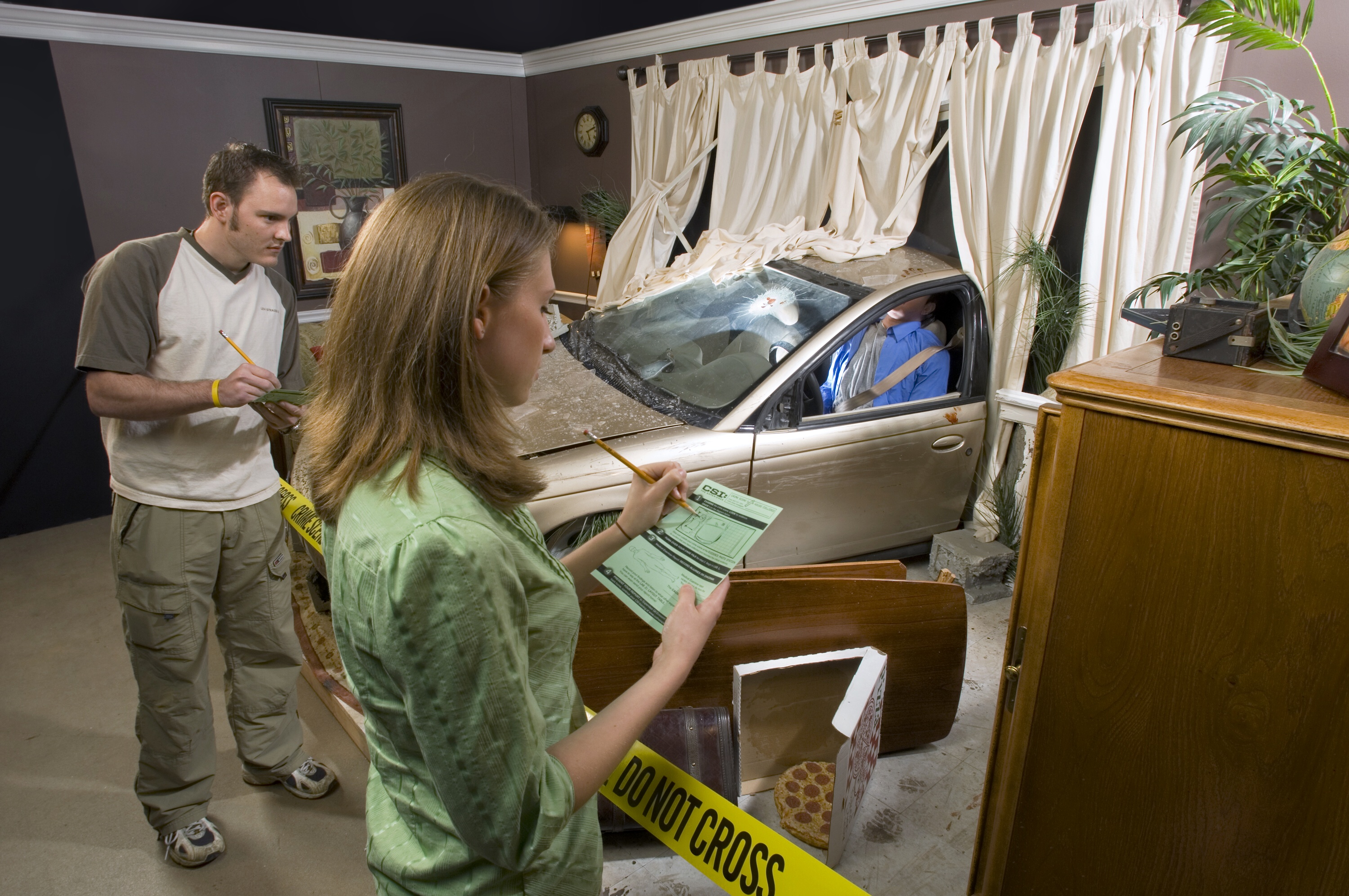
In “A House Collided,” a car has smashed through the living room window of a house in a quiet suburb. A man with his seatbelt on is in the driver’s seat, slumped over. The windshield is shattered and the car door is shut. In the living room, there are muddy shoeprints, drops of blood and a stain near the sofa. A pizza box is open with pepperoni pizza spilled on the floor. A beer bottle is by the car door, and a hand print of blood – or is it pizza sauce? – is found on the hood.

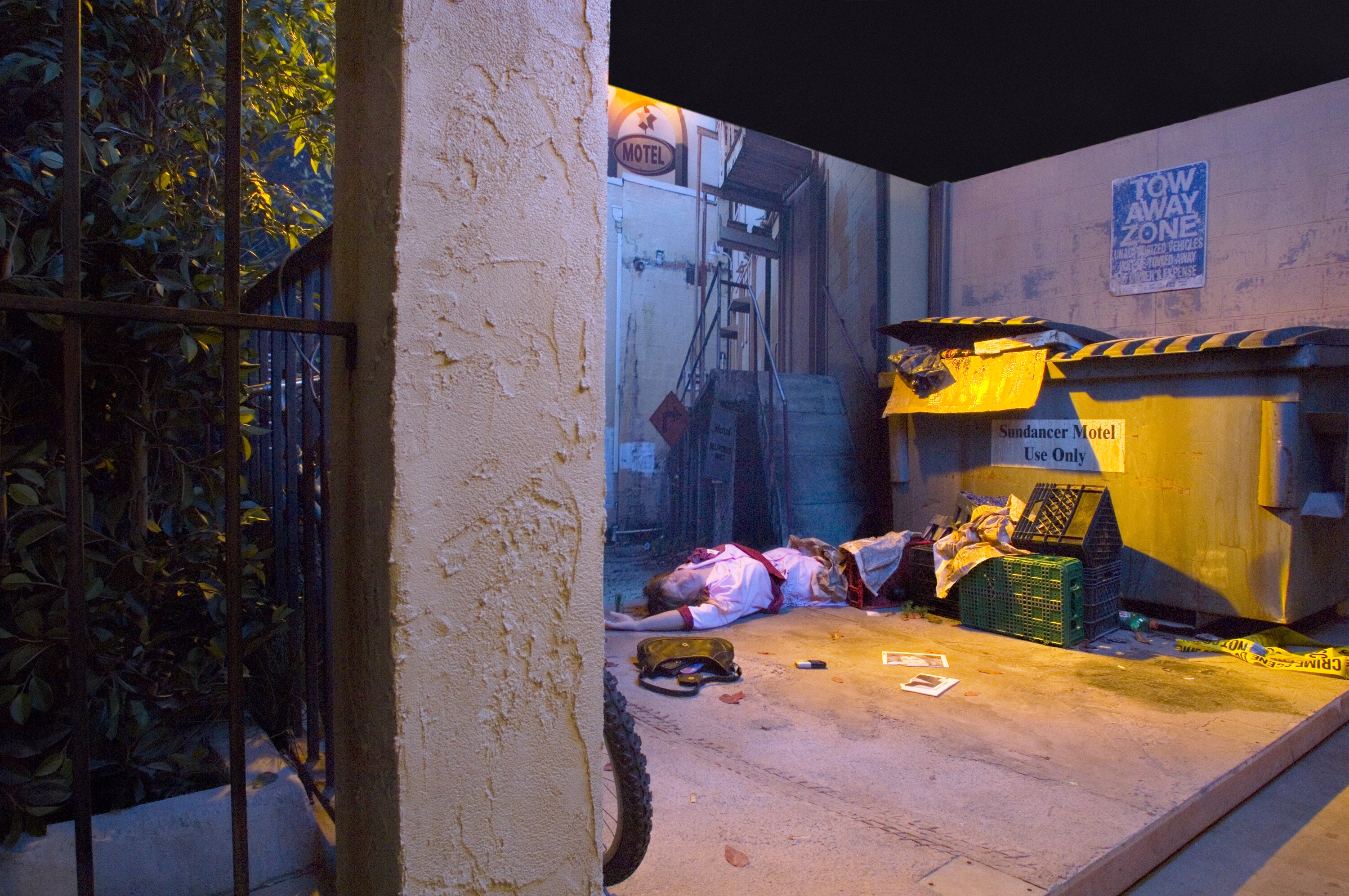
In “Who Got Served?” a young woman has been found dead in an alley behind an old Las Vegas motel. She is sprawled beneath a dumpster overflowing with trash and is wearing a waitress outfit with a nametag that reads “Penny.” There is a tire tread across her abdomen, and a photo of her has been ripped in half and tossed away nearby. No other injuries are visible. Among the trash, a handbag and a cell phone are visible.

In “No Bones About It!” a hiker has stumbled across what looks like a human skull sticking out of the ground, with a visible hole in it. It is partially buried by silt and debris. Other bones are scattered underneath the dirt. Among the remains, there are still tattered remnants of a coat and what appears to be a backpack.

Beginning the Investigation

After exiting the crime scenes, refer to a large wall of crime scene photos and clues that might have been missed. Then, begin to analyze evidence in two highly interactive lab areas, each featuring multiple stations that present different kinds of evidence testing.

Visitors investigating “A House Collided” will compare fingerprints of the victim to the evidence; examine blood spatter patterns; observe the shoes of the victim and tracks found in the room; compare fibers on the victim’s clothes with fibers in the room; analyze the victim’s blood-alcohol level; compare DNA of the victim with evidence; and eventually discover the cause of death.

For “Who Got Served?” visitors review the evidence found on a cell phone; examine the contents of the handbag; inspect the purse and headshot for fingerprints; establish the time of death; review DNA samples; test powder from the handbag at the scene; and discover the cause of death.

Visitors working on “No Bones About It” analyze the bullet from the skull and hairs found with the body; examine a seed found in the fabric of the tattered shirt; test the DNA of an animal’s hair; compare dental records to the victim; and discover the cause of death.

Cracking the Case

Grissom's Office - Here lies the moment of truth. At the end of the exhibit, visitors present their interpretation of the evidence and are asked to answer a series of multiple choice questions, based on their scientific findings, on touch screens located in this area. After completing these questions, they will get feedback from Grissom and see if they have cracked the case.

Visitors will understand the principles underlying the following areas of forensic science: DNA identification, toxicology, forensic anthropology, entomology, forensic pathology, forensic art, firearm and toolmark identification, information technology, latent prints, and blood-spatter analysis. Also, visitors will use information technology in their investigations to: Simulate the analyses of clues using database technology; comprehend the role of human judgment, even when using advanced technology; compare historical methods of crime scene investigations with today’s advanced forensic sciences.

Don't miss this first-of-its-kind exhibit. Visit Houston's Museum of Natural Science. If you really want to know who committed the above crimes, visit CSI: The Experience. Preview the video here or check out the exhibition guide here.


Monday, March 31, 2008

Separating Fact from Fiction

by Andrea Campbell

Do you remember the television show "Qunicy, M.E."? It was a long time ago and I’d say that forensic science and crime-scene drama on television has increased twenty-fold since then. Even the primetime shows such as 20/20, Primetime, and 48 Hours
have gone to the crime drama format. And for good reason: we love a mystery, we love to see stories about desperate people, and we love to see some kind of resolution. The problem lies mainly with the last element, the resolution part. Since everything on the “tube” (or should I say flat screen now?) is wrapped up in these neat, 30-60-90 minute formats (not counting commercial breaks), it gives the impression that things went smoothly from discovery, to arrest, and subsequently to conviction. Wow! if only real-life crime and cases were that condensed, we’d have to think about other things, like crime prevention (a not-so-novel idea that gets short-shrift).

I give a talk called The CSI Effect: 7 Key Differences Between TV Crime Drama and Reality. It’s amusing and I even bring props, but the scary thing is, it’s true stuff. For time’s sake and word count in this article today, we’ll take just one element I address: manpower. Television, for the sake of simplicity, has taken the jobs of twenty or more real-life criminologists and law enforcement, and rolled them into a small cast of easily-recognizable characters, maybe four or five. Okay, if you are in Podunk hill country with a population of 900, you probably know all the characters you’re going to meet at a crime scene. Get into the average, medium-sized city, however, and there is a crowd! For starters, you’ve got the “first responders,” the patrolmen of the local police department who are dispatched to the scene because of a 911 call, when a citizen discovers a body. (Outdoors it could be a hunter, berry-picker or just someone in recreation.)

The police cordon off the area, and detectives (from the police department), and the M.E. or coroner will be alerted to show up. (The difference between a medical examiner and a coroner are: 1) education - the M.E. is a
doctor of pathology; 2) appointment vs. election - the coroner is an elected position and political in nature; and 3) jurisdiction - they can both pronounce death but if the manner is a suspicious death such as a homicide, suicide, or undetermined, the examination of the body at the morgue is generally done by a medically trained pathologist conducting an "autopsy.") Now most times a city has officers who are trained to collect evidence. They are called crime-scene techs, or criminalists, or any number of outfit names like CSU, crime-scene investigators, etc. Their job is to photograph the scene, collect evidence properly, and preserve chain of custody between the scene and the lab.

At the laboratory (in Arkansas we have a state crime lab), the evidence is brought in and given to lab evidence technicians at Intake, who log-in the materials, make sure the paperwork is sacrosanct, and then later, funnel it to the correct department for scientific analysis. All the while this is going on, the detectives are looking up information for identification purposes, notifying the families, conducting interviews, checking on reports and canvassing the neighborhood, if necessary, for witnesses, etc. Whew! A lot of things swirling around and many people have been linked to the scene per their own special job.

Why, if we count only those I’ve mentioned thus far, we could have between 10 to 12 people, and the evidence hasn't even begun to be processed forensically! Okay, so I’m running out of column inch here, but suffice it to say, that upwards of 20 to 30 people can eventually have touched this case in the capacity of their jobs—and the phones haven’t been silent this whole time because crime doesn’t wait for the first case to be finished. I know you get it, it’s just not something everyone thinks about when they consider the realities of working on a homicide, rape case, or other serious felony. So there’s something to think about when you watch TV.